

Hundreds of university workers want their employers to sever ties with a retirement scheme if demands for it to divest from military companies working with the Israeli army are not met.
Academics and university workers have ramped up a campaign to demand their retirement savings provider divest in companies associated with the Israeli military, with more than 700 signing a letter sent to Unisaver on Monday.
“If you don’t withdraw our funds from genocide, we, the undersigned, will support a campaign to get universities in Aotearoa New Zealand to sever ties with you. We will not accept our retirement funds fuelling the genocide of Palestinians,” reads the open letter, adding that “40% of the signatories are Unisaver members, and 18% would join Unisaver if it divests from companies associated with the Israeli occupation of Palestine”.
Unisaver is a retirement fund available to most employees of universities in New Zealand – all universities other than AUT are part of the scheme. While similar to Kiwisaver, it has a greater employer contribution, with the employer matching up to 6.25% of earnings going to the fund, rather than the minimum 3% other companies offer. Unisaver’s investment adviser is Russell Investments, a multinational investment provider managing more than $NZ437 billion.
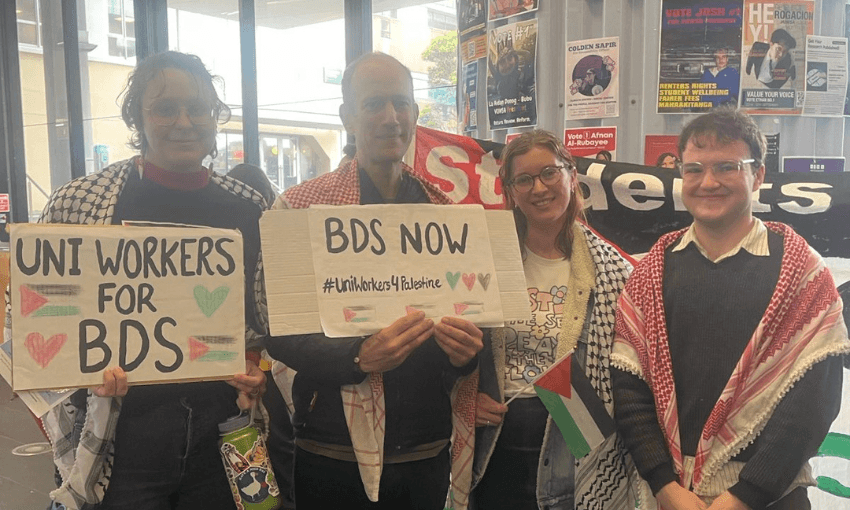
“The aim is to get them to divest from Israel and particularly companies profiting from genocide and occupation,” says Amanda Thomas, a geographer at Victoria University of Wellington and spokesperson for University Workers for Palestine, which organised the open letter.
Concerns with the company’s investments were initially raised in 2024, when an open letter was sent asking the fund to divest from companies targeted by the BDS movement. “We never got a direct reply,” says Thomas. University HR teams were also asked to communicate with Unisaver, and Thomas understands that “senior-level conversations” were held at and between universities regarding the fund.
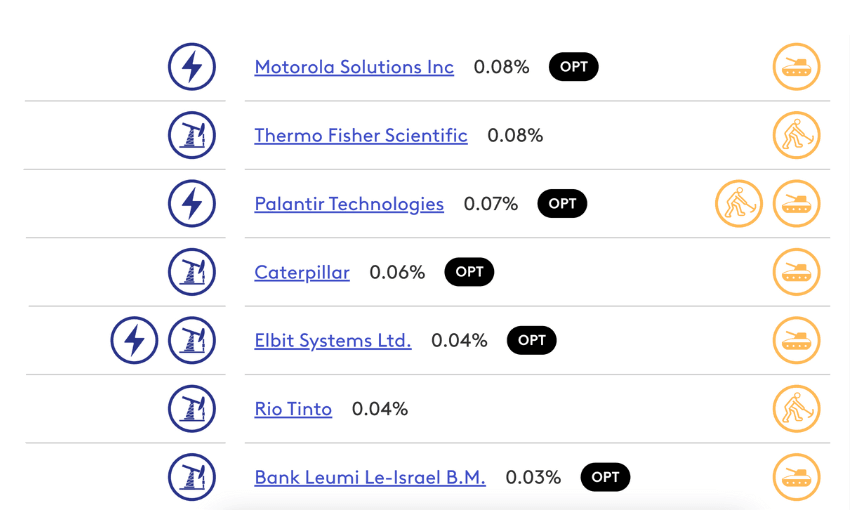
Ethical investing tool Mindful Money shows that Unisaver has investments in Palantir Technologies, Bank Leumi Le-Israel, Caterpillar and Elbit Systems, among other companies associated with numerous human rights breaches in Palestine.
Palantir Technologies and Elbit Systems are particularly concerning to Thomas and other members of University Workers for Palestine. Elbit Systems, formerly a public-private partnership with Israel’s ministry of defence, is a military technology company that provides drones and other military equipment to the IDF. Palantir Technologies is a digital surveillance company that provides software for “war-related missions” conducted by Israel. Multiple groups have divested from it because of this relationship.
Unisaver published a statement in August 2025 responding to the requests, which was last updated in early September. As there are currently no New Zealand government sanctions against Israel, there is no obligation for the fund to divest from these companies, the statement said, saying that its “exposure to Israeli securities was around $2 million”.
In a statement to The Spinoff, Unisaver said members could choose to remove their funds if they wished, and there were currently no changes to the investment approach shared in August. “It would come at a cost to all our members if we were to exclude our funds from [Palantir Technologies and Elbit Systems] or any companies seen as acting contrary to the values of any given subset of members. We would need to invest under bespoke mandates, which would be more expensive than investing in pooled funds as we do now,” said a representative of the board of Unisaver. The signatories of the open letter represented just 2.2% of Unisaver’s membership, the statement noted.
Thomas says that Unisaver’s creation of a “low carbon” fund earlier this year shows the company is willing to take ethical considerations into account in its money management. Ultimately, she points out, universities are partially funded by the government so the fact that universities are putting money into Unisaver is something all New Zealanders are implicated in. Attempts to contact university and member representatives on Unisaver’s board have gone nowhere, which feels “devastating”, Thomas says. “It’s really hard to understand that reluctance to act on something so clear.”
As well as divesting from funds connected to the Israeli military, the University Workers for Palestine group has asked Unisaver to update its responsible investments policy to rule out companies boycotted by the BDS movement or found to be complicit in Palestinian genocide.
Unisaver is not the only investment fund facing pushback over investments in Israel. Last month, the Palestine Solidarity Network launched a case against the New Zealand Superfund in the Auckland High Court, challenging “its investments in services and utilities supporting the maintenance and existence of illegal settlements on Palestinian land”. Ethical investment fund Pathfinder is also consulting with its investors over shares it holds in IBM, Google, Amazon and Microsoft, which were mentioned in the “Economy of Genocide” report from Francesca Albanese, the UN’s special rapporteur on human rights in Palestine. These investments otherwise meet Pathfinder’s ethical investment guidelines.
“We feel connected to our colleagues in Gaza, where all 12 of the universities have been completely destroyed,” says Thomas. While there is a “supposed ceasefire” at the moment, the ongoing occupation of Palestine and incarceration of Palestinians requires a changed investment policy. “Dozens of university workers have been directly targeted, because they [Israel] know the power of knowledge and education. This is about solidarity with our Palestinian colleagues,” Thomas says.
But while University Workers for Palestine are willing to take their money out of Unisaver if demands are not met, they would like to avoid that outcome. “None of the people we’ve spoken to want their retirement savings resting on Palestinian blood,” Thomas says.