
How much of what’s happening is just vibes?
For the past 60 years, young women have talked to each other about “the pill”, how it worked and how to get on it. You got a prescription, a box of pills, information you probably didn’t read, and tried to remember to take one every day. Unobtrusive and non-invasive, it has been a common choice since being introduced to New Zealand in 1961.
“The pill is always going to be an appealing place to start,” says Beth Messenger, Sexual Wellbeing Aotearoa (formerly Family Planning New Zealand) medical director. “It doesn’t hurt, and you have control over it, so if you don’t like it, you don’t take it.” A 2018 government study showed 30% of 20-24-year-old women took the pill.
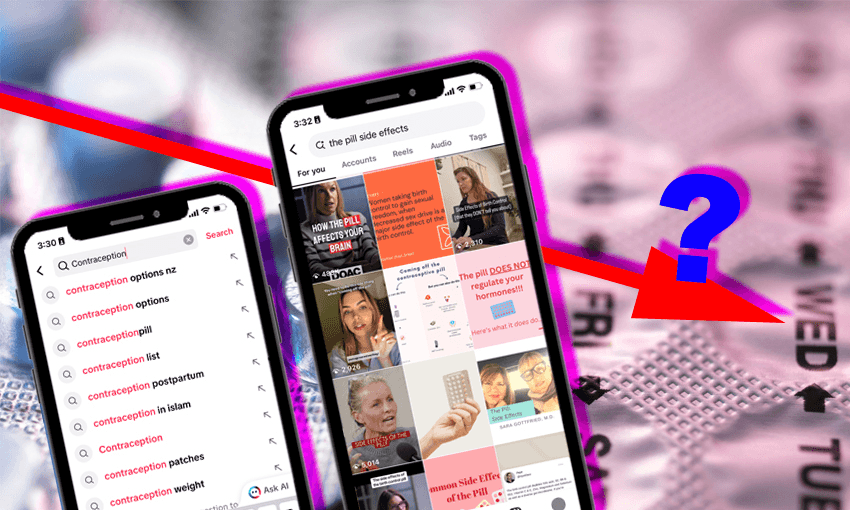
But the tide may be turning. In the UK, pill use has fallen dramatically, and two-thirds of women who stopped did so in the past two years. A recent US university study of contraceptive content on TikTok found that 53% explicitly rejected hormonal birth control.
Are people actually going off the pill?
Technically yes, but it’s really a question of what people are using. Messenger says they’ve seen a “bit of a decrease” in the pill as people switch to other contraceptives. This is mirrored by Pharmac stats. The number of oral contraceptives dispensed last year was 182,996, down on 218,279 in 2020.
“The pill” comes in several varieties: combined oral contraceptive (ethinylestradiol and progestogen) and progestogen-only ‘mini pill’. “Each pill lasts 24 hours, which is why you have to take it every day, and prescriptions are available for only six months at a time,” explains Michelle Wise, deputy head of Department of Obstetrics, Gynaecology and Reproductive Sciences at the University of Auckland.
In 2023/24, according to Pharmac, over 300,000 New Zealanders took a funded combined pill, and 60,000 took the funded progestogen-only version. A 13% decrease in the past five years has some wondering if “the pill is on the out”.
If they’re not on the pill, what are they using?
Implants are up – with 25,066 dispensed in 2024 compared to 23,005 in 2020 – and so are hormonal IUDs, up to 46,173 from 41,989. It’s important to note that dispensing stats includes repeats on a single prescription. Pharmac also doesn’t hold prescription data, just the quantities dispensed in community pharmacies.
“Nobody captures all of the data,” explains Messenger. “Nobody gets a complete picture.” Some of their pills are given on prescription, others from Practitioners Supply Orders (PSO), which allows for “immediate administration”. PSOs encompass in-clinic stock, depo-provera injections (nearly always supplied via PSO) and some intra-uterine devices. “A proportion of IUDs are used for training, so they’re never inserted in a person, and a proportion of them will be sitting in cupboards in clinics.” This means the PSO number doesn’t equate to a device being in use.
Pharmac doesn’t hold exact patient-level data. “For PSO dispensings, we provide the number of units as a proxy for the number of people dispensed the products,” the organisation said. The number of people on oral contraceptives via PSO “can not be estimated” and it instead captures the percentage of units under PSO (3.2% in 2024, up from 2.5% in 2020). People on multiple types of the pill in one year are counted once.
Funded by Pharmac, long-acting reversible contraception (LARC) like the Mirena intrauterine system and Jadelle contraceptive implant are 99% effective at preventing pregnancy, says Wise, compared to 90% for oral contraceptive pills. “There are hardly any reasons not to use LARCs.”
Hormonal IUDs, fully funded from 2019, are popular, but Sexual Wellbeing Aotearoa is noticing a shift towards non-hormonal LARCs. “We are starting to see a swing back to the copper IUD,” says Messenger. “But it’s quite a slow move back.”
Why the shift away from the classic pill?
We’ve all Googled ailments, and given the average New Zealander spends four hours of “leisure time” online each day (2.5 hours on social media), it’s tempting to link it to shifting attitudes. Messenger’s been wondering the same thing. “We’re starting to pull together a research project to do a survey to look at what is happening out there,” asking users if it’s driving their decisions. “Because we think it’s about social media, but we haven’t been out and asked.”
Influencers and users share experiences and advice about birth control, and many detail side effects. It’s shaping people’s attitudes, and given the relaxed landscape of online media, there are concerns about the proliferation of misinformation. One university study noted a “concerning trend” promoting natural contraception, and “Tradwife” influencers and content questioning the safety of birth control and promoting natural family planning have reproductive rights advocates alarmed.
Known side effects of hormonal birth control include everything from sore breasts to irregular bleeding and (very rare) blood clots. Personal experiences are widely shared online.
A Sheffield University study identified physical symptoms with psychological origins, linked to social media.“Medicine-related beliefs were associated with increased experience of oral contraceptive side-effects,” the authors said, stressing these were real experiences. “Evidence suggests that many of the commonly reported side-effects of hormonal contraception are a result of psychological, or nocebo, response to the act of taking oral contraceptives.”
At Sexual Wellbeing Aotoearoa, while clients don’t outright say they saw something on TikTok, Messenger says some concerns can be traced there. “We do get a reasonable amount of that. I think that’s the influence of what we see on social media,” explains Messenger.
Comments from high-profile figures regularly do the rounds. When Lorde said ovulating for the first time after coming off the pill was “one of the best drugs” she’s ever done, it was picked up by media and shared widely on social platforms. (She’s got an IUD now, you can see it on the album cover.)
People are tracking menstrual cycles on apps and sharing luteal phases on social media, part of a wider contemporary fixation on body metrics facilitated by digital technology.
“The idea that you can monitor your cycle is coming back because we now have a more reliable way of tracking it. And it’s fine if you have a regular cycle, and you’re highly motivated to actually make the assessments of cervical mucus and measure your temperature,” Messenger says, and its good for people to know what their bodies are doing. But most “just don’t have the discipline” to track consistently and then abstain at relevant times, or their cycles aren’t regular.
Nearly 50% of Gen Z go to social media for health advice, as do two-thirds of teenagers in Australia. A University of Chicago study showed that while there’s high-quality advice on (health professionals use it too) half the health-related videos contained non-factual information.
“As a clinician, one of the challenges is how you acknowledge that that might very well be a real experience from their friend, mum, auntie, TikTok influencer, whoever it is,” Messenger says. “The biggest influence is people around them,” someone they trust.
Decisions are shaped by a web of factors. “Ethnicity, socioeconomic deprivation, geographic location, concerns about side effects, and access to contraceptive counselling,” explains Wise. “Utilisation of combined oral contraceptives is highest among individuals of European ethnicity and lowest among Pacific Peoples; those living in the most deprived areas are less likely to use COCs compared to those in the least deprived areas.” Rural women face recognised hurdles when it comes to accessing contraception.
In a recent New Zealand study, post-partum women expressed concerns about physical side effects of hormonal contraception (things like irregular bleeding, menorrhagia, and intermenstrual bleeding) as well as cost, travel, time constraints, and family views.
So is everyone just having more babies?
Actually, we’re having fewer babies and, for some demographics, less sex. New Zealand’s fertility rate (births per woman) is 1.57, down from 2.17 in 2010. The decline is even steeper for adolescents, a third of what it was in 2010. Globally, Gen Z is less sexually active than other generations. 37% didn’t have sex the month prior to one study (17% for Gen X). A quarter of Gen Z (adults) reportedly haven’t had sex at all.