
For years Sunny Kaushal has been telling any politician who’ll listen that he has the solution to New Zealand’s retail crime crisis. Madeleine Chapman tracks exactly how the former Labour candidate switched sides and nearly singlehandedly changed the Crimes Act.
You deserve more than soundbites this election year. Become a Spinoff Member today and support in-depth journalism.
Sunny Kaushal is a politician at heart. There he is, smiling with shop owners. There he is, looking stern in a public meeting. There he is, shaking hands with a minister. No one could accuse the chair of the Ministerial Advisory Group for Victims of Retail Crime of sitting idly at home collecting his $920-a-day pay packet. Not when he keeps posting pictures of himself in action online.
In fact, scroll too fast down his Facebook page and it would be easy to assume that Kaushal is a sitting MP. Always besuited, he captions his posts and the group’s projects as any other politician would, and is more active than most. “These aren’t just ideas,” begins a post from August 2025. “These are policy actions accepted by the government through the Ministerial Advisory Group, which I lead.
“We’re building a legacy of reform not a wall of excuses.” The post ends with four hashtags – #ReformAccepted #ActionNotExcuses #MAGNZ #SunnyKaushalNZ – and the accompanying blue-tinted image shows Kaushal speaking at a podium with “WE DELIVER” and “We are taking a zero tolerance approach to retail crime” overlaid.

But who is “we”?
We could be the National government, or it could be the retail crime advisory group which in August 2025 was made up of five retail representatives, including Kaushal. Today, only two remain, after three members – Michael Hill’s Michael Bell, Foodstuffs’ Lindsay Rowles and Retail NZ’s Carolyn Young – all resigned within a month of each other in December 2025 and January this year.
It’s not known what day Bell resigned, and he did not respond to requests for comment for this story, but Rowles and Young stepped down just days apart. Rowles left the group on January 13 and told The Spinoff he “felt it was the right time to step down”. Young quit on January 16 and a week later told RNZ it was because her relationship with Kaushal had become “untenable”. Two days later she told The Spinoff that, while there had been “no communications” from the ministry about Bell and Rowles’ resignations, the timing was not a coincidence.
“All I can say to you is the three resignations are linked.” The link is Kaushal, whose behaviour Young has directly cited as the reason for her abrupt departure from the advisory group. Behaviour which included a business owners’ group he founded publicly questioning her political motives after Young spoke out against the advisory group’s proposal to loosen legislation around citizens’ arrests, a passion project of Kaushal’s.
Kaushal declined an interview for this story, citing a busy schedule, and did not answer specific questions about his political career or concerns over his work within the group put to him by The Spinoff. But on the subject of Young’s departure, he offered: “I’ve always appreciated Carolyn’s perspective. It’s a shame she has left, as her participation ensured RetailNZ’s members’ voices were very much at the deliberation table. I wish her well.”
The three departed members, across supermarkets, jewellers and the 5,000 storefronts as members of RetailNZ, collectively represented approximately 80% of the victims of retail crime.
Now just Kaushal and acquaintance Ash Parmar remain, in Kaushal’s words, “at the deliberation table” and there is fresh scrutiny over Kaushal’s spending as chair, including personally invoicing $238,625 for his own work in the first 12 months. The group’s tenure was put down for two years, ending July 2026, meaning another six months of funding to a retail crime group whose members now only represent 20% of retail crime targets. But in the centre of it all is Kaushal, the man who kickstarted the whole process nearly 10 years ago and who remains staunch in his beliefs, no matter the opposition.
Who is Sunny Kaushal and how did he get here?

Sunny Kaushal is a politician at heart. Or, for a time at least, he really wanted to be. In 2011, the ambitious businessman proudly announced that he would be running as Labour’s candidate in the Pakuranga electorate, the “first candidate of Indian origin in New Zealand” to contest an electorate for Labour.
Pakuranga is home to a large portion of New Zealand’s Indian population, and the recruitment of Kaushal was a clear attempt to move the Indian community’s party vote to the left in what was a National stronghold. “This is a decisive moment for our people,” said Kaushal at the time. “They want progress, not regress and hence will vote for Labour, which is the only party that will deliver what it promises.”
His prediction proved false. In the 2011 election, Maurice Williamson retained his seat with a 14,000 vote majority, and while National held steady with its party vote, Labour regressed, losing a share to the Greens.
Kaushal did not run again in Pakuranga. Instead he was placed at 43 on Labour’s list in 2014 as the party suffered its worst election defeat since 1922.
The Kaushal family was Labour-strong. In the 2016 Auckland local elections, father Sunny and son Shail campaigned together, knocking on doors in support of Shail’s successful run for Labour in the Puketepapa Local Board. When Phil Goff’s mayoralty win triggered a Mt Roskill byelection, Shail, as Labour’s campaign secretary for Mt Roskill at just 22, campaigned hard for Michael Wood against National’s Parmjeet Parmar. The Kaushals were father-son up-and-comers in Labour, and the faces of the party in Auckland’s Indian community.
But just three months later, Deborah Russell beat out Sunny Kaushal for Labour’s New Lynn seat and three months after that, Kaushal announced his immediate departure from the Labour Party on his Facebook page, citing his “recent stand on immigration and rising crime” as well as non-specific “hostilities and bullying” within the party’s membership. Labour did not respond to the allegations at the time and they were not widely reported.
Two weeks later, Kaushal posted a photo of himself alongside a detective inspector, celebrating that NZ Police had accepted one of his recommendations and launched a special taskforce to tackle crimes against businesses. Someone had finally listened to him, and it was under a National government.
Kaushal’s recommendations came on behalf of the Crime Prevention Group (CPG), a “non-political” action group of Auckland business owners that he founded in March 2017. The taskforce was one of six recommendations in the group’s “manifesto” to tackle retail crime that was sent to the government. Within two months, in June 2017, Kaushal announced that another two recommendations had been implemented: more police patrols and a crackdown on resellers of stolen goods.
In July 2017, three months after leaving Labour, Kaushal reintroduced himself as a proud, card-carrying member of the National Party.
Kaushal did not stand for election that year, but declared he would be “playing a significant role in mobilising and consolidating the Indian vote”. As the president of CPG, Kaushal continued to work hard to get his cause media attention. And he was very good at it. For the next five years, nearly every report on a dairy robbery or ram raid (and there were many) would soon be followed by a comment from Kaushal, demanding accountability and action from the Labour government on behalf of dairy owners.
Kaushal’s advocacy on behalf of the CPG and the Dairy and Business Owners Group (DBOG) – both of which he founded and largely self-funded – revolved around the three remaining recommendations in the CPG 2017 manifesto: tougher penalties for theft, harsher penalties for youth offenders, and increased citizen powers to detain offenders and protect property.

Kaushal never wavered in his approach, and always kept shop owners’ right to self-defence at the front of the conversation. Between posting news articles of robberies in New Zealand, the CPG Facebook page would share stories of shopkeepers fighting off attackers or police pursuing offenders. In July 2022, Kaushal told the AM Show that “a sense of lawlessness is now gripping all of New Zealand and the soft on crime approach is not working”. He went on to criticise the Labour government of the time for “wasting parliament time repealing the three strikes law” and said shop owners were looking to arm themselves in order to fight off robbers.
Three months later, in November 2022, Janak Patel was managing Rose Cottage Superette in Sandringham when a masked robber entered. Patel confronted him but backed away when the robber revealed he was carrying a knife. After stealing the cash register and some vapes, the robber fled, only to be pursued by Patel, who had picked up a hockey stick as a weapon. The two fought on the street, and the robber stabbed Patel a number of times, including once in the neck. Patel died at the scene.
The next day, Kaushal spoke to gathered mourners in Sandringham, saying “The government has blood on its hands.” He was visibly angry, and expressed the pent up emotions that many small business owners had been feeling for years. Two days later, he penned an op-ed for the New Zealand Herald criticising the government for its lack of action tackling crime and once again suggesting that a loosening of self-defence laws was the solution.
Within a week, the name Sunny Kaushal would be known around the country as the impassioned voice of dairy owners, daring to speak out against the government.
In 2020 and 2023, Kaushal campaigned enthusiastically for National – the party’s MPs had grown close to Kaushal while in opposition. Mark Mitchell, as police spokesperson, had regularly attended meetings organised by the CPG, and was one of at least 10 National MPs who accepted Kaushal’s petition at parliament in June 2023 demanding changes to the justice system.
Following National’s election win, Kaushal maintained his energy. In February 2024 he penned another op-ed for the Herald, this time his name was in the headline, suggesting by then a modicum of celebrity. “Sunny Kaushal: Who should be New Zealand’s next police commissioner?” Kaushal didn’t suggest any individuals for the job but instead reiterated his calls for citizens’ arrests to be made legal 24/7 and advocated for a “back to basics” hardline approach to lower level crime.
In other media appearances, he remained critical of retail crime rates, but toned down the commentary briefly as the new government settled into power. In March 2024, he told RNZ the members of DBOG “appreciate initiatives like the crackdown on gangs, three strike laws coming back, more police officers they are planning, military academies and investment in prisons, but we have yet to see the crime stopping.”

Meanwhile, Kaushal continued to organise community meetings with business leaders, police and politicians. Only now, rather than having National opposition MPs in attendance, he had government ministers. Mitchell (police), Paul Goldsmith (justice) and Nicole McKee (associate justice) were regular guests in Kaushal’s Facebook updates.
The CPG and DBOG had successfully graduated from advocating at the government to working with the government. And in July 2024, the relationship was cemented when Goldsmith announced the Ministerial Advisory Group for Victims of Retail Crime, a two-year project that would task a group of five retail leaders with advising the government on changes to legislation that could reduce retail crime rates and assist victims of it. The budget? $1.8 million. The chair? Sunny Kaushal.
The most vocal advocate for change in government policy was now on the government payroll, and Kaushal suddenly had a very important job that would see him occupied almost right up to the next election.
Ministerial advisory groups are not uncommon for any government. When a particularly knotty issue arises, an external group of experts may be assembled to tackle the issue head-on, compile their research and present it back to the government with recommendations.
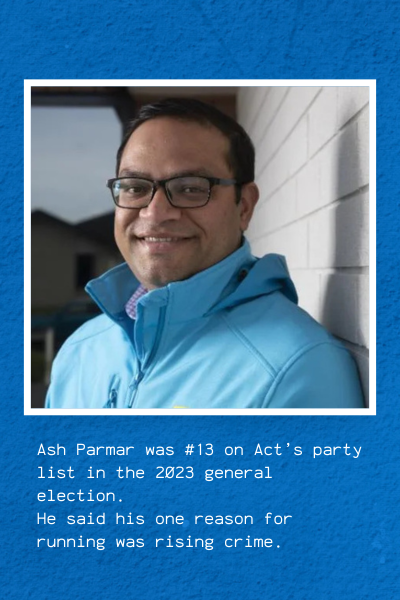
In the case of retail crime, the advisory was made up of Kaushal as chair and sole fulltime member, Ash Parmar (former Act candidate in Hamilton who owns three liquor stores), Michael Bell (Michael Hill), Lindsay Rowles (Foodstuffs) and Carolyn Young (RetailNZ).
Formed in August 2024, the concerns began almost immediately.

Young told The Spinoff that, having had experience in advisory spaces, she assumed the first task for the group was obvious. “When you start an organisation like a ministerial advisory group where you’re tasked to come up with solutions for retail crime, the first thing you should do is actually understand what is the purpose of the group. What are you trying to achieve?”
Young believed a foundational document was needed, and the chair needed to draft it to then be discussed. But “it was asked by all other members of the group for it to be done, was asked several times at several of the early meetings, and it just wasn’t done”.
As a result, the solutions to a problem that had not yet been outlined were largely pushed by Kaushal, Young said. “If you think about the type of work that was being done, these are all things that Sunny had been talking about for a number of years.” That work was focused primarily on citizens’ arrest powers but included amendments to trespass laws and harsher sentences for shoplifting specifically.
As for the meetings themselves. Young said they were “a very unpleasant environment” and it “wasn’t a nice place to go and spend an afternoon.”
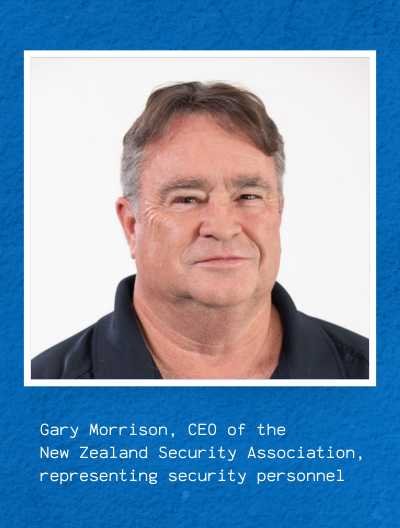
Gary Morrison, CEO of the NZ Security Association (NZSA), has been engaging regularly with the advisory group. He told The Spinoff he has had “pretty positive” interactions with all members as well as the policy advisors who served a dual purpose during meetings with Kaushal: to “get into the detail rather than reacting to the, sort of, very high level” and to “have a moderating effect… [they] sort of toned down some of the more extreme views”. Morrison wouldn’t specify what those extreme views were.
Young said there were definitely things that everyone in the group agreed on, and plenty more things where their opinions diverged. But “when you’ve got differences of opinion, the final documents going to the minister may not reflect your position… ultimately, there were times I felt there might have been one or two voices that had more final say than others.”
So it was no surprise then that the group’s first order of business was a proposal sent to Goldsmith in October 2024 suggesting an amendment to the Crimes Act to allow for more citizens’ arrest powers. Specifically:
“Every one aged 18 years or more, who is not subject to the Bail Act 2000 or the Sentencing Act 2002, is justified in arresting without warrant any person he or she finds committing any offence against this Act.”
The report includes a foreword by Kaushal, which notes that there were differing views on the proposed changes – regarding increased detention powers for all as well as non-lethal weapons for security guards – with larger retailers less likely to support them. “The concerns of the owner operator or small business owner is far more about having enhanced ability to protect themselves [and] their staff immediately,” Kaushal wrote. “This group were far more in favour of arming security guards and store workers, and strongly in favour of enhanced power of detention.”
The attached submissions, however, suggest even small business owners were split on the issue. The DBOG was heavily in favour of the changes, as outlined in a submission penned by president Sunny Kaushal. So too was the summary of verbal remarks given by small business owners in meetings with Kaushal.
But other organisations shared plenty of concerns. The NZSA was opposed to any further arming of guards. In terms of detaining powers, it advocated for further training and health and safety requirements alongside such powers for security personnel but did not comment on whether those powers should be given to all citizens.
MTA, representing 900 petrol store operators in New Zealand, submitted:
“It is the opinion of MTA that this [proposal] would not be an effective step or solution to reducing crime. In fact, it is not unfair to say it could be a backward step.”
Hospitality NZ said it “would consider it a significant health and safety risk to both staff and customers if we start advocating for stronger detaining abilities.”
RetailNZ, led by Young, wrote:
“On balance, we do not favour security guards (or retail staff or owners) being given these [detaining] powers at this time.”
Kaushal concluded the report: “While there is no consensus from stakeholders the political impact of reforms must be considered. Reforms need to be radical to end retail crime, rather than move the status quo gently in the right direction.”
Young would later say that as a member of the advisory group, she did not see the final report or recommendations before they were sent to the minister.
While the justice minister was considering the proposal, Kaushal wrote yet another op-ed for the Herald advocating for more citizen action in law enforcement – “Fighting crime needs the team of five million”. Kaushal opened his argument by detailing how a dairy owner was assaulted by a robber the week prior and how fighting crime was not just a job for the police, “it’s a job for us all”.
The dairy owner was assaulted after pursuing a thief down the street and attempting to detain him. He had stolen two boxes of beef jerky.
In February 2025, Goldsmith stood outside a Mt Roskill superette, alongside associate minister McKee and Kaushal, to announce that the government had accepted the advisory group’s recommendation and would amend the Crimes Act to allow citizens to detain anyone they believe to be committing a crime, at any time of day.

The announcement was swiftly and widely criticised, including by the police association, with president Chris Cahill saying the police advised against increased citizen arrest powers to the previous Labour government and “there are lots of things that I don’t think have been thought through in this legislation.” Young, speaking on behalf of RetailNZ, said the decision was “extremely dangerous – people will get hurt or even killed”. Asian business and community groups were also divided on the changes, with many expressing reservations and concerns for staff safety.
One vocal fan of the proposed amendments was Destiny Church leader Brian Tamaki, who said he was “excited” to have “increased powers to police … where law and order has failed”.
Kaushal, for his part, was ecstatic. He had been asking for this since 2017.
Not yet a year on from that announcement and the Crime Amendment Bill, which includes the changes to citizens’ arrest powers, is open for public submission. Kaushal’s social media in late 2025 heavily referenced the group’s (and the government’s) success in reducing retail crime rates. Ram raids have fallen rapidly from their peak in late 2022, which has variously been attributed to the new government’s tough on crime approach, extra security measures like fog cannons and bollards (funded through a previous government initiative) and a dying social media trend.
General retail crime rates are harder to measure. There are various, sometimes conflicting claims about whether retail crime is rising or falling. Reports of it skyrocketing under the last government are heavily linked to the implementation of Auror as a reporting tool in 2019, meaning retailers could much easier report incidents in their businesses (particularly theft under $500) without calling the police.
A search through police data on victimisations suggests retail crime victimisations in November 2025 were down on the year prior but still up on November 2023.
As for the group that’s been proposing the changes? It’s down to just two members, Kaushal and Parmar – the president and vice chair of the Dairy and Business Owners Group respectively. No representatives from the larger retailers, who make up 80% of retail crime targets, are members of the advisory group on retail crime.
This has not concerned Kaushal or Goldsmith, with Goldsmith defending the “absolutely fierce” chair last week, and saying he would “take stock” of the group’s future at the end of its tenure in July. The minister did not answer any specific questions put to him by The Spinoff regarding the advisory group’s formation or future, but said “we are now considering next steps”. When asked again if anyone besides Kaushal had been considered to chair the advisory group, the minister’s office did not respond.
In the meantime, Kaushal plans to continue his work. “The group remains focused on delivering practical, evidence-informed advice to improve safety for retailers and communities.”
When sent a list of questions relating to CPG, his past political ambitions and the scrutiny around his chairing of the retail crime advisory group, Kaushal responded with a statement reaffirming his commitment to his own work. “I am focused on delivering legislative reforms that will help frontline retail workers feel safe,” he said, before offering an interview “about the substance of our proposals. I’ve attached some graphics explaining the proposed changes, which you can include in your article”.
In the midst of the resignations, Kaushal’s social media presence has been consistently active. Days after his name led the major news sites with allegations of dysfunction and overspending in the advisory group, Kaushal posted on Facebook inviting his followers to make a submission in support of the Crimes Amendment Bill, with instructions on how to do so. Submissions are open until February 16.
Sunny Kaushal is a politician at heart. For years he has been telling anyone who’ll listen that he has the solution to New Zealand’s retail crime crisis. He campaigned in the media and held community meetings. And when he worked his way into a position of influence, he used it mightily and without hesitation. He did not respond to questions from The Spinoff about his political ambitions.
When attempting to explain why she believed the retail crime advisory group fell apart, Young pointed to Kaushal’s one-track mind overpowering the collective aims of the committee. “If you’re just forging one position and one perspective that someone has had for a number of years, you might not get the best outcome for everyone,” she said. “Sunny has a very strong perspective in what he wants to do… he’s just predetermined around this single outcome of what he wants to achieve.”
In 2017, political candidate turned concerned advocate for frightened dairy and shop owners Sunny Kaushal wanted the politicians to do something very specific about retail crime. In 2026, despite opposition from the majority of retailers, the police association, Labour, the Greens, the research and even some of those who sought his advocacy in the first place, he might just have done it himself.