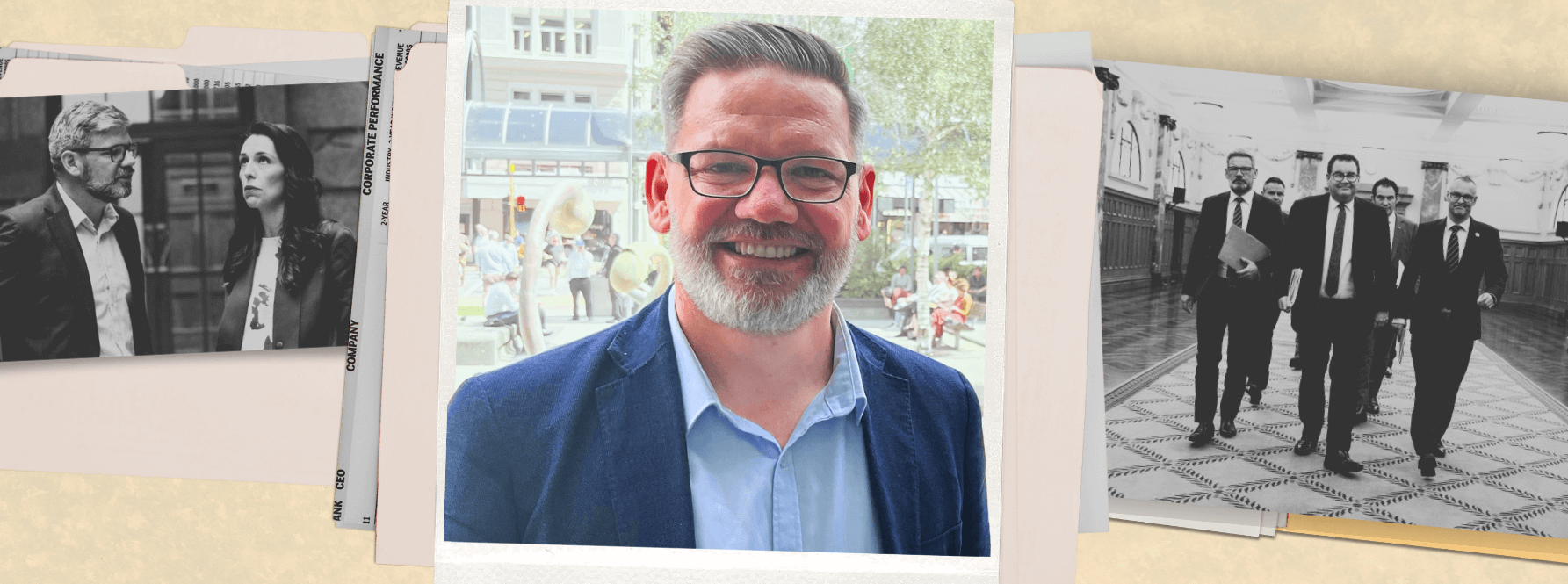

He went to therapy, grieved the career he torpedoed with an inappropriate relationship, and now former Labour minister Iain Lees-Galloway is back in politics with a new party.
There’s something threatening to burst out of Iain Lees-Galloway. It seems to be filling his chest, widening his eyes. Is it ambition? Optimism? Some might say it’s wishful thinking. Whatever – it’s palpable, intense, and when he opens his mouth, it comes out in a torrent of ideas, hopes, policy and plans. There’s so much of it, I’m worried it might start pooling on the restaurant table between us.
I can feel the ambition coming off you, I say.
“Good,” he says and laughs.
Rain pours down outside the window, because it’s the middle of summer and it’s Wellington. Political lines pour forth from Lees-Galloway because the one-time senior Labour minister is back. Back in politics, back in campaign mode, back giving an in-depth interview for the first time since he flamed out of Jacinda Ardern’s coalition government in 2020, after admitting to an affair with a staff member.
Since then, he’s held positions at the nurses’ union and Aotearoa Food Rescue Alliance, completed an MBA, and gone to therapy (“thank god that exists now”) to work through the grief of what he did to his career, his family, his reputation. Now, despite being so publicly KO-ed in the brutal sport of politics, he wants back in the ring. God only knows why.
“I see an opportunity,” he says.
That’s an opportunity with a capital O. Last month, the 47-year-old officially became general manager of the Opportunity Party and, together with new leader Qiulae Wong, he has ambitious plans. The party will run about 30 electorate candidates in this year’s election, more than double the 13 it ran in 2023.
But it’s the party vote they’re really gunning for. He believes they can make it over the 5% threshold on November 7 and into parliament. That’s despite the party’s best election result occurring back in 2017 when it clocked 2.4% of the vote. That’s despite the fact that under MMP, no new party has ever made it into parliament via the party vote.
Ambition, optimism, or wishful thinking?
“I think people are looking for something different. They are looking for an antidote to populism, they’re looking for an antidote to the division, and our challenge is to demonstrate that we have got the people, as well as the policies, as well as the organisation to be that solution,” he says.
He has a booming voice with a back note of gravel. He uses it to paint a vision of Opportunity as a teal party (combining environmentalism and pro-business policies) sitting at the centre of the political spectrum, in coalition with National or Labour. He sees the party getting legislation in place that will pass the test of time, halting the pattern of law-making and overturning, law-making and overturning, as power is knocked back and forth between sides.
He says he joined the party because of his concern for the environment. “I think we need a party in parliament that can prioritise the environment and make it a priority, regardless of whether the right or the left is in parliament, is in government. The environment should not be a left-right ideological issue, and it’s too important an issue for it to be parked every time the right is in government.

Founded in 2016 by the colourful businessman, economist, philanthropist and enemy of roaming cats Gareth Morgan, The Opportunities Party, or TOP, as it was then known, was built around the idea that evidence rather than ideology should inform policies.
Lees-Galloway, who was in opposition as Palmerston North’s MP when TOP launched, remembers thinking the party’s policies had merit and that it might have legs. “I watched with curiosity as to how they would do in the election,” he remembers. “Then, of course, Gareth started talking in the election campaign, and I thought to myself, ‘what a shame’.” He stops to laugh, before continuing: “What a shame that they haven’t actually grasped what is necessary to win an election, to actually garner votes and get in there.”
“What was missing was the emotional connection, the interest in what voters wanted and what voters’ concerns and issues were. So, you know, they had great ideas, but if you just go out there and tell people, ‘we’ve got great policy and it’s good for you and you should vote for it,’ the evidence tells us that people are not going to vote for you.”
That’s why he thinks the party’s fourth election, under its fourth leader (Geoff Simmons and Raf Manji followed Morgan) will be the one in which it cracks 5%. He thinks he can solve its connection problem. He’ll do it by running more candidates so that real humans are on the ground in local communities and he’ll do it by letting new leader Qiulae Wong be herself.
“Of course, I would say this, I’m not going to say anything else, but… people are impressed. They like the way she carries herself. They like the fact that she’s not an old-school politician, and they like her background. Yeah, they like her CV, but they like her, they like her demeanour. She’s got a magic combination of competence and warmth.”
Ding, ding, ding! Iain Lees-Galloway is back in the ring, but this time he’s in the corner holding the water bottle and spit bucket for Qiulae Wong.
Wong comes into politics fresh, from a background in ethical and sustainable business. Over the phone she says she’s leaning hard on Lees-Galloway’s experience. “This is all pretty new to me, and having his guidance and experience has just, countless times, been valuable in the last couple of months.”
In fact, everyone in Opportunity has always been fresh until Lees-Galloway, she reckons. “I don’t believe the party’s ever had someone with that kind of experience really working day-to-day on the campaign, so I think that’ll make a huge difference to this year.”
It will need to. While the party considers itself centrist, its ideas will be radical to many voters. This year it wants to push the message that perpetual growth is unsustainable and that the economy and businesses need to work with nature. It will also campaign on a citizens’ income (a payment at about the rate of the jobseekers’ allowance paid to most New Zealanders), a land tax, and a single flat rate income tax for most individuals and companies.
Lees-Galloway first became involved with the party two years ago. He knew he wanted to mentor a new generation of politicians rather than lead the party or go for a seat in parliament himself, and about a year ago he volunteered as a manager. Toward the end of 2025, he announced Wong’s appointment and then on January 19, with his wife’s support, he locked in, turning his political hobby into his second run at a full-time political gig, this time as general manager of the Opportunity Party.
The following week, National minister Judith Collins resigned. After 24 years as an MP, she’d reached her political end, right as Lees-Galloway was embarking on a new beginning. The timing! It was Collins, of course, back in July 2020, who spelled the beginning of Minister Lees-Galloway’s abrupt end.

Judith Collins was getting absolutely killed. The blows were coming from every angle. She’d been National Party leader for less than a week, stepping into the role, blinking, when Todd Muller crashed out of the leadership after 53 days. Muller left her with the tailwinds of a mess created by Clutha-Southland MP Hamish Walker, who had released private Covid-19 patient data to the media.
In the fistful of days since, MPs Amy Adams and Nikki Kaye – who had backed Muller – announced they were retiring. Then, a sex scandal: the parents of a teenager contacted prime minister Jacinda Ardern’s office alleging Rangitata National MP Andrew Falloon had sent her explicit, unsolicited messages.
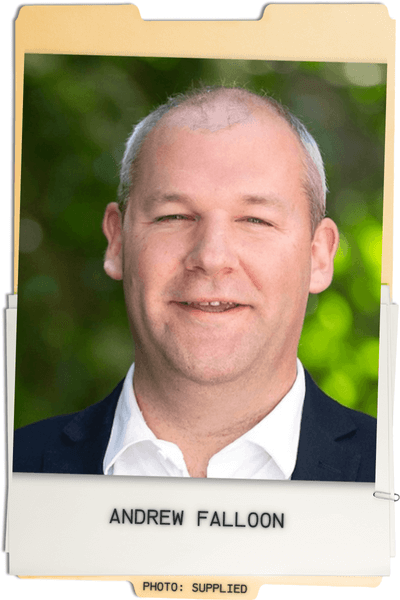
At first, Falloon side-stepped the allegations, announcing he’d retire at the next election because of mental health issues, but within hours, news of the pornographic messages broke. Then more women with more allegations about more messages. Falloon, who has maintained his Facebook account was compromised after his password appeared in a data leak, resigned.
Collins was on the ropes. She threw a punch. “I spoke to the prime minister yesterday as we were coming out of question time,” she told the AM Show. “I asked to speak to her and I said I had received… a tip-off.”
Ardern called a media conference and showed up with her serious face on, that one we all knew so well by then. She announced Lees-Galloway, the minister of ACC, immigration and (wince) workplace relations and safety had admitted to a year-long, consensual relationship with a person who had previously worked in his office and then in one of his agencies. She was stripping him of his ministerial portfolios.
“In undertaking this relationship he has opened himself up to accusations of improperly using his office,” she said of the married minister. “He has not modelled the behaviour I expect as a minister that is in charge of setting a standard and culture in work places.”

In the restaurant, rain is marking the windows. Lees-Galloway’s words come a bit slower. “Jacinda asked me what I thought needed to happen. I said, ‘got to let me go’. I mean, she would have anyway, but I understood.”
He immediately decided not to contest the next election, calling time on 12 years in parliament. “You would’ve had to have had a pretty insane ego to not see that that was the right course of action, not just for myself, but that was the right thing for the party,” he says.

In the aftermath, analysis of the affair ranged from condemnation – what a power imbalance, what terrible judgement for a workplace minister, what a shame to see another tawdry example of MPs behaving badly – to ambivalence – the relationship was consensual, the complaint had not come from the former staffer, and Lees-Galloway was a victim of a tense political climate.
Collins was clobbered with questions about how she’d handled the episode. She denied playing dirty politics, and said the AM Show had asked her if she had ever received a complaint like the one Ardern received about Falloon and she wasn’t about to obfuscate.
What does Lees-Galloway make of how Collins handled the tip off now? He shrugs. “All’s fair in love and war.”
Those green leather seats, that wood panelling – the debating chamber was such a formal, impersonal backdrop given what Lees-Galloway needed to say in his valedictory speech.
“2020 has been an extraordinary year for all of us. Can anyone really believe it is still only August and not in fact 2025? For my family and me, it hasn’t just been about the incredible effort of responding to Covid-19. There was the near end of our marriage, the death of my father and now the end of my political career. We even had to put the dog down a few weeks ago.”
He went on to apologise to his family, whose trauma he called “excruciating”, and for the impact of his actions on “so many others”.
Yet, one of his overwhelming memories of that day is the feeling of relief. He says he was exhausted, burnt out, and pleased it was all over.

The past few years had been intense. He was proud of work he’d done on pay equity and migrant exploitation, but disaster after disaster had taken a toll. He was the immigration minister who shut the borders against Covid. He was ACC minister when the Christchurch mosques were attacked. He was workplace relations and safety minister when White Island erupted. He’d only just survived bungling Czech convict Karel Šroubek’s deportation case, and he still grimaces when he talks about holding the immigration portfolio in a coalition containing Winston Peters (“Is my eye twitching?”).
Grief eventually rolled the relief. “It took me a little while to realise that I was grieving for what I’d lost, not just the role, but, you know, my reputation.”
He went to therapy and spent a lot of time with his family. “I had not grasped just how disconnected I had become from the people who were dearest to me – family, friends – and so re-establishing those relationships and rebuilding that understanding of how important they are has probably been the key to getting me to where I am now.
“I went through a period of deliberate introspection and deliberate reflection on what it was about me that led to the mistakes that I made… learning a lot more about my personality and a lot more about my psychology and what things I need to put in place to work with who I am. And so I think I understand myself a lot better, and I’m alert to what the warning signals are that I need to be aware of.
“A big one has been being really, really alert to how I respond to stress and look, that’s a big part of it. It’s not an excuse, but it’s part of it. We all have things about us that we need to be alert to and aware of and learn the signals and make sure that we channel that into a constructive response rather than a negative, damaging response.”
His bruises have faded, but he says his hunger to create change never did.
Couldn’t you make change elsewhere, I ask. The nurses union and the Aotearoa Food Rescue Alliance would both count as change-making, and would surely (surely!) offer a less brutal environment.
“When you work in that advocacy space for long enough, you’re reminded, actually, you need someone to set the rules to make doing the right thing as easy as possible… I’ve got the skill set and the experience to do it. I get it – it’s not for everyone. So for those of us who, for whatever reason, are mad enough to want to do it, I think it’s the right thing to put our hands up and give it a go.”
He already feels like the past five-and-a-half years never happened, that he never left politics, but he also feels this time round it will be different. He feels different, he thinks the party can offer voters something different, and if Opportunity gets candidates into parliament, he thinks he can ensure they go in with a different, supportive culture.
Ambition, optimism or wishful thinking?
Lees-Galloway gets up to leave. He shakes my hand, looks at me. “Be kind,” he says and winks. He’s joking but there’s some weight in his gaze.