Colin Mantell has passed away, but supporters are ready to protect his MAPAS legacy

Colin Mantell helped change the face of medicine in Aotearoa. More than 50 years later, the future of the programme he helped establish is under threat. (Image: The Spinoff)
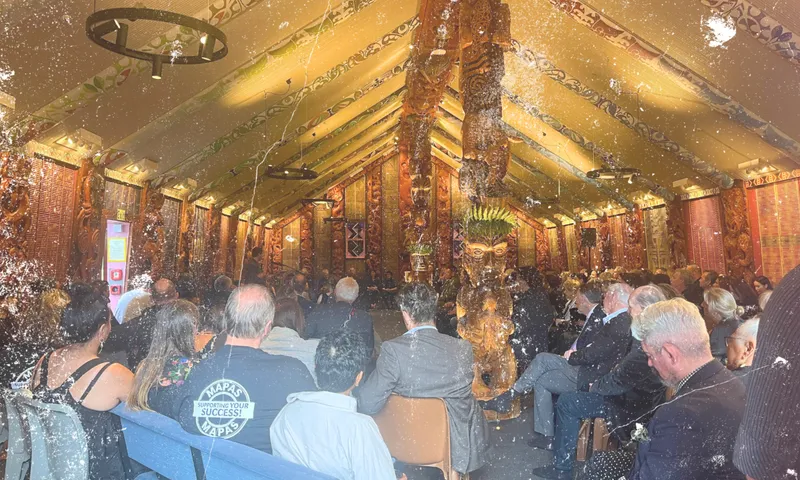
At the pioneering Māori doctor’s kawe mate, tributes flowed along with vows to protect the university admissions scheme he helped establish.
The measure of a life can be found in the words spoken of it after death. At Waipapa Marae on Wednesday morning, there was no shortage of people wanting to acknowledge the enduring impact of Colin Mantell, who passed away last month. But his kawe mate also gave guests a chance to stand up and signal they were going to fight to protect his legacy.
Mantell established the Māori and Pacific Admission Scheme (MAPAS) at the University of Auckland, which carved a path for Māori and Pacific students to enter medical school. Ahead of the election, Act campaigned on abolishing affirmative action programmes like MAPAS.
“Colin was a radical,” said one speaker. The room full of leading health professionals, academics, and close friends gestured in agreement.
Mantell grew up in Middlemarch, Otago, and eventually landed in the “urban jungle of south Auckland and academic jungle of the University of Auckland”, as Stuart Walker put it. It was the late 1960s when Mantell first studied at the University of Auckland, which was still very oriented towards serving Pākehā students and interests. Walker’s father, Ranganui Walker – a giant of academia and activism – took Mantell under his wing.
After moving to Oxford, England, for four years, Mantell returned to New Zealand in 1973, with his wife Annie and two children, to lecture at the University of Auckland. In 1972, alongside another of Ranganui Walker’s sons, Michael Walker, Mantell helped establish the Polynesian preferential entrant scheme for the university’s medical school and served as its inaugural chair.
Later, the programme expanded and it has since produced hundreds of Māori and Pacific medical school graduates, many of whom have become leaders in their respective fields.
One speaker estimated that at least 24 graduates had become professors, and the programme had also produced people leaders for hospitals and healthcare systems throughout Aotearoa and the wider Pacific region.
But still some speakers felt they must justify the programme’s existence. “We sit the same exams as everyone else,” one told the crowd.
“MAPAS graduates are more likely to serve underserved communities, work in rural areas, and stay in Aotearoa… MAPAS students are really good for the taxpayer and really good for all of New Zealand,” said professor of Māori health Papaarangi Reid. “Long live MAPAS.”
The defiant, defensive tone came on the back of the weekend’s election results, which put the current coalition in the strongest position to form the next government.
“You can imagine the dark mood in my house on Saturday night,” said dean of medical and health sciences Warwick Bagg. “We have been deeply disappointed by the conduct of the deputy prime minister [David Seymour] and even more deeply disappointed with what he campaigned on,” Bagg said. Given the election result, Bagg said the university is “preparing with a bevy of lawyers to defend MAPAS”.
But it’s not just Auckland university’s MAPAS that is at risk. The 2023 coalition agreement between Act and National committed the government to a wider review of targeted admission programmes across institutions, raising questions about whether other equity-based entry categories – such as those for rural, low-socioeconomic, or refugee backgrounds – could face broader political or policy scrutiny. The review was completed earlier this year but has not been released publicly.
Act said the review showed MAPAS constitutes “racial discrimination”, with Seymour telling Stuff: “If one student is going to miss out to one with lower grades, and if patients are going to be seen by doctors who would not have gained entry to medical school without special treatment, there needs to be a serious justification.” He said the review showed there was no justification.
Bagg was not having it. “We will not walk back without a tremendous fight. Until we have equity of health outcomes, we have work to do," he said.
In the meantime, MAPAS continues to produce graduates who will go on to work with underserved communities in underserviced areas. Staff members in the programme are currently preparing to interview 80 applicants per day over the next seven days, all of them hoping to win a place in the university’s medical school.
While a majority of those MAPAS students likely never met Colin Mantell, they will benefit from his legacy of advocacy for Māori and Pacific people. But it’s not just MAPAS. Mantell was the first Māori obstetrician and he helped establish Māori and Pacific medical programmes, continually advocating for them in the health space throughout his life. As one speaker said, Mantell breathed life into MAPAS and Māori in the health workforce like Tāne breathed life into Hineahuone.

Liam Rātana
Liam Rātana (Ngāti Wairupe/Ngāti Kurī) is editor of The Spinoff's Ātea section. He is passionate about indigenous and minority issues. Liam enjoys cooking, poetry, photography, and exploring the outdoors.


