Job-seeking teens are being asked to submit videos now

Job-seeking teens are being asked to submit videos as part of their applications. (Image: Getty; Composite: The Spinoff)
What rights do they have once that footage has been submitted to a potential employer?
A grunt came from the lounge. My son had slammed his laptop shut and was sitting in a grump with his arms folded. He’d spent 20 minutes filling out an online job application, submitting first a tailored CV, then a cover letter, then answering a lengthy questionnaire.
He’d got to the point he didn’t like: taping a video audition.
My son is 16 and, with the Christmas holidays approaching, he is looking for work. He’s applying for part-time customer-facing roles for companies often offering just a handful of hours a week.
Yet, many of those applications – my son estimates more than 50% of those he's interested in – require a video submission to be made alongside his CV and cover letter.
Who’s collecting these videos, and what happens to those videos once the hiring process is over? Is it safe for teenagers to do this? What’s going on?
So how do these video submissions work?
There are two types of video submissions, my son says. The first type asks him to film a free-form one-minute video introducing himself, explaining his best qualities and discussing why he wants to work for that particular company. The other gives him a series of on-screen prompts, often in the form of questions, and he is asked to film his responses, with the ability to redo the video if he doesn’t like the take.
How often are these videos being requested?
While there’s no available data for this trend, anecdotally, they’re on the rise. Video components for job applications have become “very common,” says Auckland University Student Association president Nimish Milan Singh. He’s done them himself and says they’re “happening across the board”.
CVs and cover letters remain the primary job application formats, says a spokesperson for TradeMe Jobs. However, “recruitment practices continue to evolve, particularly across customer-facing roles,” that spokesperson says. “While video screening has gained traction overseas, across Aotearoa it remains an emerging tool primarily used for high-volume, customer-facing positions.”
The Spinoff approached the dominant job-seeking platform, Seek, but it didn’t have any data to share, and didn’t want to comment for this story.
Who’s doing this, and why?
Louise Saviker, CEO of Student Job Search, says it offers employers the option of requesting video submission requests through its app and portal. This, she says, "gives students another way to share their strengths and enthusiasm, particularly when they have little paid work experience to put on a CV".
The Spinoff approached three companies my son says requested videos as part of the job application process: the cinema chain Hoyts, the supermarket Woolworths and the froyo store Shibbys.
A Woolworths spokesperson says a CV can’t always convey the attributes – “warmth, empathy and clear communication” – it wants from a candidate. “For customer-facing roles, inviting applicants to record a short introductory video gives candidates the opportunity to bring their personality and interpersonal strengths to life, and at a time and place that best suits them,” the spokesperson says.
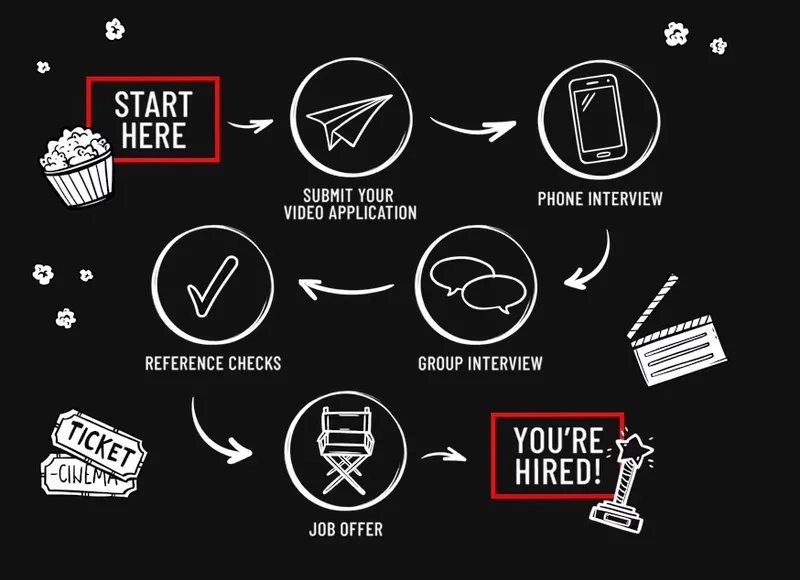
On its website, Hoyts says a video submission is stage one of the hiring process, followed by a phone interview, a group interview, then reference checks before an offer is made. When The Spinoff asked Hoyts for comment, a spokesperson replied: “We can confirm that we no longer request application videos for new applicants.”
Shibbys didn’t respond to a request for comment.
What are the potential problems?
Nikki Chamberlain, a senior lecturer at Auckland Law School, says companies can only collect personal information from job applicants if it “does not intrude to an unreasonable extent upon the personal affairs of the individual concerned”.
This, Chamberlain says, is thanks to the Privacy Act 2020, which says it is particularly important when information is being collected from children under-14 and young people aged 14-18.
Under Privacy Principles, videos can only be used for the specific purpose they was collected and cannot be kept for longer than necessary for the purpose on which it is collected. Breaches can result in a complaint to the Privacy Commissioner, which can issue a fine of up to $10,000.
A spokesperson for the Office of the Privacy Commissioner says: “We encourage agencies to collect the least amount of information they can and to consider privacy implications before they collect personal information.”
Gehan Gunasekaram highlights another issue. “My main concern is that the uploading of such auditions suggest that AI is being used to process applicants,” says the commercial law professor. “If such technologies are being used there is the risk that images that are uploaded to platforms could end up elsewhere such as on biometric databases held overseas with the potential for misuse.”
Woolworths uses AI during the recruitment process, a spokesperson confirms.
Are those videos deleted after the hiring process is over?
Woolworths says video submissions are collected only for “assessing suitability for the role”. “Once the hiring process is finalised, files are securely deleted in line with our data retention policies, unless a candidate has expressly chosen to remain in our talent pool for future vacancies,” a spokesperson says.
How to stay safe – and get those videos back
Before applying for a role, a spokesperson for the Office of the Privacy Commissioner suggests verifying the employer is genuine, either by looking at the company’s website or the recruitment website, then reviewing their privacy information.
Chamberlain, a law professor, also says applicants should check the terms on which their video is being requested and stored before sending it in. “If the video is only for the purpose of the particular job, then once the job search is complete, the applicant should seek confirmation that the video has been deleted from their records,” she says.“It is also recommended that the job applicant not disclose anything in the video which is highly confidential in case there is a breach of an IPP (the Privacy Act's Information Privacy Principles).”
Under the Privacy Act, everyone in New Zealand has the right to request access to their own personal information. “People have the right to ask for a copy of the video,” a spokesperson for the Office of the Privacy Commissioner says.
For now, my son is only applying for jobs that don’t require video submissions. If they ask for one, he’ll be slamming his laptop shut again.

Chris Schulz
Chris Schulz is a contributing writer at The Spinoff. He's an award-winning journalist from Tāmaki Makaurau who has spent 25 years working for local publications. His specialties include live events, pop culture, infrastructure and Aotearoa music.


