How Black Sheeps brought a Kiwi cult classic back from the dead

Director Jonathan King (right) on the set of Black Sheeps in Wellington (Photo: Supplied)
Alex Casey has a stomach-turning visit to the set of Black Sheeps, the much-anticipated sequel to the mid-2000s local cult horror classic.
One does not simply walk onto the set of Black Sheeps without getting splattered in a little bit of fake blood, especially not on such an occasion where the crew are cheerily wishing each other a “happy umbilical cord mucus day”. At the gore table, someone in the art department reveals the perfect fake bloody mucus as a mix of strawberry and orange jelly crystals and custard. My stomach churns confusedly – half in revulsion, and half with an instant hankering for trifle.
I’m at Avalon Studios for one of the last shoot days of the much-anticipated sequel to the local cult classic Black Sheep. Released in 2006 and written and directed by Jonathan King, the original film followed the fallout of a failed genetic experiment which turned a flock of sheep into bloodthirsty zombies. Legend says that they ran out of their allocated fake blood supply on set by day three, and the phrase “more blood” soon became the unofficial production tagline.
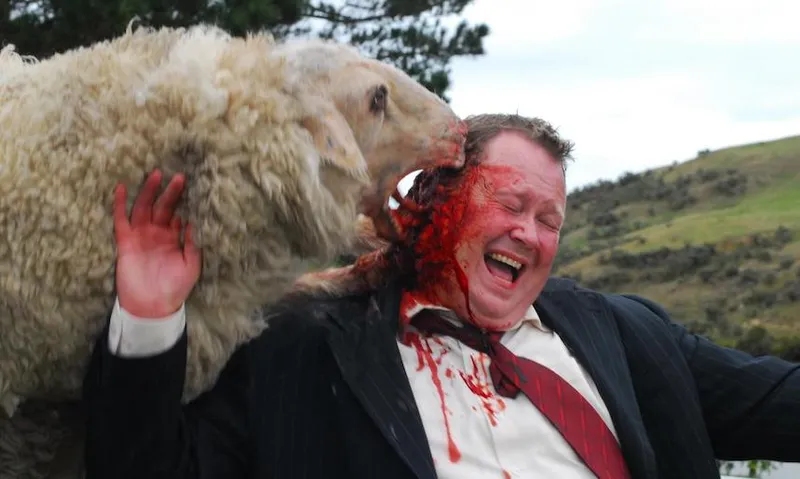
Two decades on, there is no risk of a similar shortage occurring. My notebook is somehow flecked with fake blood almost immediately on arrival to set (“please wipe your feet and hoofs” the studio door reads) and nobody will shake my hand because they are all in various states of dismemberment. “I’ve just been eaten by a sheep,” beams production manager Rowena Patterson, her green flannel shirt and wool cardigan splattered with blood.
The air has the earthy tang of a shearing shed and practically every surface is littered with all manner of human viscera, from a box of “spare boils” to a bucket simply labelled “bloody chum”. A small pottle of feta salad sits next to an oozing torso, while the gore team uses headlamps to make a severed leg glisten. “That’s the beauty of Black Sheep,” says producer James Partridge as he guides me through the gore. “It’s about monsters that you can touch and feel.”
The Black Sheep universe arrived fully-formed in the mind of Jonathan King in the mid-2000s, when he was staying at the family farm for an event. “I remember driving up the hill to the shearers’ cottage we were staying in, and the headlights going across the sheep's faces and catching their eyeballs, and realising that was actually quite scary,” he says. “When you're a city person getting close to sheep, they're not these little balls of cotton wool anymore.”
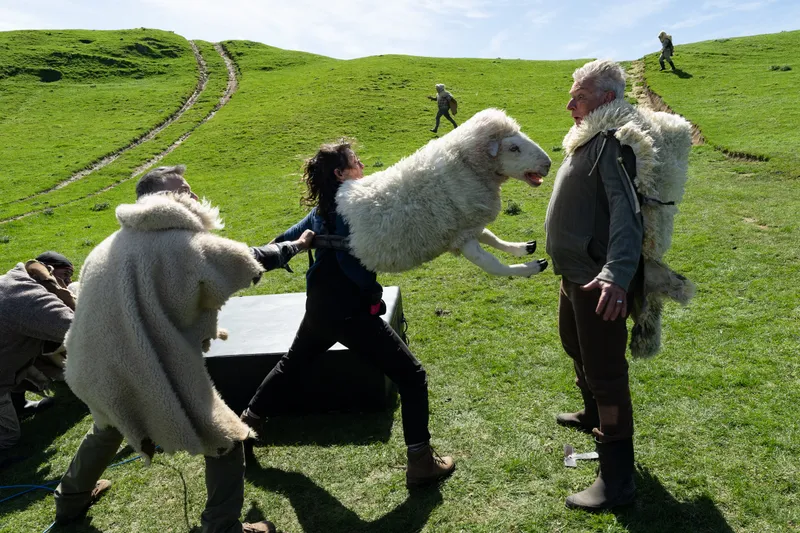
He went home after that trip and wrote a first draft script about murderous sheep in a few days, tying in societal concerns of the time like the rise of “greeny politics”, genetic modification, and the urban/rural divide in New Zealand. Black Sheep premiered at the Toronto Film Festival in the Midnight Madness section, toured the international horror festival circuit and went “gangbusters” during its theatrical release in the United Kingdom and United States.
Described as “every bit as violent and contagious” as 28 Days Later, the film garnered plenty of positive reviews from critics internationally. Spin magazine said it “doubles as a fable about two grown brothers and triples as a fresh national myth for New Zealand.” The Times praised its “woolly mix of hilarity and horror”, adding it will “put you off doner kebabs for life.” The Observer called it “extremely violent, full of black humour and what might be called shear terror.”
As for the response back home in New Zealand? “It did… OK,” laughs King. “I think a lot of people weren’t sure if they should laugh or not.”
But as time has worn on, Black Sheep’s cult status has only grown. Two years ago, a remastered version screened across the country in the Terror-Fi genre festival, and King was staggered by the response. “People just roared so freely with laughter, even at every half-joke,” he says. “I think it has aged really well, even with the more topical jokes in it. I wouldn't have necessarily thought that a Kyoto Protocol joke would still play so many years later, but it does.”
It was always a “fantasy” for King to eventually pen a follow-up to Black Sheep, one that would have a significant jump in time “as with Road Warrior to Mad Max” where “things have gone to shit”. While in the midst of trying get other film projects off the ground in 2023, he found there was only one thing that producers wanted to discuss: “hey, it’s really great to talk about this, but seriously why are you not making a Black Sheep sequel?’”
Set 20 years after the original, Black Sheeps follows a budding scientist Oats (Tabatha Killick) who is investigating a mysterious new pathogen with links to the first outbreak. “I wanted the hero to be a scientist, and I wanted smart science and green science to be a positive force,” says King. “Covid-19 is obviously not explicitly mentioned in the film, but there’s a lot of ideas in it about science following a trail, and our different attitude towards truth.”
There’s also a secret boomer cult of sheep worshippers, tensions arising over swish new eco villages, and, of course, a flock of bloodthirsty sheep. Oliver Driver returns as corrupted developer Grant, as does Nathan Meister as a now-grizzled farmer Henry Oldfield, and Wētā Workshop are back onboard to make all the ooze as practical as possible. “It’s a love letter to making a monster movie again, so we threw the kitchen sink at it,” says King.
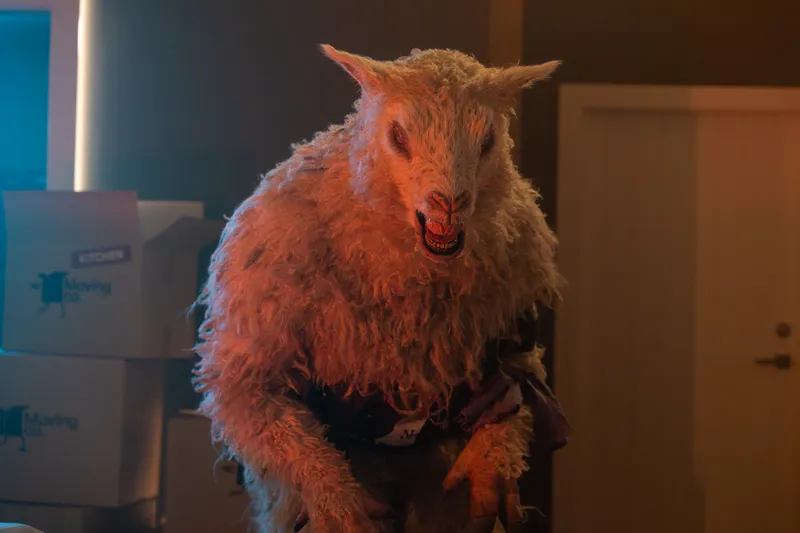
Without giving too much away, let's just say “umbilical cord mucus day” on set really lived up to that ethos. I stood agog as creature performer Ben Fransham sat laden in kilograms of prosthetics as the final boss of the film. Off to the side, another Wētā whizz was controlling the ears and eyes. “Chewing and chilling please, creature,” King directed gently from behind the monitor. “As soon as we can folks, we’ve got a man in a lamb suit here.”
After a day spent around so many rubber were-sheep and human limbs, I did wonder where they all end up once the shoot is finished. King had to call the Wellington police once to warn of excessive (fake) bloodshed in the inner-city green belt, so surely the prosthetics weren’t headed to similarly terrify civilians at the tip? “They’re all piled up at home,” says King. “My wife got a real shock when she saw these gored, bloody legs hanging on the washing line.”
Still, waste not, want not. If Black Sheeps has taught King anything, it’s that it is never too late to go baa-aack to to the farm. “You do hate to throw them out,” he muses. “Maybe we'll hold on to them for Black Sheeps Three.”
Black Sheeps is in cinemas nationwide from November 12

Alex Casey
Alex Casey is a senior writer at The Spinoff with over a decade of experience writing about popular culture and social issues in Aotearoa. She lives in Ōtautahi and likes watching reality TV and walking the dog, occasionally at the same time.


