The hard-fought history of women’s public toilets in New Zealand

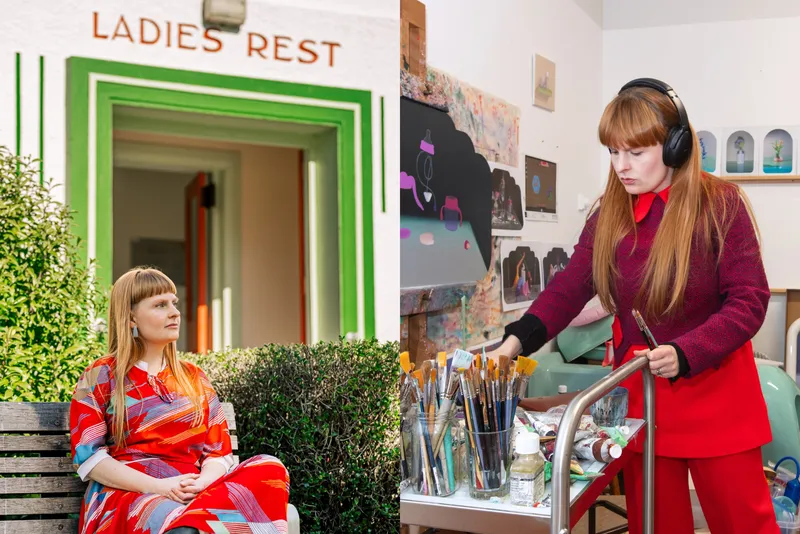
Artist Emily Hartley-Skudder's latest exhibition is centred around the heritage-listed Ladies Rest public toilets in The Square, Palmerston North. (Photo: Supplied)
The idea that women might need to answer nature's call while out and about was once highly controversial. While we may have moved past that, public restrooms remain inherently political, loo-focused artist Emily Hartley-Skudder tells Michelle Duff.
Is there anything more aggravating than waiting for the women’s bathroom at a concert, while men stroll right in and out of the neighbouring stalls, whistling as they wipe their hands on their pants?
If ever a man deigns to notice the line for the women’s toilet, or – god forbid – say something, it’s all too often laced with subtext; but you women take so long, or it’s because you’re always nattering in there.
Sure, we’re pissing and yarning, but, as always, there’s more to it. “Technically, women do spend a bit longer in the bathroom because often we'll have periods or children or other different important things that need to happen,” says artist Emily Hartley-Skudder, who The Spinoff finds surrounded by unaffixed bathroom fittings and sanitary accoutrements in her Pōneke studio. She’s holding a cutesy lavender breast pump; behind us, an avocado-coloured shub (shower/tub) takes up a whole corner, stacked with an array of sinks.
“From the get-go, it was quite hard fought to get women’s bathrooms in New Zealand. It was like, ‘They don’t need to go to the toilet.’ It was embarrassing to think that women would go.”
If you’ve ever tried to tell a poo story to a squeamish friend, this will strike a chord. In fact, public restrooms used to be so taboo that the first ones were built underground, lest someone spy you on your way to the shitter. Because private, domestic spaces were considered the realm of women, public urination was reserved only for men. “One of the most segregated, compact, and ubiquitous expressions of gendered urban space: the public toilet,” write feminist historian Annabel Cooper and co-authors in article Rooms of Their Own, while tracking the emergence of public loos in Dunedin. “The bladder [was] a kind of leash restraining women’s forays away from home…the provision of public toilets weaves a pocket history of gender, class, embodiment and space.”
In Aotearoa, Wellington, Dunedin and Auckland got their first women’s loos in the early 1900s; the opening of the Grafton Bridge toilets in 1910 was considered a milestone for gender equity, meaning a woman in early 20th century Tāmaki could nip to the toilet as she went about her daily errands. (Unfortunately, the toilet door was situated inside a tram stop, so she still had to push past all the people waiting to get there.) The first stand-alone ladies restrooms in the city came 17 years later, on Karangahape Road, pushed for by New Zealand’s first woman councillor, Ellen Melville, and lobbying from the National Council of Women.
Toilets, which many of us have the privilege of using without thinking, are not neutral spaces and never have been. It’s partly the reason why Hartley-Skudder, whose hyperrealistic paintings explore still life and the domestic, became so drawn to them. “They’re linked to bodily functions people don’t really like talking about; it brings out a lot of prejudices, the people we don't want to share these intimate spaces with. They’re inherently political.”
This can be tracked through time, with bathroom-related controversies inevitably tied to progress; whether it’s attempts to prevent women from participating in public life, to racial segregation in apartheid South Africa, pre-civil rights America and in pockets of Aotearoa, to homophobia and fear around HIV and AIDS during the height of that epidemic in 1980s Sydney. These days, we have the anti-trans rhetoric whipped up by a sector of society and courted by parties like NZ First.
“There’s always this link to, like, the fear of the ‘other,” Hartley-Skudder says. “Hopefully by drawing attention to these spaces people might think, ‘Imagine if I had to worry every day about whether I'd be able to go to the toilet’.”
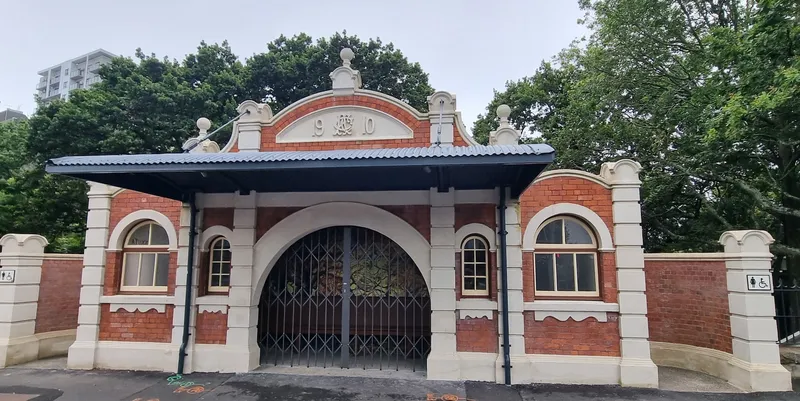
Hartley-Skudder’s current exhibition CAMEO, at Palmerston North's Te Manawa Museum and Gallery, revolves around Ladies Rest, the heritage-listed Palmerston North women’s restrooms in Te Marae o Hine, The Square.
Built in the 1930s, like many of its type, Ladies Rest was a product of an understanding that women in public couldn’t be shoved back in the bottle, but that they needed their own space – particularly with babies and children in tow. These restrooms were centred around motherhood, often with attached Plunket rooms. The Palmy ablutions block was subject to its own scandal in 2004, when an additional men’s restroom and information centre was proposed. The feminist group who opposed this development, CAMEO (Community Action by Mothers and Existing Other Users), became the title of the exhibition.
A mixture of paintings and sculpture, CAMEO is an evolution of Hartley-Skudder’s last bathroom-related show, Splash Club, which she developed during her 2023 Frances Hodgkins Fellowship and showed at the Hocken Gallery in 2024. Suffice to say, she’s now been collecting bathroom fixtures for years – recyclers, online, from op shops – which are mostly stored in two shipping containers in a Dunedin paddock. “My practice has a collecting component, but the found objects used to be miniatures,” she says. “Yeah, it’s become large-scale.”
The Te Manawa exhibition was developed with the help of the $40,000 Fair Art Prize, which Hartley-Skudder was the first winner of in 2024. It is larger and more ambitious, with elements of construction involving automotive painters, glaziers and builders. Its centrepiece is a giant, carpeted conversation pit in the middle of the gallery, resplendent with working tap fountain.
“Water in the gallery! It’s very risque,” Te Manawa senior curator Sian van Dyk says, as we sit and talk to a backdrop of tinkling on a recent Monday morning. “There’s been a lot we’ve needed to consider, it’s been a huge challenge.”
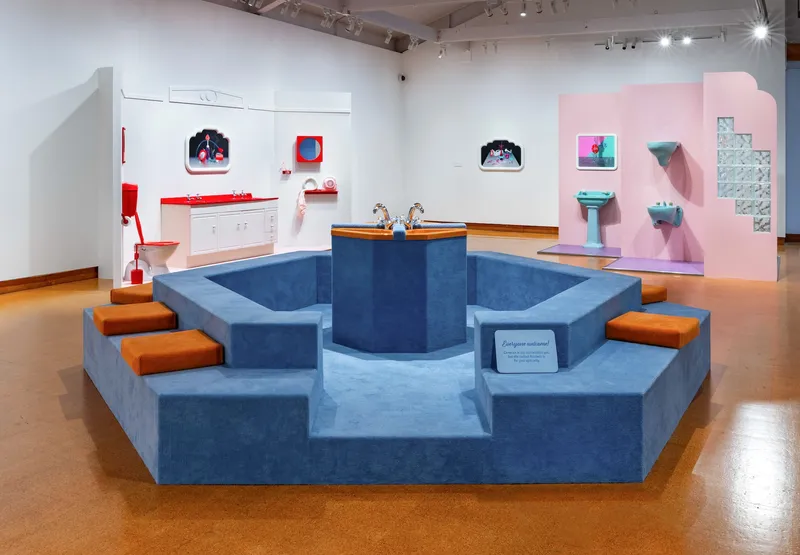
We are soon joined in the pit by some visiting students from the Eastern Institute of Technology, along with some local kuia. Before we know it, everyone’s sharing bathroom stories; whether it’s a dalliance with an illicit substance, or a brush with a crush, or a time you just needed to go and have a proper cry. One of the older women expresses her approval for the Ladies Rest. “It’s when life used to be proper, in public and in private,” she says. People nod, and then another woman tells a cruder story about a time she didn’t make it.
“That’s the power contemporary art can have, if you can do it in the right way. It leads people naturally to consider their experiences in these spaces,” van Dyk says.
“It’s a chance for us to talk about accessibility and intersectionality, all these topics that are so political but Emily’s work makes it so accessible. It’s so inviting, it looks sweet, it looks like all the things we expect from women and then when you go deeper you get a little bit of a jolt, a shock in a good way.”
Hartley-Skudder, whose own bathroom stories include a woman who had just had breast implants offering her a feel at Estab on Courtney Place and attending schoolgirl fights in the McDonald’s in Newtown, says she is glad people are responding.
In essence, she wants to provoke conversation – and this includes all the good bits of the women’s bathroom experience, too.
“It’s this weird sphere of something that's private, put within a public context, and it just becomes a default place for all these things to happen,” she says.
“The friends you make, the beautiful bonding, the gossip. It’s such a fertile space. To me, that is the most fascinating thing.”
Te Manawa curator Sian van Dyk will lead a panel discussion about gendered history, cleanliness and control with Emily Hartley-Skudder and local artist Catherine Russ, historian Alison Breese and architect Felicity Wallace as part of the Festival of Design Aotearoa at Ladies Rest on October 24 at 5.30pm.

Michelle Duff
Michelle Duff is a freelance journalist, and author of Surplus Women, a book of short stories published by Te Herenga Waka University Press.


