What happens if this tight election delivers a hung parliament?

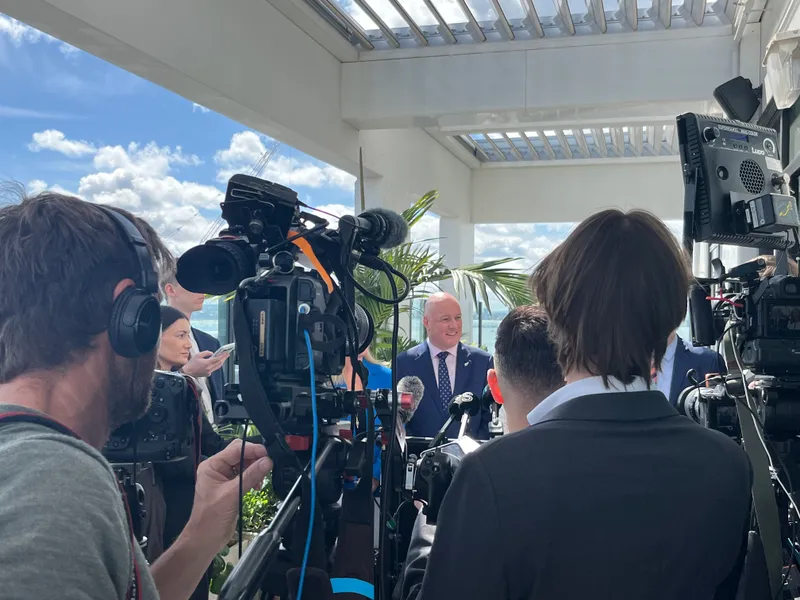
What happens if the left and right blocs end up with the same number of seats? (Photo: Isaiah Tour/The Spinoff)
Analysis: A poll this week showed we could end up with a hung parliament. What the hell happens then?
One of the possible outcomes of this week’s 1News/Verian poll – which TVNZ accorded its full “bombshell poll shake-up” status – was an honest-to-God, no cap, genuine hung parliament. That is, a situation where both party blocs have an equal number of MPs and no-one can claim a majority in the House of Representatives, and thus the right to govern.
This possible outcome arose from the poll’s measure of the party vote delivering National 38 seats, Labour 32, the Greens 19, ACT 13, NZ First nine, Opportunity eight and Te Pāti Māori just the one. If that result was replicated at the election, existing coalition partners would get 60 seats, while the other four parties combined would also have 60.
Of course, before we all get too excited, the possibility of a hung parliament raised by the poll involved a couple of caveats. First, it was assumed that there would be no “overhang” seats in the House. If you need a primer on what these are, there is this. But I’ll go out on a limb and say that there will be at least two, and quite possibly more, of these created at this election.
The second caveat is that Christopher Luxon sticks to his word and refuses to make a post-election governing deal with the Opportunity Party, meaning the two blocs stay frozen at 60-60. Let’s just say that I know no-one who believes this will actually happen. And, even if Luxon did try to stick to his word, why do we think the rest of the National Party caucus will let a guy they have already tried to roll twice dictate to them that they aren’t allowed back into government?
These caveats combined mean the actual chance of a hung parliament come November is negligible. Most especially, if the Opportunity Party gets MPs into the House, there will be cross-bloc votes available to break any apparent tie. And if they don’t get MPs into the House, then the “wasted” votes cast for them means that the current coalition parties will win a clear majority.
However, the potential for a future hung parliament always exists because of a pretty simple, and pretty silly, feature of our electoral system. The 120 seats in our House of Representatives is an even number, so is always at risk of being equally divided between opposing blocs.
(As an aside, back in 2023, the Independent Electoral Review I was a part of recommended that this feature ought to be changed so that we always have an uneven number of parliamentary seats. This advice was ignored, so if we ever do end up with a hung parliament... well, I told you so!)
Given that fact, let’s imagine a properly hung parliament – one where National/ACT/NZ First have 60 seats and Labour/Greens/Te Pāti Māori have 60. What would happen here?
Well, we’d still have a government. Whoever held office before the election would continue to do so under the “caretaker convention”. This allows them to keep the country running on existing lines, while obligating them to consult and try to act on a cross-party consensus basis for any new matters. It’s a stop-gap measure until a new, proper government can take over.
And in order to try and create that new government, the parties would have to talk to one another across the blocs. Is there a way that Te Pāti Māori could support National/ACT/NZ First in government in exchange for, say, a bunch of devolved Māori social service contracts? Perhaps Winston Peters might jump over to join Labour/Greens/Te Pāti Māori in exchange for the role of prime minister? Or, could Labour and National put aside their historic enmity and try to form a grand coalition (despite what some numpty thinks about that prospect)?
All of these discussions involve political deal making done by the parties themselves. The governor-general, who eventually appoints the prime minister, will sit back quietly and wait until the parties can provide a clear, public signal that they’ve done a deal that creates a parliamentary majority. Once that has been given, the governor-general puts the new PM in place and the new governing bloc takes up the reins in accordance with their inter-party agreements.
However, what if all the inter-party chat leads to nowt and the parties remain firmly stuck in their respective blocs? Well, one thing that likely won’t be able to happen is for an individual MP (or even a group of MPs) to split from their party and jump over to give the other bloc a majority. The party-hopping law, which allows a party to expel an MP who deserts it from parliament, effectively prevents that fix.
Should the stalemate go on for long enough, the governor-general might feel the need to gently remind the parties and their leaders of their obligation to the country to try and reach some negotiated solution. But the governor-general can’t force anyone to do anything, and she shouldn’t try to engineer any particular outcome (because she needs to remain politically neutral).
So the days may turn into weeks, then maybe even turn into months (Belgium went nearly two years with an interim government in place, albeit its much more decentralised government made this less of an issue than it would be for Aotearoa New Zealand). At some point, it might become clear that the only solution is to turn parliament off and back on again through a new election. How would this happen?
The governor-general can, in theory, dissolve parliament at any time and call an election. In normal constitutional times, she must only do this on the advice of the prime minister. But in a situation where there is a hung parliament, the acting prime minister doesn’t have the support of a majority of MPs to perform that advisory role. Which means, under the caretaker convention, they should only advise the governor-general to call a new election where the move is supported by parties with a majority of MPs in the House. And the governor-general should only accept the PM’s advice to do so if the PM can demonstrate that it comes with that majority backing.
Of course, at this point people would likely be pretty mad at politicians across the board and deeply resentful of having to vote twice in reasonably quick succession. That would mean there would be very strong political incentives to find an arrangement that avoided such an outcome. But as long as we keep an even number of seats in our parliament, we’re inviting at least the chance of it occurring.

Andrew Geddis
Andrew Geddis is a Professor in the Faculty of Law at the University of Otago.
Sign up to Two Ticks, delivered straight to your inbox.


