Willis vs Wong: The moment the Q+A People’s Debate came alive

Nicola Willis and Qiulae Wong face off at the Q + A People's Debate.
The finance minister took on the Opportunity leader over R&D spending, and came off second best.
The biggest moment of Thursday’s Q+A People’s Debate came in response to a question by a physics professor.
The debate, hosted by Jack Tame, featured seven candidates: National deputy leader Nicola Willis, Labour campaign chair Kieran McAnulty, Act leader David Seymour, NZ First deputy leader Shane Jones, Greens co-leader Chlöe Swarbrick, Opportunity leader Qiulae Wong, and Te Pāti Māori MP Hana-Rāwhiti Maipi-Clarke.
Members of the public, at TVNZ and online, asked questions to the candidates, while Tame kept everything moving. Auckland University physics professor Nicola Gaston, co-director of the MacDiarmid Institute, was concerned about science being “chronically underfunded” and wanted to know “how will you ensure that the innovators and experts of the future deliver the value of their research in New Zealand?”
Willis pointed to the government’s investments in geothermal energy research, fusion technology and agritech but argued that fiscal restraint was needed. “I want us to be a wealthy country capable of making those investments, and that means managing the books well”.
Tame handed the floor to Wong, who focused back on Willis: “Yes, but Nicola you’ve focused this term of government on cuts, not on investing to grow." She said New Zealand should increase its investment in research and development, which is below the OECD average. “We have to invest to grow, and we need to grow the economy so that we have more to spend. But if we don’t fund the science and the research of today, we won’t have the Rocket Labs,” she said
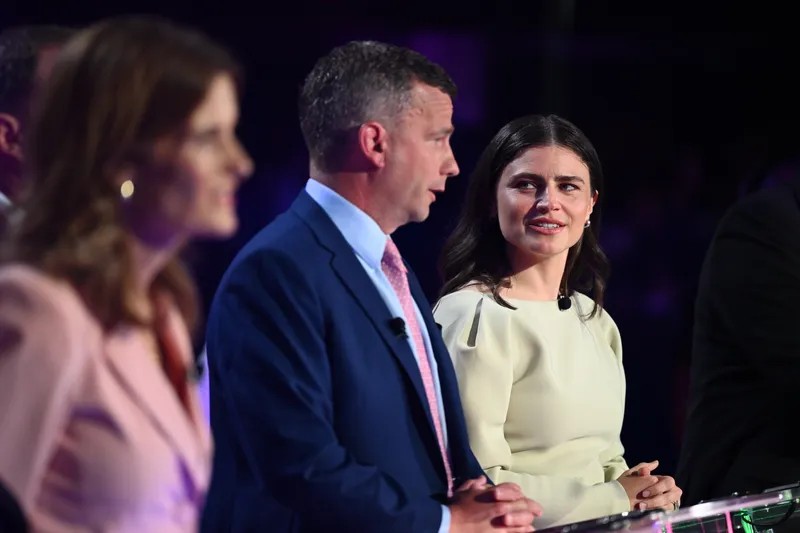
“Jack, can I please respond to Qiulae?" Willis asked. Willis turned 90 degrees to face the woman next to her and said, at a volume that made Wong laugh uncomfortably: “Would you have preferred I didn’t spend $600m on cancer drugs?"
It was an intense response to a rather technical discussion about R&D spending as a percentage of GDP relative to the OECD.
“I would have preferred you didn’t give $200m to oil and gas exploration,” Wong replied.
“Drill baby drill,” chimed in Shane Jones, offscreen.
“Would you have preferred I took the money from special needs education?” Willis continued. “Or the money I invested in new hospitals in Nelson and Palmerston North?”
“The oil and gas industry. That is what I would rather you take it away from,” Wong said.
“Would you have preferred I took the money from New Zealanders who we gave tax relief?”
“I’ve just told you Nicola, you can take it away from the oil and gas explorations.”
It was a bizarre moment to see the sitting finance minister ranting at the leader of a party that has never sent anyone to parliament. Rather than projecting confidence, Willis looked panicked and desperate, while Wong looked calm and in control.
It was a distillation of the night for both women. Willis aggressively defended her budget decisions and got into heated arguments with Swarbrick and Maipi-Clarke. Meanwhile, Wong got a couple of moments to lay out her policies and emerged unscathed, looking like a kingmaker in waiting.
Among the other candidates on stage, David Seymour and Kieran McAnulty were the clear standouts.
Seymour has been trying on a more statesmanlike, adult-in-the-room persona this campaign and Willis gave him a couple of opportunities to appear above the fray by calling for civility amongst the chaos. He had his strongest moment during a question from a university student about the fees-free policy with an affecting speech about why the trades should be valued more.
Swarbrick interjected to point out that no one on stage had suggested the trades shouldn’t be valued. But, strawman aside, he’d taken the opportunity to deliver a populist message and he did so effectively.
McAnulty landed several laugh lines endearing himself to the live audience. He laid on his rural everyman schtick, squeezing in a reference to Barry Crump during a question about the arts, telling a self-deprecating anecdote about being a lazy student and admitting that the only things he knows about nuclear policy are from The Simpsons.
His most memorable moment of the night came in a response to a question about vaping. “The only reason I got off the smokes was the vapes. And now I’m off the vapes, I’m on the nicotine gum, so I’m on a bit of a journey here,” he said. “I had one in my mouth until the very second that we went live.” It was a bit of a non-answer (he eventually said he wanted to ban flavoured vapes, but not all vapes), but an entertaining and relatable non-answer nonetheless.
Swarbrick was on her classic form; sharp and impassioned. However, David Seymour noticeably got under her skin and as she got riled up she fell into her old habits of speaking at a million words a minute and focusing more on being right than being persuasive. After a week as the central focus of National's negative ad campaign about the prospect of her as finance minister, it may have been a better idea to present a calm, responsible front.
Maipi-Clarke had moments where she seemed out of her depth (she was a last-minute replacement for Oriini Kaipara) but was relentlessly focused on speaking directly to young Māori and is probably the party’s best messenger to inspire youth turnout. Shane Jones, meanwhile, seemed like he was barely there. He gave one strong answer about the economic opportunities of mining, but otherwise didn’t affect the debate.
The decision by the Q+A team to have members of the public ask questions was a stroke of genius because it forced the candidates to answer the questions directly for fear of appearing rude and the candidates generally allowed each other to speak.
That quieter vibe made the moments of direct conflict jump out even more – and the exchange between Willis and Wong is the clip people will remember from this debate. Nicola Willis and National built their brand around being the steady hand on the books, but in that moment Willis looked like the least steady person on stage.

Joel MacManus
Joel MacManus is a senior writer for The Spinoff. He previously worked at RNZ and Stuff, and began his career at Critic Te Ārohi. His writing explores the political, economic and cultural systems that underpin modern New Zealand. He won the 2025 Voyager Media Award for Best Columnist, Opinion or Critique.


