The hangover: Key takeaways and reactions from Election 2026

The full picture hasn't yet formed but here's what it all means so far.
The key points

- The preliminary results are in and the election is too close to call. Special votes are due in 19 days. See all the results here.
- This election has delivered New Zealand's largest parliament, currently sitting at 131 seats
- Opportunity is going to parliament, and could hold the balance of power
- Te Pāti Māori's overhang strategy worked, and the Greens' Māori vote surged
- Elections are also a bit weird, here's a wrap
- If you think democracy has gone to the dogs, here's a bunch of dogs
South Auckland doing heavy lifting for Labour
In 2023, Labour's Pacific MPs were the few in the party to hold on to their electorate majorities, mostly in South Auckland.
Despite being second in party vote and electorate wins, the three biggest-margin electorate wins this election went to Labour. Jenny Salesa, Lemauga Lydia Sosene and Arena Williams each collected more than 60% of candidate votes in Ōtāhuhu, Māngere and Manurewa respectively. That dominance converted to party votes too with Labour sweeping the Pacific-heavy electorates, including the newly formed Kenepuru with Barbara Edmonds.

The big farewells from National
While the right's overhang strategy may have saved the coalition (so far), National's hefty overhang means zero list MPs will return to parliament, and there are some heavy hitters on there.
- Nicola Willis. The duputy leader and finance minister is number two on the party list but that's two too low. She said last night that "the thing that’s always mattered most to me is that National can form a government and can keep governing the country". If that happened, it would be without one of the most prolific ministers of this term. Willis said her departure "does come with some disappointment. But at the same time, I really do feel immense gratitude for the opportunity I have had to serve as minister of finance in this Luxon Government and to be an MP for eight years."
- Chris Bishop. National's RMA, housing and transport man needs to win Hutt South to stay in parliament. Preliminary results suggest that won't happen, with Bishop trailing Labour's Ginny Andersen by 889 votes before specials have been counted. An MP for 12 years, Bishop was touted as a future National party leader. He says he's looking forward to spending more time with his young family.
- Paul Goldsmith. The man with a million portfolios will have to pass all of them over after failing to shock David Seymour in Epsom. Having actively avoided candidate votes in consecutive elections, Goldsmith made a last ditch play for the Epsom seat and performed surprisingly well. Could he have won it with a full-throated campaign? He's likely pondering that today.
- Gerry Brownlee. The speaker of the house was looking positively sanguine as it became clear early on that he would not be returning to parliament. After a three-decade career with the National Party, the former minister, aged 70, said retirement is on the cards.
'There's nervousness in the puku of Māori around the country'
The spanner that is Opportunity. That was the topic of discussion between Oriini Kaipara – Tāmaki Makaurau winner for Te Pāti Māori – and Labour's new MP for Te Tai Tonga, Mananui Ramsden, in studio with Scotty Morrison. Kaipara acknowledged that with special votes to be counted and Opportunity in kingmaker position, Māori had a "nervousness in the puku" around where the newest party in parliament would land.
But even if Te Pāti Māori and Labour found themselves in opposition, both MPs said they were excited by the changes to parliament's makeup. "I'm looking forward to the camaraderie in the excellence that's about to hit this parliament," said Kaipara, citing Tania Waikato from the Greens as a new colleague she was excited to work with. As for Ramsden? "I'm just excited to be here," he said, and his focus for the term would be "becoming the prime minister for Te Tai Tonga".
'If Labour had focussed on getting National out, instead of on us, Chris Hipkins would've woken up prime minister'
Te Pāti Māori co-leader Rawiri Waititi didn't mince words when asked for his election thoughts on Marae this morning. Te Pāti Māori went early in announcing their overhang strategy, imploring voters on the Māori roll to candidate vote TPM and party vote either Labour or the Greens. The strategy was broadly successful, with TPM set to return to parliament with five Māori electorate wins, and the Greens in particular surging in their Māori party vote.
But Waititi believes Labour hurt their own prospects by not endorsing the strategy. "If Labour had focussed on getting National out, instead of on us, Chris Hipkins would've woken up prime minister," he told Scotty Morrison. Labour ran candidates in all seven Māori electorates, winning two. Waititi and co-leader Debbie Ngarewa-Packer argued Labour should have "pulled their weight" in not contesting those seats. "We would’ve had the seven overhang seats, and Chris Hipkins would've woken up as prime minister," Waititi reiterated. "The results show that."
Gaming out the possible outcomes after special votes
The patron saint of electoral law, Andrew Geddis, helpfully walked Jack Tame through the possible (and likely) outcomes of the specials count, based off past election results. First, some key factors:
- Voter turnout is estimated to have dropped to 74.6%, down from 78.2% in 2023. Geddis noted this is surprising given advance voting numbers were up by 250,000 and close elections tend to bring out more voters.
- Special votes are down about 30%, likely due to changes in electoral law (same day enrolment and changing enrolment details while voting were previously classed as special votes).
Geddis explained that NZ First historically lose a seat in the specials, and the Greens pick up one. If that played out again this year, the current coalition would still hold a one-seat majority. There are a handful of electorates too close to call which could flip in the final tally. Geddis said there are three potential outcomes:
- “Existing coalition narrowly holds on by probably a seat."
- A 65/65 split (Nat, NZF, Act on the rigtht, Lab, Green, TPM, Opp on the left).
- With a few things falling the left's way, they could form a one-seat majority
In other words, the overhang – however large or small – will prove "critical" to the final outcome of this election.
Michael Wood is on a rollercoaster ride

Labour candidate Michael Wood has some nail-biting days ahead. He's ahead in Mt Roskill by 262 votes. National's Carols Cheung could still take the seat on the specials. The seat flipped back and forth between them last night as the votes were counted.
Despite not knowing for sure which way Mt Roskill will go, or who will end up in government, he has told RNZ he thinks it's remarkable that Labour is even in contention to form a government after only one term out of office.
Wood, of course, was a minister in Jacinda Ardern's government, and then served under Chris Hipkins. Wood resigned his portfolios after failing to declare shares he owned that conflicted with his ministerial responsibilities. He went on to lose Mt Roskill to Cheung in 2023 and hasn't been in parliament since.
Mahesh Muralidhar looks for some advice
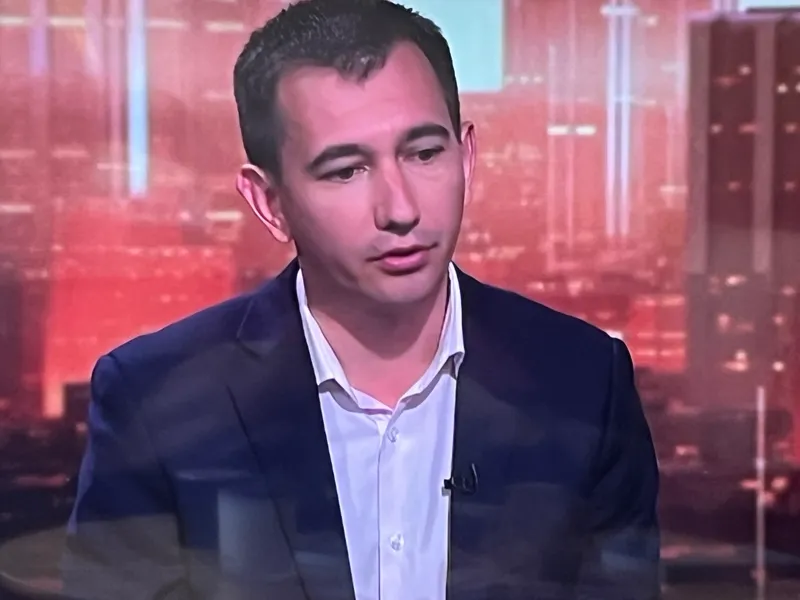
Mahesh Muralidhar, fresh from wrestling Tāmaki back from Act for National, is on RNZ's live show. He's a first time MP. Asked what happens next, for instance, when will he meet with the rest of the party, he tells Ingrid Hipkiss and Guyon Espiner they probably know more than he does. This is all new to him.
Muralidhar has a convincing lead in Tāmaki, sitting on 15,330 with Labour's Max Harris a long way behind on 9,974. Interestingly, Act's candidate, James Christmas lags at 7670. This was the seat of Act's Brooke van Velden, who announced earlier in the year she was bowing out of politics at this election. Has the right overhang strategy been a roaring success here, or did the people of Tāmaki just really dig van Velden more than Act?
Māori will be worried, political scientist says
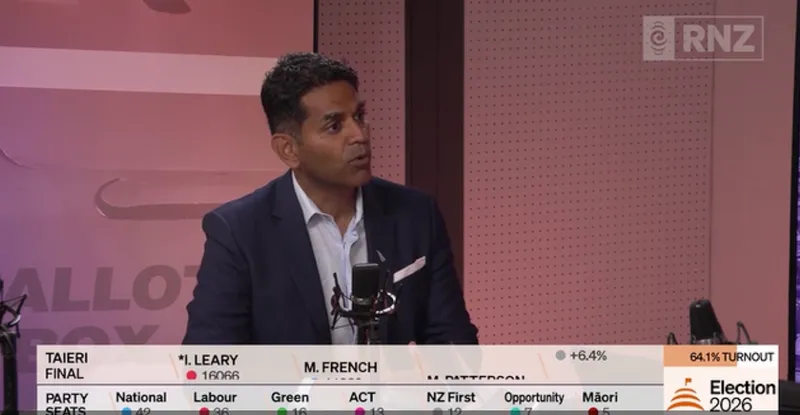
Lara Greaves, associate professor of politics at Victoria university, is on RNZ's live show, saying she was doing seat maths at 2am.
She says while Te Pāti Māori had a good result, winning five of the Māori seats, there's still a chance that they'll lose one. The Greens' Hūhana Lyndon is 436 votes behind Te Pāti Māori's Aperahama Edwards in Te Tai Tokerau, so she has a shot at taking the seat on the special votes. If that were to happen, the left bloc would lose a seat, as Te Pāti Māori has all its seats on electorate wins, creating an overhang. That overhang would reduce by one if the Greens picked up Te Tai Tokerau.
A lot of Maori will be freaked out looking at last night's result, Greaves says. While things could still change, it looks to Greaves ike the right bloc may be able to form a government. That means Māori will be looking at another term of the National-NZ First-Act coalition and wondering if that means the Waitangi Tribunal will be abolished and there will be a referendum on ending the Maori electorates.
Who's going to be the next finance minister?
Former Labour MP Sue Moroney told Q&A that while she believes Labour remained "relentlessly positive" during its campaign (an assertion that led Jack Tame to point out Labour had run some attack ads on Christopher Luxon) she believed there was one area in which Labour could have been more aggressive.
"We should have been talking about who's going to be finance minister with Nicola Willis gone?" She said, referring to National's attack ads against the Greens that focused on the hypothetical of Chlöe Swarbrick as finance minister. "Probably [it will be] David Seymour and what are the implications of that?"
Chlöe Swarbrick on the 'upside down' election and the Greens' dilemma electorates
Could the Green Party, after an historic night last night, be quietly hoping for an electorate loss? In Te Tai Tokerau – dubbed the most interesting electorate race in the country – the Greens' Hūhana Lyndon is hoping to win the party's first ever Māori electorate. Lyndon was the favourite in the limited polling ahead of Saturday, but Te Pāti Māori's Aperahama Edwards currently holds a narrow lead. If he holds that lead, TPM bring an extra overhang seat to the left bloc and Lyndon still returns to parliament on the list. If Lyndon wins, she enters as an electorate MP and TPM (and the left bloc) loses an overall seat.
Appearing on Q&A, co-leader Chlöe Swarbrick wouldn't go so far as to say she hoped Edwards holds on to the win, instead praising Lyndon's campaign more generally and cursing the "upside down election" we're having.
On the left needing Opportunity (and some good specials results) to form a government, Swarbrick welcomed a call from Qiulae Wong. "They have the choice, they don’t get to sit on the fence any more and I implore them to choose positivity."
Accidental(?) snark from RNZ
A major topic of last night and this morning has been whether or not Christopher Luxon will pick up the phone and speak to Opportunity about working together. As it stands on the preliminary count, he wouldn't have to, with the right coalition scraping together a tiny majority.
But special votes have historically resulted in a seat or two lost from the right bloc and gained by the left, which would leave Opportunity as kingmaker. So can Luxon, who spent the entire campaign doubling, tripling, guadrupling down on his firm and final ruling out of working with Opportunity.
But throughout last night and this morning, Luxon's senior MPs have refused to co-sign that promise, leaving the door open for quiet walkback on his "no".
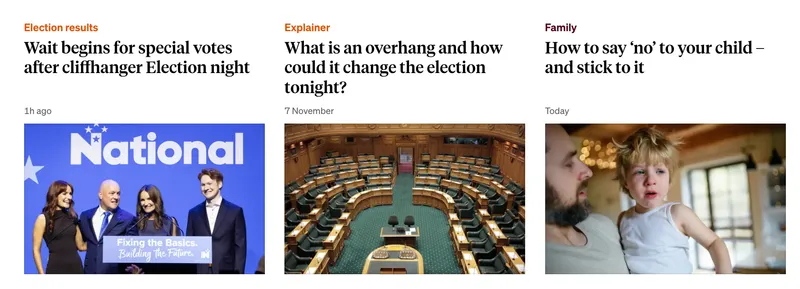
All that to say, a quite funny – maybe intentional, likely accidental – lineup of headlines on RNZ this morning.
Do we need a review of MMP?
On RNZ's live post-election coverage with Guyon Espiner and Ingrid Hipkiss, the talk is of whether the overhang will put MMP under the microscope.
Steve Maharey, who served as a Labour minister in Helen Clark's government, says" "This is not the sort of result people were looking for from MMP". He's calling for a review: "There needs to be a look at how the system works."
Shane Jones won't rule out working with Opportunity
Shane Jones is on Q+A. Jack Tame is eyeing up the potential for a hung parliament and wants to know whether NZ First would consider swinging over to do a deal with the left bloc. Jones is definitive: "Negative, no."
There's no such certainty when it comes to Opportunity though. Asked if NZ First will work with the parliamentary newcomers if it needs to, Jones fudges it: "Let's just wait until what hte specials reveal."
Is Simeon Brown National's new deputy leader?
Simeon Brown is on TVNZ's Q+A special. He says last night's result is "bitter sweet", because National won the most seats in the house, but lost senior MPs, including deputy leader Nicola Willis, and some of the strongest performing ministers of the last term, including Chris Bishop and Paul Goldsmith, as well as speaker Gerry Brownlee.
Tame puts to Brown that National was against the campaign to create an overhang, but the overhang is the reason National had as much success as it did last night. Brown won't accept it. "It shows our strength is in electorates". Tame pushes him, saying National benefitted from the campaign. "No, what you see in that is our candidates performing extremely well"
Tame is asking why National ran such a negative campaign, and if it was a mistake. "We made choices to create contrast," Brown says. "We made deliberate choices to put the risks to voters around tax, around the Greens."
Tame has the receipts. He's sifted through the last 20 National Instagram posts and found 80% were attack ads: "Voters need to be able to see what the choice is." Brown says,
With Nicola Willis gone, is Brown National's new deputy leader? Brown says the party has not even considered who takes Willis's place.
What do the results *look* like?
If you're more of a visual learner, we've got you covered with our visual results map. Have a play with the interactive maps and tables to see which electorates are poised to flip once the special votes are counted, and which electorates lean further left or right compared to the rest of the country.
Welcome to the morning after
"We went into election day thinking, this is going to be really close. The morning after? This is going to be really close."
That's Spinoff editor-at-large Toby Manhire opening his analysis of last night's results, which saw Opportunity become the first new minor party (not formed by current or former MPs) enter parliament under MMP. Currently positioned as a kingmaker-in-waiting, the special votes will determine whether the current coalition could return to power without Opportunity's help.
Today will be filled with analysis, post-match interviews and hot takes, which we'll be collecting in this here live blog. Get your coffee, your hangover cures and your calculator and join us for the morning after the night before.
Madeleine Chapman
Madeleine Chapman is a contributing editor. She was editor of The Spinoff 2022-2025.


