Who won the 2026 election?

Christoper Luxon and Chris Hipkins arrive at their election night functions. Photos: Phil Walter and Alex Burton / Getty ImagesImages
Chris and Chris, locked together, and the biggest questions unresolved.
We went into election day thinking, this is going to be really close. The morning after? This is going to be really close.
The path to power is unquestionably clearer for the right. As of 12.30pm, with more than 95% of the ordinary vote counted, the three parties that make up the incumbent coalition had the backing of almost exactly 50% of the total.
That's plenty enough to send National back to power, with Act and NZ First in tow, right? On the night, the MMP calculator had the bloc commanding 67 seats in a bloated parliament of 131 MPs. Done deal? Not quite.
“A lot of people are getting carried away right here, right now, about what the outcome means,” harrumphed Winston Peters before slipping out the back door of the Duke of Marlborough hotel last night. “It'd be very wise if they held their counsel and found out what the results actually are.”
A couple of hours later, appearing at his function just after the pumpkin hour, Christopher Luxon said much the same. “I can tell you now, it’s too close to call.”
Special votes, amounting to around 20% of the total, will not be reported for 19 days yet. Those are likely to shave a bit off National’s vote, and lift the parties of the left. It would need to be an almighty lift to push the right bloc out of pole position. Just as consequential could be what the specials do to a number of electorates where the numbers are close. As of last night, National was holding 42 seats – five of those via the poltergeist that has haunted the 2026 election: the overhang.
Luxon’s celebration was muted not just by the uncertainty of the outcome, nor by the reality of a result that is almost nine percentage points down on 2023, but by having to issue a bitter farewell to four of National’s most senior MPs: Gerry Brownlee, Paul Goldsmith, Chris Bishop, and his deputy leader and finance minister, Nicola Willis. That dismal party vote means National’s count of list MPs will be zero.
Chris Hipkins, like his namesake, wore a stoic sort of lightness when he spoke at the Hutt Cossie Club. "Tonight New Zealand has spoken,” he grinned. “It may take us a little bit longer to figure out what exactly it is that you've said.”
Chris and Chris, in a sequel cost-of-living campaign, had spent much of the last term entwined in a kind of embrace from a primordial myth, each of their fates depending on the other. Had either gone, the other would surely have followed shortly after. On that count, the only Chris who could really be described as having been vindicated last night was Chris Penk.
It was somehow fitting, therefore, that the two big parties finished election night not just on comfortably the lowest combined support in the MMP era, but in a dead heat. As of 12.30pm, with 98% counted, National was on 29.27% of the vote. Labour was on 29.27, too. After all this time, they were separated by 41 votes.
Yet still, National’s outsized electorate haul gives them seven more seats than Labour. How much of that is down to the idiosyncratic campaign led by Harry Mowbray, Don Brash and co, to amplify an overhang is difficult to say. Te Pāti Māori supporters certainly appear to have taken heed of the exhortation to split their votes and take advantage of an overhang.
It is some mercy, at least, that the overhang advantage is roughly shared across the aisle. With a parliament of 130-or-so MPs in the offing, there is certainly going to be some carpentry required to seat them all, but it will be on both sides of the horseshoe.
All the same, a serious review of the overhang provision, as well as a reappraisal of the recommendations of the 2024 Independent Electoral Review that was so sniffily disregarded, is essential. One of the most potent arguments that informed New Zealand's decision to abandon first-past-the-post and move to a proportional system was the sight, in 1978 and 1981, of National winning more seats than Labour despite Labour winning more overall votes. In 2026, under the proportional system of MMP, that is about to happen again.
The Opportunity Party has comfortably cleared the threshold, hitting 6%. In doing so, it has made history by becoming the first new party to enter parliament without mutating out of an existing party.
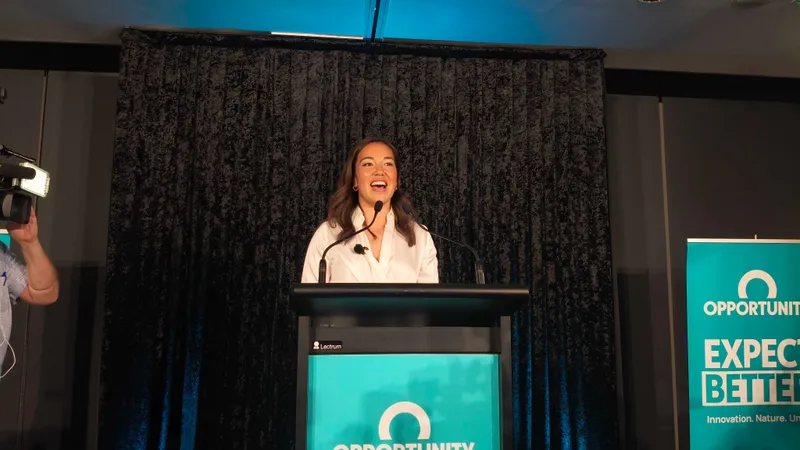
Whether they’re needed by National is one of the key questions that special votes will answer. Whether a Luxon-led National Party can work with them, despite Christopher Luxon ruling out any such thing with a hypnotic regularity, is another. Mark Mitchell, whose support was instrumental in Luxon surviving a second attempted caucus coup, appeared to lay the first paving stone last night towards a U-turn, suggesting that an accommodation might just be found, and that we need to “recognise we work in an MMP environment”.
The Greens can celebrate a record high result, built on a boldness that Labour concertedly eschewed, an achievement all the more impressive given the state the party was in two years ago. Act won record support, too, with a campaign that made them sometimes look like the only adult in the cabinet room. Paul Henry was a boon to David Seymour. You campaign in Henry, perhaps, and govern in Seymour.
New Zealand First never hit the mid-teen numbers that Winston Peters clearly had in mind a year or so ago. Having hoovered up voting constituencies and a cast of old-school repertory players, they, like Act, have pulled off the remarkable feat for a small party of being easily re-elected to parliament after supporting the government, even if – or perhaps because of – “supporting” as often not been the word you’d choose to describe it.
With extended guest spots for everything from the Mongrel Mob to the Mowbray Show, the campaign was ultimately about cost of living. It shuddered and stalled like a station wagon running out of very expensive fuel.
It was close, so close – enthralling at times. Yet never really sparkling. Long. Arduous. Often unpleasant. It was a race, yes, but so is bog snorkelling.
The question that has nagged away for months now: is this a change election? The answer, this morning: too soon to tell.

Toby Manhire
Toby Manhire is editor-at-large at The Spinoff. He loves to cast a pod, whether it's Gone By Lunchtime, At Large or Juggernaut. He is a former editor of The Spinoff and has worked as a journalist in NZ and the UK since the last millennium.


