How Hugo Koha Lindsay turned colonial blackboards into works of Māori resistance

Hugo Koha Lindsay at his home studio.
Treating art as an act of discipline rather than creativity helped artist Hugo Koha Lindsay produce his new body of work, Minor Infractions.
All photos by Chevron Hassett.
Māori artist Hugo Koha Lindsay didn’t grow up with te reo Māori or the worldview that comes with it. His latest exhibition, Minor Infractions, explores the role blackboards played in the erasure of language and knowledge in Aotearoa.
Hosted at Gow Langsford Gallery in central Auckland, the works transform the colonial history of blackboards into a contemplation of the language, memory and resistance, which sits quietly beneath the surface.
Hugo says the labour-intensive process behind the paintings, and the repetitive act of painting Māori and English vowels as part of the works is akin to writing lines on a classroom blackboard, which Hugo says played a significant role in the assimilation of Māori in the Western education system.
Kia ora Hugo. Tell us a little about where you’re from.
I started life in Rongotai, Te Whanganui-a-Tara. We left for Waiheke Island in Auckland when I was six, after my three half siblings moved away from home. My late father Bruce Lindsay (Te Āti Awa and Taranaki) and mother Deborah Drawbridge (Pākehā) were looking for a slower lifestyle. They wanted to rebalance their family and work life dynamics and were seeking a slower pace of life.
Waiheke in the 90s was a very different place to what it is today: most of the roads were still gravel, land was cheap, and those that lived there were after a very different lifestyle to those on the mainland. It cultivated a community consciousness which is near impossible to find in most cities.
In retrospect, Waiheke was a wonderful place to have a childhood, but it felt small at the time, and a little naive. I think those that leave end up back there at some stage, although that’s not without its difficulties. Its popularity with a particular wealth class and general lack of housing has pushed house prices beyond what many of us can afford.
Did you always imagine yourself becoming an artist, or did that path reveal itself over time?
Growing up, I imagined myself as many things. Drawing has always been a big part of my life, but becoming an artist was never really something I had ambitions of until much later on. I was exposed to art and artists early in life. My mother’s second cousin, the late John Drawbridge and his wife Tanya Ashken, were well respected artists in Wellington. We had several of John’s pieces on the walls of our family home, and my parents had many artist friends on Waiheke. But becoming an artist didn’t really cross my mind back then.
What’s your earliest memory of making art, or realising that creativity was something you wanted to pursue?
I’ve always made things, but that didn’t seem to be anything particularly unique. After leaving school, I was landscape gardening for a while and could have easily found myself in the trades. But I needed something with creative agency, where I was able to experiment with ideas through making, and a community of people that engaged with the world in similar ways. I actually started art school with the intention of becoming a photographer but found painting somewhere along that journey. Painting offered a specific set of conditions that fulfilled my temperament. Art school was what consolidated this idea of pursuing a creative practice.
Every artist has a moment when making shifts from being a passion to something they commit their life to. What was that turning point for you?
It’s still a passion, and a way of being in the world. But it has also become a kind of career, I guess. I’m not sure if I intended it to be this way, it’s just kind of happening. I’ve always worked other jobs alongside my practice for pragmatic reasons.
Your latest exhibition, Minor Infractions, feels incredibly considered, from the repeated gestures to the physical presence of the works. Where did this body of work begin and what ideas were you hoping to explore through it?
It came about by considering how to further develop my practice and the kind of visual language I’ve been working with for the past few bodies of work. I was also thinking about how I can connect to my own personhood through abstraction-finding ways of looking outwards and backwards to reflect and consider my own relationship with whakapapa and te ao Māori.
Inevitably, it became a project about scrutinising this relationship through a lens of not knowing – being both aware and proud of my own identity as Māori, but also not inheriting the language and systems of knowledge. These paintings are closely linked to the logic of the blackboard.
The blackboard becomes not a symbol of knowledge through a post-colonial lens, but also an apparatus of erasure. It’s about looking at what it might have meant to my late father, or nana Puata, and ultimately what it means to lose language and history. It’s about the cutting or severing of those bonds.
What did a typical day in the studio look like while making this exhibition?
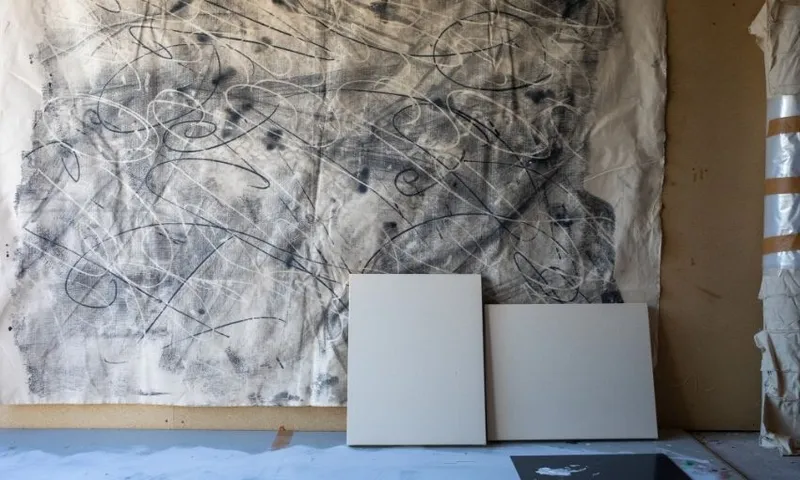
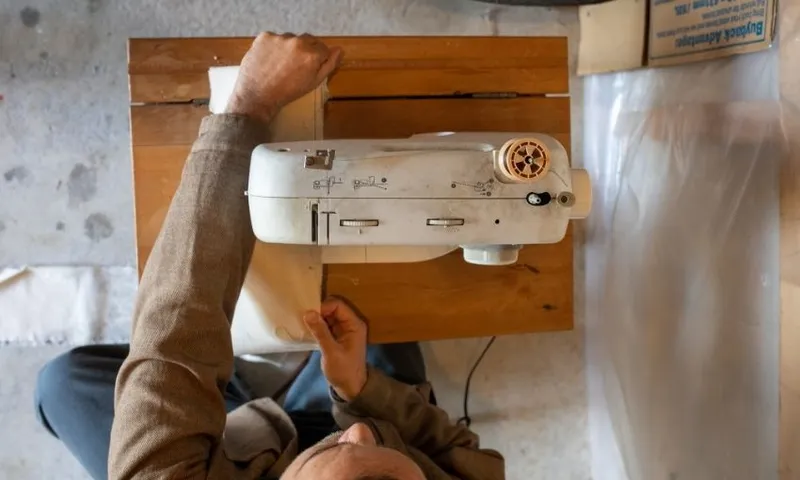
My studio is a dinky single garage, which is not ideal. It kind of dictates what can happen at a given moment. It’s spatially challenging, so I’m forced to compartmentalise my practice into stages. For the first while it was purely dedicated to painting grounds and using large sections of floor as a DIY printing block. Following this, the studio would be dedicated to tearing the paintings into measured parts, which would then be reordered and sewn together on my partner’s sewing machine, fittingly sitting on a vintage school desk. It’s a difficult studio to work in at times, but it’s at home and I have small children, so it allows me to be close and spontaneous.
Repetition sits at the heart of these paintings. Did repeating the same gestures day after day change your relationship to work?
It’s both meditative and demanding. The sewing is methodical and arduous at times. I would liken it to manual labour, if I’m to be honest. But it also acts as an activity that one can kind of disappear to. If you do it for long enough, your sense of time collapses. It was important for the work to be difficult – it’s like being in detention and it’s also honest to the conceptual body of the work. There is nothing creative about this process – it’s oriented around discipline.
What kinds of ideas, observations or experiences keep drawing you back into the studio?
The studio is like an open arena to allow for the experimentation of ideas and material to emerge. Sometimes, it’s very considered and conceptualised. Other times, it functions as a kind conduit for lived life and experiences to intermingle with elements of play. I guess this is also what abstraction has come to mean for me – not something removed from everyday life, but as an extension. It’s a means of cultivating or proposing a new visual and material reality from a multitude of ideas, processes and materials. A bit like cooking.
Audiences usually only see the finished exhibition, but rarely the months of experimentation beforehand. What happened behind the scenes that people would never know from simply walking through the gallery?
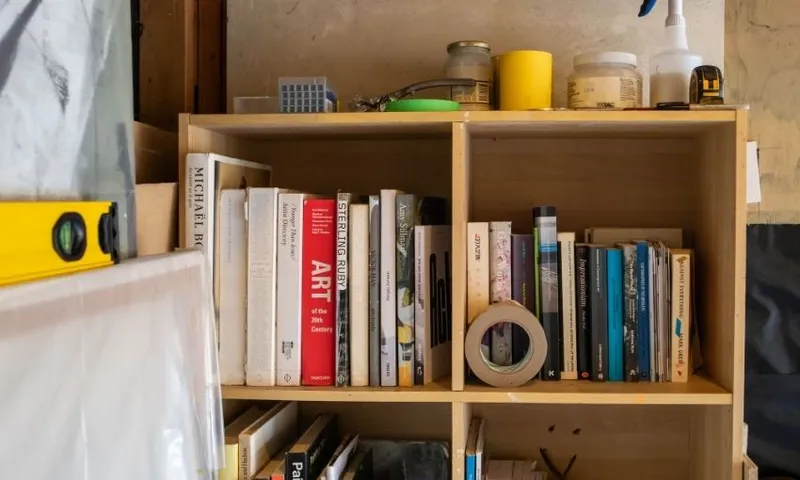
The many mistakes, mishaps and the constant cleaning. The studio is an unglamorous space, and not unlike many other workshops.
Now that Minor Infractions is out in the world, what has this body of work taught you and where do you feel your practice is heading next?
I have found a thematic space that I think can carry my practice for a while and I’m keen to find a way to accommodate sculpture and collaborative aspects at some stage.
What’s the first thing you do when you get to the studio?
Clean.
If you weren’t a painter, what do you think you’d be making?
Sculptures.
After an exhibition, what do you look forward to?
Developing a new body of work.
One tool or material you couldn’t work without?
Broom stick or extension pole and paint.
What’s some advice you’d share to an up and coming artist?
Stay humble. Be opportunistic, but learn to say no. Do the mahi without expectations. Travel.

Chevron Hassett
Chevron Hassett (Ngāti Porou, Ngāti Rongomaiwahine, Ngāti Kahungunu) is an artist based in Tāmaki Makaurau Auckland. His work spans sculpture, photography, and public installations, exploring urban Māori experiences, memory, and place. He has exhibited across Aotearoa and Australia, and is currently developing new sculptural works that respond to community, architecture, and whakapapa.


