The emissions trading scheme is broken. Can anyone fix it?

The government can’t sell any carbon credits and the environment could pay the price. (Image: Tina Tiller/The Spinoff)
New Zealand’s most important climate change policy depends on the carbon price increasing. Cheap forestry credits have pushed it the other way.
The government tried to sell 3.9 million carbon credits last week. Nobody bought any. It was the seventh consecutive quarterly auction where this had happened.
The emissions trading scheme, introduced in 2008 under Helen Clark’s Labour government and heavily amended by the following National government, requires businesses which produce greenhouse gases to offset those emissions through carbon credits, officially known as NZ Units (NZU). It’s New Zealand’s primary method of driving emissions reductions and meeting our international climate targets.
It depends on the price of carbon increasing, because higher ongoing costs provide an economic incentive for businesses to cut their emissions. Since 2021, the government has attempted to orchestrate that price rise by auctioning off a shrinking supply of credits, with an ever-increasing minimum price.
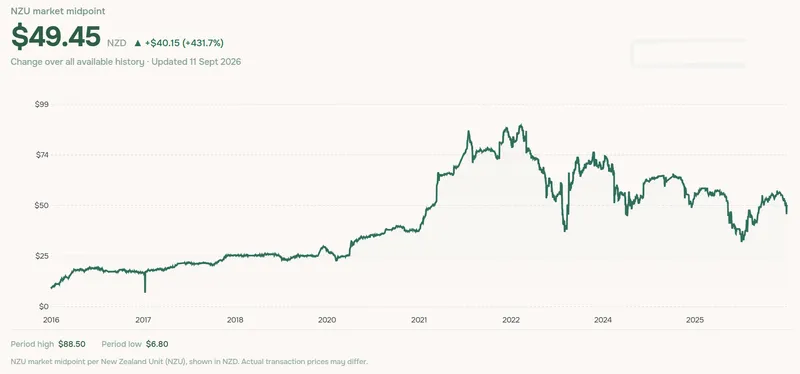
The problem is that emitters can also purchase carbon credits from local forestry companies. Right now, the government’s minimum auction price for one tonne of CO₂ emissions is $71, but you can pick up the equivalent credit for $49 on the private market. So, naturally, that’s what every large emitter is doing.
Since its infancy, the emissions trading scheme has dealt with participants taking a diabolical amount of the piss.
From 2011 to 2015, large New Zealand companies including Fonterra, BP, Z Energy, Genesis and Contact bought some $200m of carbon credits from Russia and Ukraine, often for as little as a few cents each. Some of them have been described as fraudulent or at least highly questionable.
International credits haven’t been allowed since 2015. In the years following, the NZU price climbed to a peak of $88.50 in 2022. But that just created a new problem. As the price rose, it became highly lucrative for land owners to plant forests in order to earn carbon credits rather than do more productive things with their land, such as growing food.
According to research by Beef + Lamb, some 330,000ha of sheep and beef farms have been sold into forestry since 2017. The total area of forest registered in the ETS grew from 560,000 hectares in late 2022 to 680,000 by January 2025.
It’s profitable for some landowners, but it has been devastating for rural communities due to the loss of farming jobs. “We’re already seeing the impact of reduced populations for our rural communities, who are struggling to keep school buses, sports clubs and local shops running,” Federated Farmers climate change spokesperson Richard Dawkins told Farmers Weekly.
Environmentalists complain that carbon forestry’s reliance on fast-growing pine trees is creating a biodiversity risk. “Solutions need to be long lasting and address the entwined climate and native biodiversity crises at the same time. Flammable, short-lived, and shallow-rooted pines just don’t cut it as a permanent carbon sink,” said Forest and Bird spokesperson Dean Baigent-Mercer in 2025.
And as far as the climate is concerned, planting more trees is helpful but nowhere near as good as actually reducing emissions. But the scheme in its current form isn’t incentivising businesses to decarbonise. It’s incentivising them to buy forestry blocks.
The emissions trading scheme, under its current settings, clearly isn’t working as intended. Several parties have put out proposals to fix it. Act wants to get rid of the government’s minimum auction price in order to meet the market. The Greens want to remove forestry offsetting entirely, creating a hard cap where the government’s auctions are the only source of carbon credits. Opportunity wants to exclude new pine forests from the scheme but would give credits to the owners of native forests and wetlands.
In government, National has made changes around the margins. It cut the number of credits at auction, and restricted farm-to-forest conversions on better land. It also “decoupled” the ETS from New Zealand’s international climate commitments, which caused a 34% overnight crash in the carbon price.
Labour’s policy, announced last week, calls for an urgent review of the ETS in order to “identify changes to incentivise genuine emissions reductions rather than relying on offsets” and “reconsider the role of forestry”. Notably, Labour announced that it would abandon plans to include agricultural emissions in the scheme, ending a years-long will-they-won’t-they dance.
Pragmatically, including agriculture in the scheme was always an awkward fit. Many environmentalists are attracted to the idea out of a sense of justice, feeling that farmers ought to pay for the environmental destruction of their industry. But the ETS doesn’t exist to dole out retribution, it exists to change economic incentives.
A business that runs on coal burners may, if faced with higher carbon pricing, be incentivised to electrify. That same price signal doesn’t really work in farming unless you want dairy farmers to switch to a different, less productive form of farming. That would be economically self-defeating for New Zealand, and Labour knows it. It’s important to encourage dairy farmers to adopt new low-emissions technologies, such as vaccines and feeds that reduce the amount of methane cows produce. But there are easier ways of doing that without needing to use the ETS.
That may sound a bit vague, but it is notable that Chris Hipkins said “the carbon price is too low to drive meaningful emissions reductions”. It’s not easy for a politician to admit they want something to be more expensive, especially in a cost of living election. National’s climate change spokesperson Simon Watts decried Hipkins call for a higher carbon price as “more tax!” that would “whack Kiwi households by increasing the price of carbon”.
It should be noted that household consumers are not part of the ETS, though an analysis by the Ministry for the Environment predicted that a $10 increase in the carbon price could have a “modest impact” on inflation, raising prices by 0.1% and costing households an additional $87 per year.
This response is characteristic of the National party’s strategy under campaign chair Simeon Brown, who never found something he couldn’t call a tax. (The same press release claimed that Labour was campaigning on a bed tax, which it isn’t.)
I asked Watts if National’s position was that the carbon price should fall. He didn’t directly answer the question. His press secretary provided this statement: “National’s position is that now isn’t the time for a fundamental review of the ETS designed to increase climate taxes and hit Kiwis in the back pocket, which appears to be Labour’s view.”
Watts is playing silly buggers here: he knows full well that the ETS only works if the price goes up. He said it himself back in 2024 when he made changes to reduce the supply of credits: “Reducing the number of units will likely see the carbon price rise. We need the carbon price to encourage businesses and individuals to reduce their emissions to meet our climate targets.”
Some will call Labour’s policy a backdown. And that may be true. But it also shows that they’ve listened to rural communities, addressed their concerns without demonising them, and maintains the credibility of New Zealand’s most important piece of climate change policy. Right now, that’s a lot more than Watts is offering.

Joel MacManus
Joel MacManus is a senior writer for The Spinoff. He previously worked at RNZ and Stuff, and began his career at Critic Te Ārohi. His writing explores the political, economic and cultural systems that underpin modern New Zealand. He won the 2025 Voyager Media Award for Best Columnist, Opinion or Critique.


