Are Chris Bishop’s RMA reforms on shaky ground?

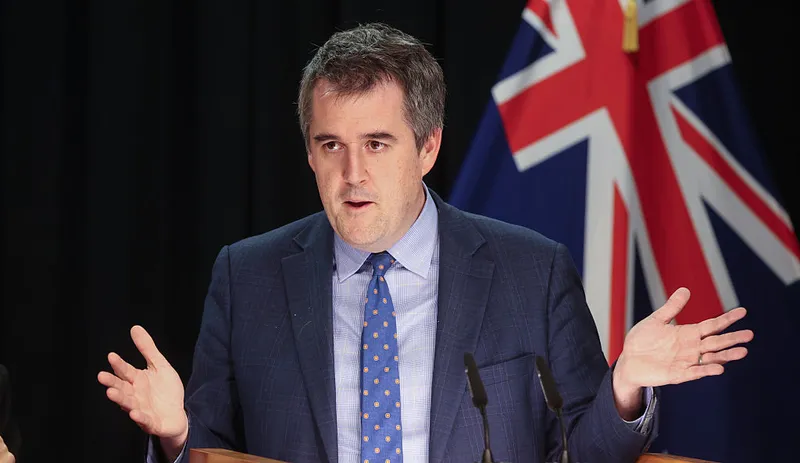
RMA reform minister Chris Bishop holds the Planning Bill and Natural Environment Bill.
The latest controversial changes to the Resource Management Act risk making the legislative package even more politically toxic.
No ordinary person should ever have to think about the Resource Management Act. Sure, you might run into an annoying consenting issue on a DIY project, but it’s probably never going to be the number one issue affecting your life.
However, there are a few classes of people in New Zealand society for whom the RMA is of extreme importance: farmers, mining companies and property developers. For them, getting a resource consent can be the difference between making millions or going bust.
That may be a clue as to why these three industries form the vast majority of corporate political donations in New Zealand. And it may also explain why the government sees reforming the RMA as so important to its agenda even though it’s not particularly salient to your average punter.
Chris Bishop’s sweeping reform package across housing, infrastructure, transport, environmental regulation and urban planning is broadly unified by one theme: providing more certainty to developers. The fast-track approvals system was designed as a one-stop shop for permitting, and the reforms to the RMA aim to eliminate the chance of pesky local councils or iwi disrupting the process.
Bishop presented the Planning Bill and Natural Environment Bill, which will replace the Resource Management Act, to parliament on Monday ahead of their second reading. There were some notable changes from the first versions of the twin bills that went even further than those recommended by the Environment Committee, chaired by National’s Catherine Wedd.
The changes give ministers more direct power to grant approvals, prevent councils from regulating greenhouse gas emissions, and keep the controversial provisions that financially punish councils for restricting certain land uses.
Most significantly, the changes will scrap all existing Mana Whakahono ā Rohe agreements between iwi and councils. The agreements give iwi a formal, recorded role in resource management decisions: input into council plans, consultation on consents, a voice in monitoring and enforcement. They do not hand iwi veto power over any decision.
There are currently eight of the agreements, which were first introduced in 2017 by National minister Nick Smith, though reportedly several dozen more agreements were in the works, no doubt motivated by iwi wanting certainty in the face of a rapid reform programme.
The first draft of the legislation would have blocked the creation of new agreements but upheld existing deals. The new version eliminates them entirely, replacing them with new deals in a more narrow scope set by the government.
In other words, the Crown (via councils) signed an agreement with iwi leaders promising partnership, participation and protection, only to turn around years later and unilaterally change the terms of the agreement. Sound familiar?
Chris Bishop has correctly identified that New Zealand’s unicameral parliament can pass laws extraordinarily quickly when you exploit urgency rules to limit scrutiny. On the other side, it also makes it easy to repeal laws you don’t like, as evidenced by the coalition’s mission to eliminate almost all legislative evidence that the previous Labour government existed.
The key to leaving a legacy in New Zealand politics isn’t passing reforms, it’s getting them to stick. A policy has to be too popular, too embedded or too complex for an opposing government to bother changing. That’s why Michael Cullen’s KiwiSaver is a part of our lives today while Norm Kirk’s superannuation scheme isn’t, or why Michael Joseph Savage’s social security survived while Michael Wood’s fair pay agreements barely lasted a year.
So far, Bishop has been fortunate that Labour hasn’t wanted to spend much political capital on this issue. Chris Hipkins doesn’t want to kick off another cycle of repeal-and-replace. He has, however, made it clear that Labour would change key parts of the legislation, especially on iwi partnerships and regulatory relief.
Strategically, this looks like an own goal from Bishop that creates risk for National’s electoral chances and for the survival of the reforms he so dearly treasures. These latest changes are highly unlikely to survive any change of government, but they act as a lightning rod that generates even more controversy and motivated opposition.
These changes, introduced so late in the process, will be seen as further insult by some iwi leaders. It will only further sour relationships with local councils, which are already annoyed at the government for hastily forcing them to come up with amalgamation proposals.
The Post reported that Treasury has put the RMA reform programme on “amber/red” rating in its Gateway Review process, meaning there are significant issues with delivery but these issues are resolvable if acted on without delay. And Bishop himself admitted yesterday that he is “highly unlikely” to win back his Hutt South seat on current polling.
Bishop’s reform package increasingly looks like an albatross around this government’s neck, equivalent to the Three Waters reforms under Labour: a policy for which there are very few voters to be won but many that could be lost.
Joel MacManus
Joel MacManus is a senior writer for The Spinoff. He previously worked at RNZ and Stuff, and began his career at Critic Te Ārohi. His writing explores the political, economic and cultural systems that underpin modern New Zealand. He won the 2025 Voyager Media Award for Best Columnist, Opinion or Critique.


