The Greens take on Opportunity without taking on Opportunity

Green Party co-leader Chlöe Swarbrick (Image: supplied)
At their AGM, the Greens took jabs at Paul Henry and NZ First. Their criticism of Opportunity was more subtle.
It’s a weird time to be a Green. The party has spent 30 years putting forward ideas to shake up New Zealand’s claustrophobic status quo. In exchange for their troubles, its MPs have been written off as loonies, extremists and fruitcakes, and that’s just by Winston Peters. They’ve struggled to be taken seriously, even over policies that are later adopted by the mainstream.
The current political environment should be a Green dream come true. Incrementalism is loosening its headlock on our nation. Centrists are fleeing left and right, abandoning their red and blue teams in search of real change. But instead of heading to what’s arguably their natural homes, many of the disillusioned voters are jumping into the arms of Peters or Qiulae Wong
Maybe a party that’s been in parliament 30 years just doesn’t look like enough of a shake-up to the jaded masses. At their AGM on Sunday, the Greens’ co-leaders tried to frame the party’s long political history as a selling point. “I love you,” said a slightly bemused Chlöe Swarbrick as she took the stage to a loud ovation, perhaps revelling in a more positive reception than she normally gets on Ryan Bridge Today. She quickly launched into a trip down memory lane, reminding the 150-strong crowd at AUT’s south Auckland campus about the Greens’ 2005 “Buy Kiwi Made” campaign.
The callback helped set up a jab at one of the Greens’ competitors for the growing band of Labour and National refugees. “We’ve got to buy Kiwi-made. We have to build Kiwi-made. That might just be what I mean when I say we are the real New Zealand first party,” said Swarbrick.
New Zealand first in policy, maybe, but not New Zealand First in nature. Outside of a small band of Young New Zealand First members shouting things like “drill baby drill”, that party’s campaign launch last weekend was a sea of grey hair. The Greens’ AGM was adolescent by comparison, with only a smattering of the Rod Donald-era old guard in attendance. Perhaps bravely for a group that sometimes gets accused of lecturing, it was held in a lecture theatre. But the room’s small size meant it was packed. It felt loud and energetic; another contrast to the NZ First launch, which played out before a swathe of empty seats at the larger Due Drop Events Centre in Manukau.
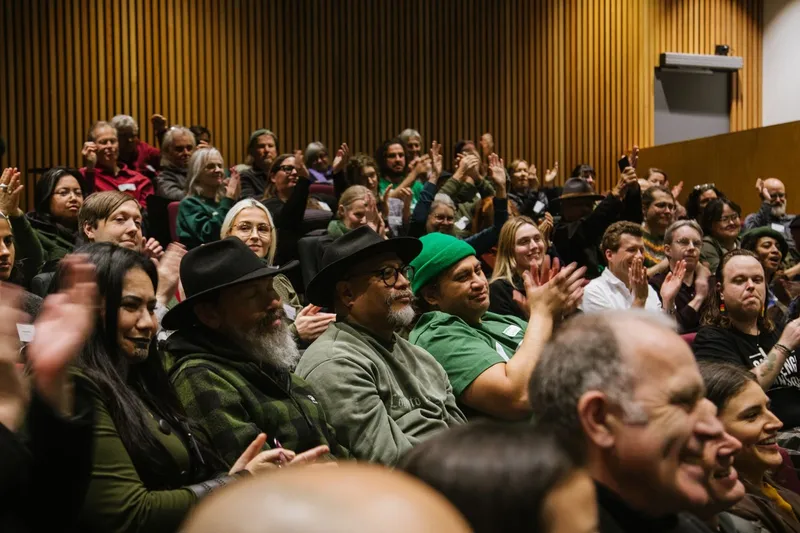
Peters wasn’t the only one Swarbrick was trying to usurp in her speech. She also took aim at Act’s new headline recruit Paul Henry, who told Q+A’s Jack Tame last week that he wanted to restore the “aspirational vibe” of his childhood. She pointed out that vibe was set by a host of Green-ish policies, including high taxes on top earners and a strong welfare state safety net. “We don’t need to accept the record homelessness that has been created through 40 years of politicians shredding the welfare state that our great grandparents built,” she said. “That’s not just vibes.”
Greens insiders said some of the focus on history was aimed at warding off the oft-repeated criticism that the party had betrayed its core values. The only policy announcement from the AGM – a call for a moratorium on data centre consents – was pitched as basic environmental common sense.
But if there was an overarching message it was something akin to “you can trust us”. It wasn’t NZ First but the Greens that would put New Zealand first. It wasn’t Act, but them, that could restore the glorious past. It was also the Greens, not those starry-eyed political newbies wandering down the road talking about land taxes and UBIs, who could actually create change.
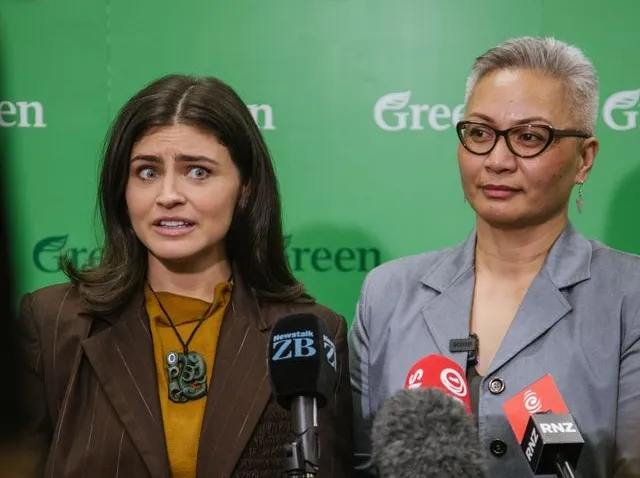
Opportunity wasn’t mentioned by name at the Greens’ AGM, except for when co-leader Marama Davidson pointed out that it might put National back in power. But the party wafted in the background of some of Davidson’s talk about the Greens’ long political whakapapa. Though Opportunity and others now advocate for stuff like solar power, the Greens wanted people to know they had been there first. “If governments had listened to the Green Party solutions for energy resilience decades ago, that would have been the best time, but the second best time is now,” said Swarbrick. “Imagine how much better off our households would have been now.”
The party also unveiled a new campaign slogan. “For all of us,” sounds a little bit like the Jeremy Corbyn-era UK Labour slogan “For the many, not the few,” but the Greens’ leaders insisted it was more of a statement of intent. In her speech, Swarbrick pleaded with party faithful to talk to people they wouldn’t normally approach. “No one is ever going to be able to empathise with your worldview if they feel that they are under attack,” she said. “No one is ever going to be able to accept new information if they feel they are losing. If we want to win, we’ve got to win together.”
It was a plea for a broad-based Green Party that welcomes in new voters rather than browbeating them. Perhaps Swarbrick sensed an, ahem, opportunity. It’s been a long time in the trenches for the Greens, and progress has been hard. Now people are more open than almost ever before to hearing new ideas and opening their mind to new electoral possibilities. It should be the party’s time to shine but, with a Talbot-Mills poll last week showing the Greens down four points to just 9% of the vote, the big question is whether the electorate will let them.

Hayden Donnell
Hayden Donnell is a senior writer for The Spinoff. He previously worked at RNZ, TVNZ and the New Zealand Herald, alongside other media companies that have since closed down or been renamed. His primary passions are local politics and the Big Fresh animatronic fruit and veggies.


