


The game was originally meant to illustrate the problem with land speculation. We could just look at our entire economy instead.
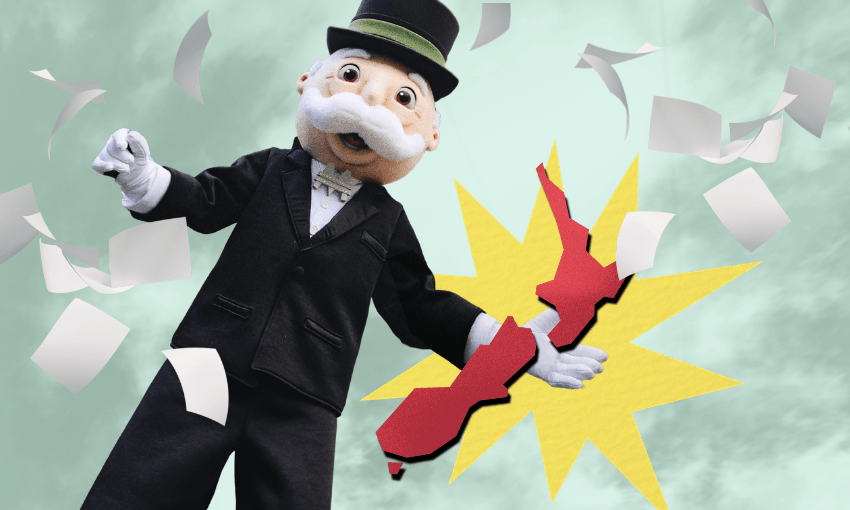
The mood was jovial as Hasbro launched its updated version of NZ Monopoly at the Sky Tower in Auckland last Thursday. Mr Monopoly strolled about, stroking his moustache, twirling his cane, staying silent but indicating his pleasure by allowing wads of Monopoly money to be handed out to passersby. Comedian Tom Sainsbury posed with the tile for Hobbiton, one of the game’s new properties. Children milled about. A horrible humanoid Sky Tower lurked in the background.

There was some reason for the revelry. For one thing, the Sky Tower was finally being recognised as New Zealand’s most valuable bit of real estate, taking the prized final dark blue spot on the board. For all the talk about people conjuring up visions of villas when they think of Auckland, that weird concrete needle is the city’s actual most recognisable heritage building.
But if Lizzie Magie could have seen the celebratory scene, she’d have been absolutely ropeable. The Illinois game designer and actor is the real inventor of Monopoly. Only, in her version, it was known as The Landlord’s Game. She was a fervent devotee of the American political economist Henry George, who advocated for a land tax as a way to address rising inequality in wealthy societies.

The Landlord’s Game played similarly to Monopoly, but its framing was different. Instead of passing go, players would mosey past a square marked “labour upon Mother Earth produces wages”. If they ran out of money, they would be sent to the poor house. The intent was to show how property accumulation worked to enrich wealthy land barons and impoverish their tenants.
Magie couldn’t make the Monopoly launch event due to being holed up in a humble grave at Columbia Gardens Cemetery in Virginia. If she’d been at the observation deck of the Sky Tower, it’s likely she’d have gestured at the villa suburbs below, with their $3 million prices, and screamed “this is exactly what I was talking about” straight at Mr Monopoly’s bushy moustache.
There’s hardly a better illustration of the problem Magie was trying to illustrate than New Zealand. Almost uniquely in OECD countries, we’ve steadfastly refused to implement taxes on land, capital or generally anything that might have enriched a robber baron in the early 20th century when Magie was coming up with her concept. Partly as a result, the top 10% of New Zealanders own roughly half of all wealth. By far the largest share of that is invested in property. According to Stats NZ, around $1.16 trillion, or 48.5%, of all our country’s assets are in real estate.

No wonder the economic commentator Bernard Hickey can’t stop calling our economy a housing market with bits tacked on. As Magie feared, it’s created a two-tiered system of housing haves and wage-earning have-nots. Our landowners have used their lightly taxed property assets to bid up the price of yet more lightly taxed property assets, all while failing to chuck more than a few bits of spare change in the direction of the productive economy. Mortgage-free homeowners now possess on average $1.8m in wealth, compared to $185,000 for the average renter. Without comprehensive taxes on capital or wealth in place, the richest New Zealanders pay an effective tax rate of just 8.9%.
A few political parties have feinted in the direction of change. Notably, Opportunity is advocating for us to implement a version of the land tax Magie was trying to promote. Its leader Qiulae Wong tells The Spinoff she actually has a copy of the original Landlord’s Game at home. “Winning at the expense of others is a fun game with your mates over a beer. But it sucks in real life,” she says.
Sucks for some. Rocks for others. Not everyone agrees we need to change our property-loving system, with political parties bigger than Opportunity advocating for a mildly augmented version of the status quo. In the meantime, there’s a new version of NZ Monopoly out. It has the Sky Tower. It’s about $35 from Kmart. If you don’t have that on hand though, you could always just go about your day. New Zealand doesn’t really need its own version of Monopoly. We’re already living in one.