
It’s keeping a dedicated handful of teenagers off their phones and teaching them patience. These boys love sewing club and they’re ‘not worried what people think’.
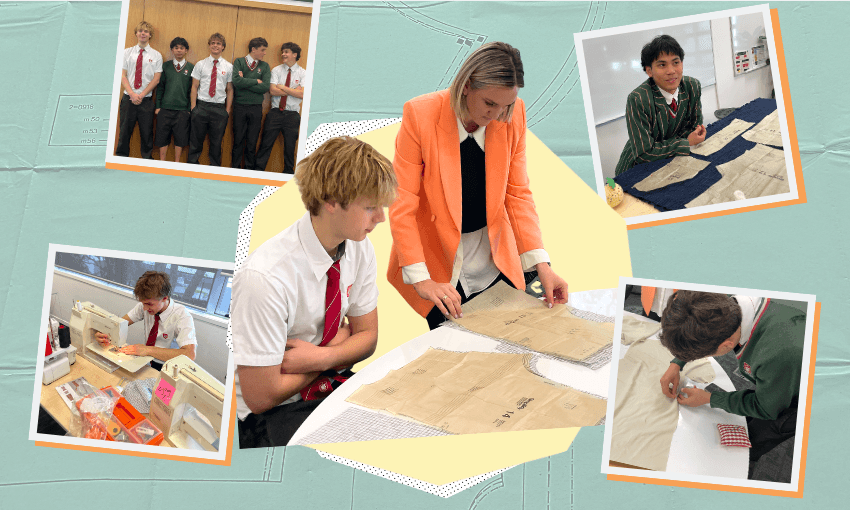
The bell shrieks signalling the end of the school day at Westlake Boys High School. Throngs of stripy green blazers surge out of classrooms; some are heading home, others to practice and a handful are setting up for their sewing club.
Cooper Phillips, a year 13 student with a mop of blond hair, explains the origin story. He’d admired a jacket made by his media studies teacher Casey de Wit, telling her he’d be keen to learn how to sew. “A few weeks later, she came up to me and said ‘how would you how would you feel if I made a sewing club?’” Pushing concerns about his own work ethic aside, “obviously if you do it, then I’ll join” he told her. “I’m glad I stuck to it, it’s like something that I really like.”
In May this year, Cooper and Prince Mancilla became the founding members. Kruze Agnew found out what they were doing and wanted in too. More followed. The boys meet every Monday after school. While there was some judgment from their peers and a few guys had a laugh, “we’re not too worried about what people think,” Joseph Wrightson tells me, unpacking a machine. His extracurriculars are rugby and sewing club.
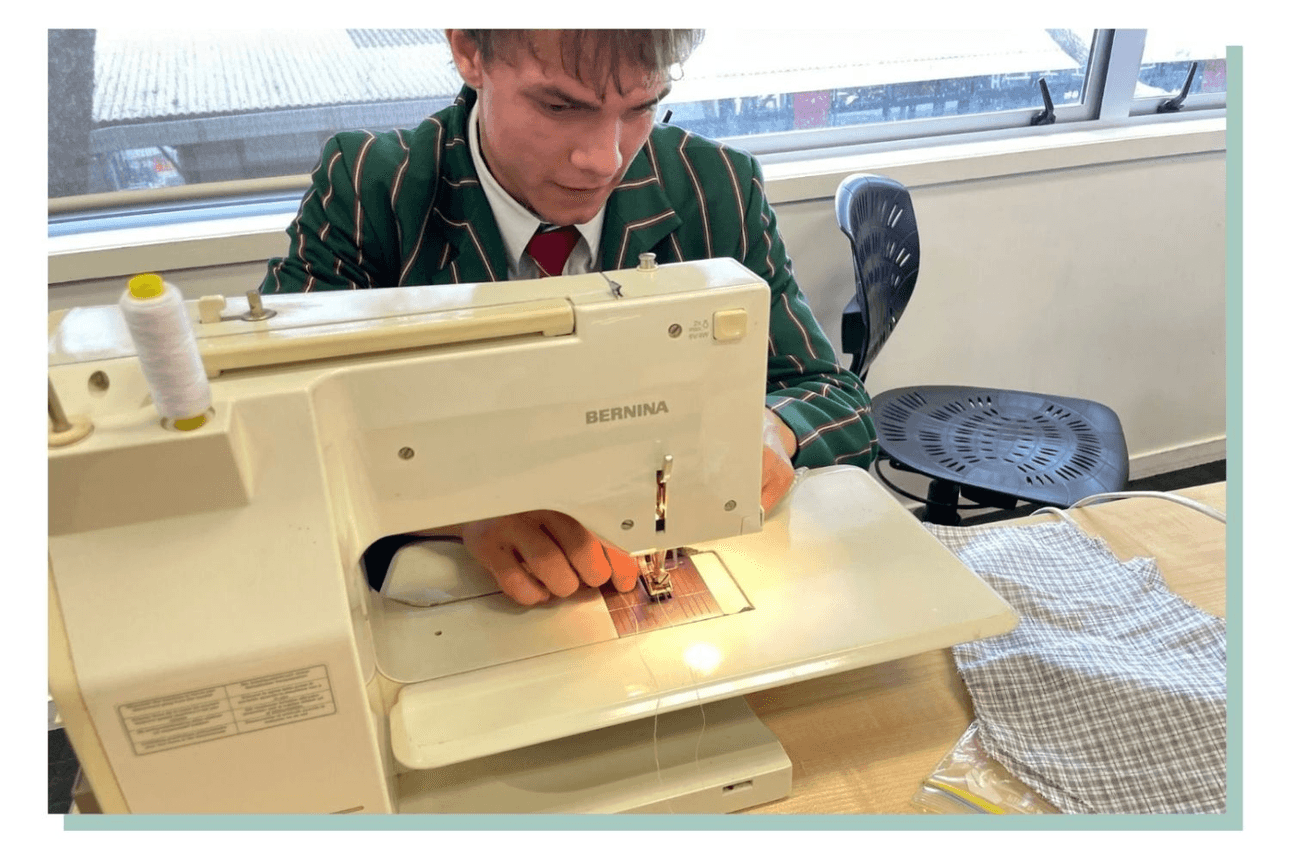
They learned to sew on scraps, made tote bags, then moved on to garments. These required more fabric, which was a bit of a wake-up call. “All that stuff was expensive,” says Cooper. “So that’s why we did the bunting.” Selling handmade bunting to the teachers was their fundraising initiative. Cooper, Prince and Justin Gordon pitched the project in the teachers’ lounge. “The whole staff was there… it was a bit nerve wracking.” They made 33 sales and the money they raised went towards materials – an exciting trip to Spotlight – with some left over. “That’s what led to us going to New Zealand Fashion Week,” explains Cooper. “That was really cool.”
Seeing garments on the runway was exciting. They were “more like artwork”, adds Prince. He’s busy cutting out his shorts, a little behind the other boys because he took on another project, a soft-toy bunny. “That took me a whole week.”
The machines they use were all donated to the club or purchased secondhand from Westlake Girls. The boys share, setting them up carefully and asking for help when they’re unsure about a lever or button. The mood is light; they’re here to learn but also to hang out. Though some were friends before, they’ve all become closer through the club. It gives them a chance to connect outside of school, says de Wit. “It’s really nice for the friendship side of things.”

The boys chat as they work. They’re making trousers and shorts, their first real garments. Kruze is at the ironing station, concentrating intently on pressing his trouser pieces. Ironing before you sew is important, Kruze explains. He enjoys the ironing, he says. What about the club? “I love it.”
The others are sewing up their trouser legs. They check they’ve got the right pieces together, sit down at the machines and begin to stitch. School shoes rest tentatively on pedals and the room begins to hum. It’s disrupted with jokes, gentle razzing and plaintive cries of “Miss?”. “Accidents happen when you’re sewing,” explains Prince. If something goes wrong, they unpick and try again.
They’re learning patience. “We’ve stuffed up and had to unpick for ages,” says Joseph. “We get frustrated a bit, it’s harder than you expect.” Understanding the time, money and effort involved in making something raises the stakes of the task at hand. Seated at his machine, Joseph worries aloud whether he’s done something wrong. Then, it clicks: “I get it now!”

Around the room there are similar cries of exasperation and breakthrough. These eureka moments make de Wit smile. Kruze has one as well. Despite exclaiming “I’m not OK!” while hunched over his machine, he’s quietly delighted when his side seam and pocket bags are successful.
Sewing is teaching them resilience, explains de Wit. “They get so frustrated if something goes wrong.” Instead of giving up, she encourages them to be patient: unpick, work out what happened and try again. And again. Although they want everything to be perfect, the process of slowing down, taking your time and doing it yourself is rewarding. She’s been surprised by how much satisfaction they get from it. “This is something that they actually enjoy.”
It helps them focus – a major feat for teenage boys (and everyone else) in 2026. Cooper says it gets him off his devices at home, where he uses his mum’s machine. “I’ll go upstairs, leave my phone in my room and just sew for a couple of hours. I just feel like I’m in the zone, it’s really nice.”

But modern technology does help learn more skills; he looks up tutorials on YouTube “all the time” and often sees sewing content on TikTok and Instagram Reels. These boys are savvy, fluent in clothes as a means of self expression (they prefer that term over ‘fashion’). “What you wear really represents who you are as a person,” explains Cooper. “If you can pull off certain things, it shows people how confident you are.”
Joseph agrees. “We all care about [clothes].” He tells me they’re not the only boys at Westlake picking up a needle and thread. “Lots” sew at home – one modifies “all” of his clothing and another tweaked his school trousers.
Modifying clothing is popular because it’s cheaper and easier than buying material or starting from scratch. Prince has “always wanted to adjust clothes to what I want them to be”. He got into sewing through skateboarding, because skaters have great fashion sense (he’s right) and often modify garments.

It appeals to Cooper too. “I’ve always been real big into clothes… but lots don’t fit how I want.” Sewing gives him the means to adapt them. “It’s a good skill to have for upcycling.” He’s done a few projects at home and modified things for his friends. “I got all the boys coming up to me now asking me to tailor their stuff,” he says. “I’m no pro or anything, I just have very basic sewing skills.” During sewing club he’s making a pair of shorts, bent over the table to get his pocket placement just right. “Is that too high, Miss?”
As they pin and sew, the boys talk about hanging out after school, meeting up with girls and other teenage business. It’s Joseph’s birthday and he’s just turned 18, so the topic of voting comes up – some of them are enrolled already. They discuss political parties for a while before the conversation swerves in another direction. It swerves a lot – these are teenage boys, so any focus is challenged by the frenetic energy of adolescence.
They ask me whether other clubs like theirs exist but I don’t have an answer. They’re surprised to learn that sewing, or rather “fashion and textiles technology” and “soft materials”, is offered as a subject at other schools. In New Zealand, 763 education organisations are consented to assess on apparel cutting and sewing to level two, but that doesn’t mean they all offer it. (Westlake Boys is among them, but doesn’t have soft tech as a subject.)
At a secondary school level, New Zealand doesn’t have enough technology teachers, explains Westlake Boys technology teacher Ellie Basterfield, who also helps with the club. For the school to offer soft tech as a subject, there would need to be more students interested. “If it gets really popular, then it’s something we could propose,” de Wit confirms. For now, they have the sewing club.

The boys’ sights are set on finishing the school year (exams are looming) and planning what’s next. Although Cooper likes the idea of studying fashion design at a tertiary level, he’s not ready yet. “I’m gonna go into a sparky apprenticeship,” he explains. “Maybe further down the line, if I’m still keen, I’d definitely love to give it a shot.” He likes using his hands to get stuff done.
“We have a lot of students that want to go into trades,” says Basterfield. If apparel manufacturing was a viable trade pathway it “could be something really good”.
Kruze also wants to do an apprenticeship next year too. “Drainlaying or plumbing, I’m not sure.” Prince plans to relocate to Perth for a job and Joseph has applied to the University of Otago. With most of the boys finishing year 13, de Wit hopes they can keep the club going in 2027. Only Blas Chacon-Monreal is year 11. “He’ll bring the new recruits next year.”

Kruze and Blas after sewing club last week. (Photo: Emma Gleason/The Spinoff)