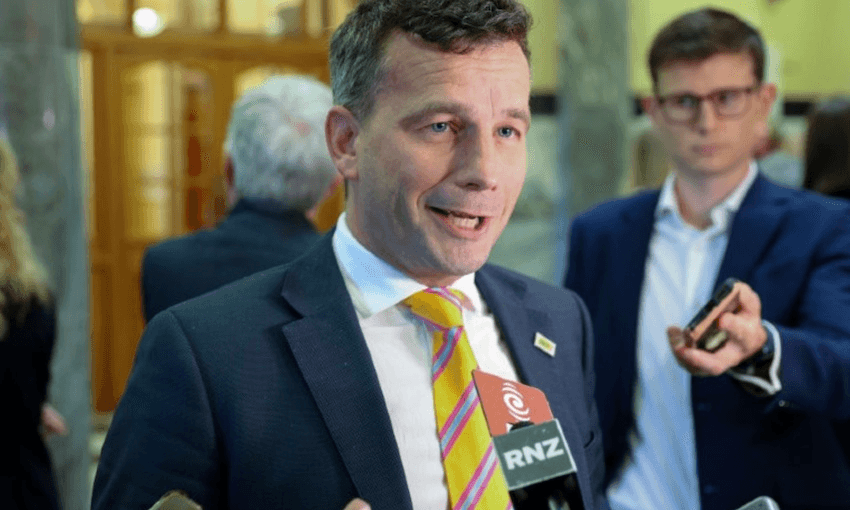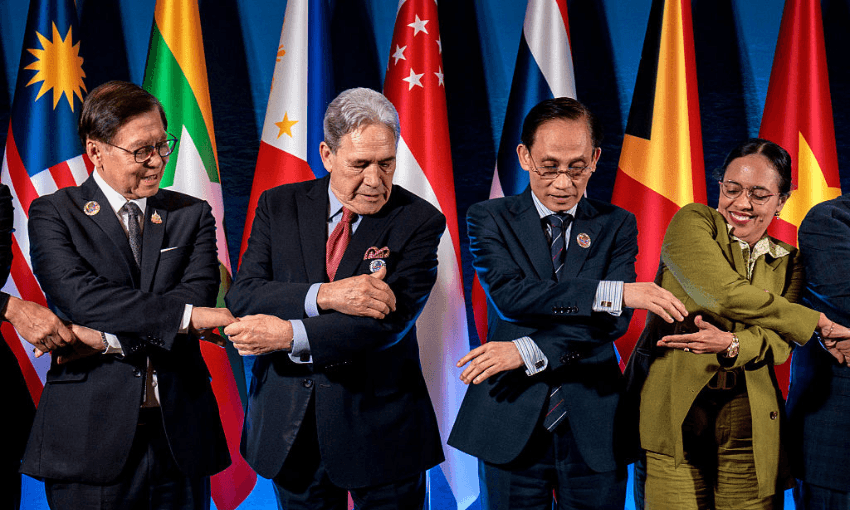

In his final major speech as minister of foreign affairs, Winston Peters has questioned the way New Zealanders think about the nuclear-free policy, saying it boosted national identity but came with costs, writes Henry Oliver in today’s excerpt from The Bulletin.
To receive The Bulletin in full each weekday, sign up here.
Winston Peters has used his last major foreign policy speech of the term (and possibly his last as foreign minister, depending on how the election goes) to challenge the “mythologising” of New Zealand’s independent foreign policy, arguing that the anti-nuclear stance and the decision not to join the Iraq War were good for national self-esteem but not without consequences.
Speaking at parliament to the New Zealand Institute of International Affairs yesterday afternoon, Peters said some New Zealanders – “especially for those on the left” – had conflated independent foreign policy with their own version of national identity at the expense of the national interest, the Herald’s Derek Cheng reports. He described that version of independence as reacting in only one direction, against the United States, whether through the anti-nuclear policy or the decision not to join the 2003 Iraq invasion.
“The anti-nuclear policy and the construction of this in David versus Goliath terms bolstered our national self-esteem, no doubt, as it boosted our sense of national identity,” Peters said. “However, a realist would ask whether the anti-nuclear policy grew or constrained our agency in the decades following, and the answer to that is far more mixed, because costs did occur.”
He did not specify what those costs were, Cheng notes.
No need for that kind of language
Peters also criticised past language towards the United States during the 1980s nuclear dispute, saying there was “no need for some of the language we used,” according to Stuff. He argued independence “can never be confined to pointing a megaphone in only one direction,” citing Palestinian statehood recognition as an example of a multi-directional foreign policy.
The speech came amid an ongoing back-and-forth with former prime minister Helen Clark, who has argued New Zealand has moved towards the United States at the expense of its independent foreign policy, particularly by exploring Pillar Two of the AUKUS defence alliance. More recently, she has said New Zealand’s reluctance to recognise Palestinian statehood is leaving it on the wrong side of history.
‘Make NZ Healthy’ (Again?)
NZ First has released a health policy promising what it calls a bold shift from treating illness to preventing it, 1News reports. The plan centres on metabolic health and nutrition, and includes embedding good nutrition in the curriculum, an independent review of dietary guidelines, funding research into nutrition and mental illness, and a review of vitamin D.
It also pledges hospital trials of intravenous vitamin C before and after surgery, removing Medsafe and Pharmac barriers to what it calls recognised safe nutrients, letting patients make their own health decisions, reducing admin for GPs, and better conditions and mental health support for nurses. A spokesperson said other parties focus on spending more on medicines rather than preventing the causes of illness.
Going ‘to the brink’
Over the current parliamentary term Peters made 44 offshore visits, spending 248 days overseas. The Post’s Anneke Smith reports Peters framed the travel load as the price of a small state. “We’ve pushed ourselves to the brink this term… It cannot be achieved from Wellington.”
He said he inherited a “moribund foreign policy” and called the annual fight for MFAT funding “Sisyphean,” having won an exemption from the coalition’s 2% savings exercise – and signalled he would pursue the same in future coalition talks, a pitch that helpfully doubles as his case for NZ First’s continued value in any future National-led government.