What AI data centres could do to your electricity bill

New Zealand’s growing data centre industry could cause trouble for power consumers. (Image: Tina Tiller)
Two proposed data centres in Taranaki and Southland could eat up as much as 13% of New Zealand’s annual electricity supply. Here’s what that could mean for you.
In a recent appearance on Q+A, energy minister Simeon Brown downplayed the risk of AI data centres affecting the consumer electricity market. “If you look at the actual numbers and the actual reality, only about 0.6% of our power consumption at the moment is being taken up by data centres and it’s projected to grow to about 3% by the end of this decade,” he said.
Although Brown admitted that demand could grow “significantly beyond that”, these figures understate the scale of the issue. His projections seem to be drawn from an MBIE report from July 2024, which didn’t take into account the newly-announced 250 megawatt CDC data centre in Taranaki or the 280MW DataGrid data centre in Southland.
When fully operative, these two locations combined would be capable of drawing as much as 6,000 gigawatt-hours per year. That’s equivalent to 13% of New Zealand’s current annual electricity supply. Further developments or expansion could push that much higher, to a level of power consumption that completely upends New Zealand’s grid.
To understand how data centres could affect the price you pay for power at home, you need to know how the electricity market works.
Imagine you are standing in front of a supermarket bulk bin section. Every five minutes, someone hands you a cup that you must fill to the brim as cheaply as possible with any combination of products from the bulk bins. Every cup is a different size, and the price and availability of the products in the bins keeps changing.

Sometimes the cup is very small and you can fill it with plentiful cheap oats and lentils. Other times, the cup is enormous and there is still space after you empty all the cheap bins so you have to top it off with expensive pistachios and pine nuts. The price of the most expensive product is the price of the entire cup. Even if the cup is 99% oats and only 1% pine nuts, it gets charged as if the entire thing is filled with pine nuts.
In this metaphor, you are Transpower, the state-owned enterprise that operates the grid. The varying size of cups represents the total demand for electricity at any given moment. The products in the bins are the different sources of electricity generation.
The generators tell Transpower how much they need to be paid to turn on their turbines. Transpower picks all the cheapest offers first and works its way up until the cup is full. The last offer accepted sets the price paid to every generator – and largely determines how much you pay at home.
Each source of power has its own quirks. Wind and solar offer the cheapest contracts. The downside is they are intermittent and unpredictable, producing lots of energy some days and virtually nothing on others.
Geothermal energy is also among the cheapest options, but it has the opposite problem. Steam comes out of the ground at a fixed rate, with no ability to scale up or down when needed.
Hydropower, the largest source of power in New Zealand, is more expensive because of opportunity cost. Water is free when it falls from the sky but the amount of water in the hydrodam lakes at any given time is a finite resource. To account for this, the hydrodam operators give the water a price, known as “water value”, which gets higher as the lakes get lower.
Fossil fuels such as coal and gas power are the most expensive and environmentally damaging and only become economical when everything else is in short supply.
The worst case scenario for consumers and the environment is a cold winter in a dry year, where demand for heating is high but the lakes are low and renewables aren’t producing much. This causes prices to spike and can lead to rolling outages. It’s known in the industry as the “dry year problem”.
If several large new data centres popped up overnight without anything else changing, they would increase the total demand for power. In other words, every cup would get larger. On days with high renewable production, the cup would still be fairly cheap to fill. But on bad days they would make the dry year problem even worse.
One possible solution is to require data centres to provide at least as much new energy as they consume, such as National’s proposed “additionality test”. To an extent, this is already happening in the private sector because long-term power purchasing agreements from data centres give the generators financial security to build new power plants.
Geothermal energy is ideal for additionality policies because it is steady and reliable, so as long as there is an additional surplus it shouldn’t affect consumers. However, most of the new proposed power plant developments are wind- and solar farms, because they are the cheapest to build. Even if the new wind and solar farms produce more total annual energy than a data centre uses, that power won’t necessarily come at the right time. Battery storage can help but only for a few hours, not months. So on some days data centres will need to draw more water from the dams, leaving less for the rest of us, and pushing the whole system towards more fossil fuels.
Another option is to get new data centres to agree to cut or reduce their power at times when the grid is under pressure. Meridian and Contact already have a similar arrangement with the Tiwai Point aluminium smelter, which gets paid to shut down operations at peak times. Some data centres need to run continuously and so would find this unacceptable, but others have more ability to move energy-intensive tasks around.
Ultimately, whether prompted by data centres or not, New Zealand needs to build more power generation to solve the dry year problem. There are several schemes currently being debated which purport to do that, including an LNG terminal in Taranaki and a pumped hydro scheme at Lake Onslow.
In the long run, data centres could play a key role in reducing emissions and consumer power prices by incentivising so much new wind, solar and geothermal energy generation that hydropower becomes our backup battery rather than our primary engine, and fossil fuel power becomes unused and unnecessary.
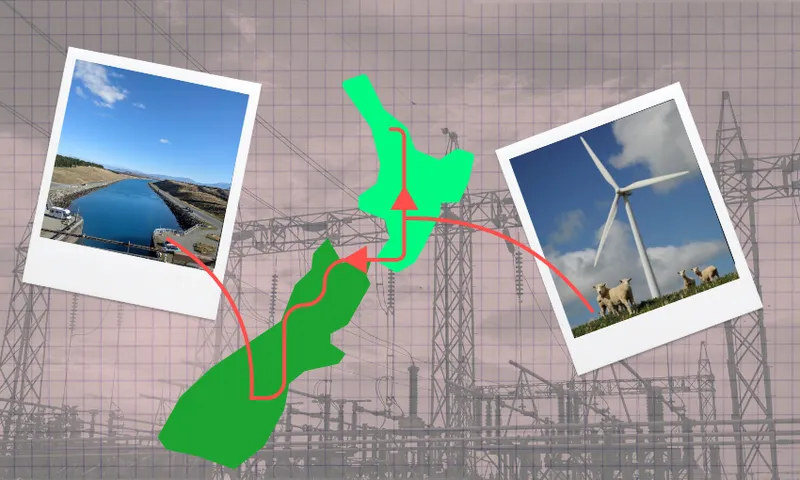
However, even if you buy that optimistic vision of the future, timing is an issue. It’s generally faster to build a data centre than a power plant, which could mean a massive new source of demand connecting to the network before the additional supply gets hooked up. Mercury chief executive Stew Hamilton recently warned that the two proposed data centre developments in Invercargill and Taranaki would “probably consume our ability to build power stations over the next five to ten years”.
Much like how Transpower has to adjust every five minutes in order to keep its cup full and the system operating, the next few years will require the government to be flexible and reactive. Get it right, and New Zealand could have a lucrative new industry with minimal climate impacts. Get it wrong, and it could mean higher power prices for everyone, more pollution in the atmosphere, and a social license that disappears in a puff of carbon dioxide.

Joel MacManus
Joel MacManus is a senior writer for The Spinoff. He previously worked at RNZ and Stuff, and began his career at Critic Te Ārohi. His writing explores the political, economic and cultural systems that underpin modern New Zealand. He won the 2025 Voyager Media Award for Best Columnist, Opinion or Critique.


