'Bury me with something trashy': Airini Beautrais' books confessional

Airini Beautrais is the author of Ockham award-winning short story collection Bug Week, and Salt Quilt, her latest collection of poetry.
Made possible by

Welcome to The Spinoff Books Confessional, in which we get to know the reading habits of Aotearoa writers, and guests. This week: writer and author of poetry collection Salt Quilt, Airini Beautrais.
The book I wish I'd written
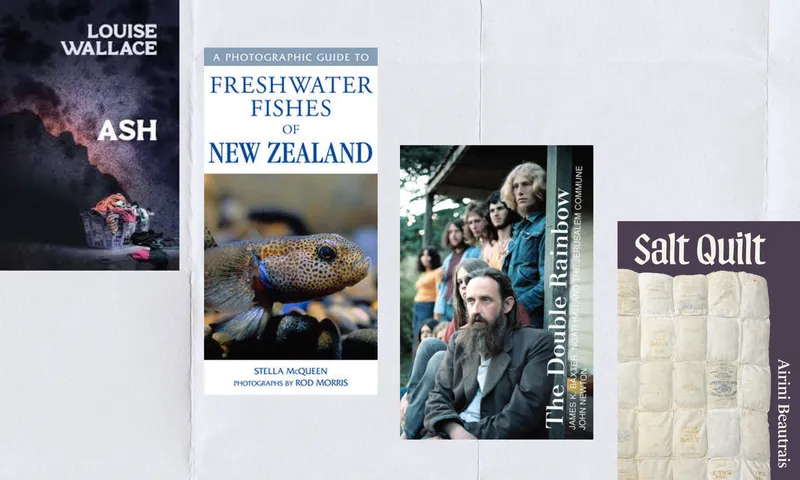
Louise Wallace’s Ash. I don’t really wish I’d written it, but I wish I could write something that spot-on, concise and clever. I wish Louise would write more books like this, and I wish that more writers would explore genre hybrids. I would read more novels if there were more novels like Ash.
The book everyone should read
I think every bookshelf in New Zealand should have a couple of nature guides on it, like the Andrew Crowe books and the New Holland series. One of the most loved and most read books in our house is Freshwater Fishes of New Zealand by Stella McQueen. I think we should all know more about our natural environment. If we all knew about freshwater fish and how endangered some of them are, there would be a nationwide rāhui put on whitebait until they recover. Some editions of the Edmonds cookbook have a recipe for mock whitebait fritters, and they are pretty good.
I also think it’s important to be acquainted with NZ history, especially the history of colonisation, and if more people were more knowledgeable, there would be less opportunity for politicians to use race-baiting to gain power. Start with Michael King’s Penguin History of New Zealand and then read some books about the legacy of colonisation like Dick Scott’s Ask that Mountain, Richard Shaw’s The Unsettled, and some of the Bridget Williams texts like Imagining Decolonisation.
The book I want to be buried with
It seems pretty wasteful to bury a book. Perhaps bury me with something trashy that there are lots of copies of in the op shops, like Fifty Shades of Grey or the Lance Armstrong autobiography. A nicer idea could be to have a handmade book that people can write messages in when a person is dying, or during their lifetime, then be buried with that.
Utopia or dystopia
I am really interested in utopias at the moment. Some of the things currently happening in the world are making dystopian fiction feel less and less fictional to me. I am interested in reading about people’s imagined utopias. Obviously it is an unattainable thing, but I think having ideals is helpful. On the other hand, some scenarios that start out as apparently idealistic can go wrong. I would like to read more books about alternative communities that were complicated, like Olive Jones’ Commune and John Newton’s The Double Rainbow. Also, although it is disturbing reading, books like Anke Richter’s Cult Trip.
Fiction or non-fiction
Both, but I do enjoy reading popular non-fiction a lot. I also really enjoy reading autobiography and memoir. Out of all the forms and genres, I find big fat literary novels the hardest. I’ll still read one now and again, but it might take me months. It might be a perimenopause brain thing, struggling to focus. I will happily stay up half the night reading genre fiction, because I am very susceptible to suspense. Or maybe I am actually just super basic and not very intellectual. In any case, I have got to the point in my life where I read whatever I feel like, and I am at peace with that.
It’s a crime against language to…
I don’t think there is any crime against language itself, because language is very resilient. But I think that writers should have ethical standards. I have had a lot of arguments with people about this. When it comes to a question of "is it worth hurting other people for the sake of my art," my answer is usually no. I think trauma survivors have a right to write about their experiences from their own perspective, and that people who have abused others shouldn’t have an automatic right to anonymity and privacy. But I don’t think anyone has a right to use language as a tool of cruelty, abuse, control, or incitement to violence. Also, in one of the poems in Salt Quilt I write about "celebrating your shitty behaviour in verse" and I don’t think anyone should do that, in verse or in prose. I think there is an ongoing trope of the writer as misanthropist, and I don’t think it helps anyone’s writing.
The book character I identify with the most
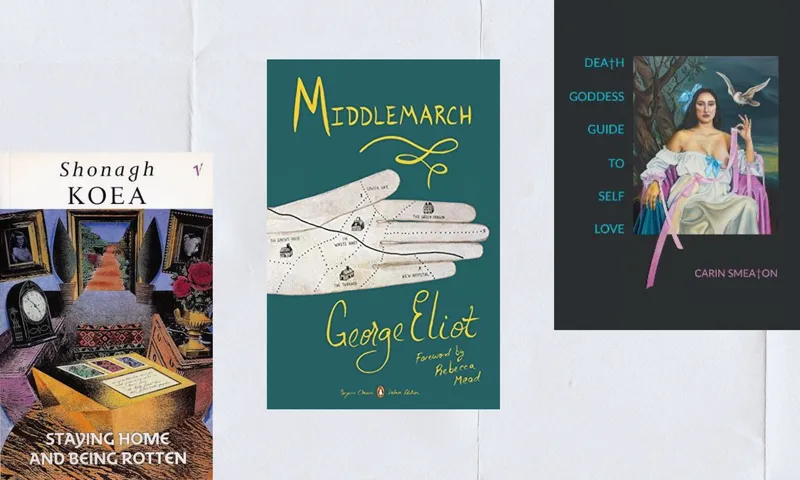
I identified a lot with Dorothea in Middlemarch when I was young, because I was puritanical, idealistic, somewhat naïve and easily taken in by older people who positioned themselves as experts. I still love Middlemarch but I feel like I have outgrown that character.
I have been collecting a back catalogue of NZ women’s fiction and reading my way through it. Recently I read Staying Home and Being Rotten by Shonagh Koea. I loved it so much I read it twice in succession. It’s set in the early 90s during the economic downturn, and the main character is a widow who is struggling financially on her own. It resonated with me as a single woman in my 40s trying to figure out how to afford the living costs of the rest of my life. It’s quite absurd in places but also very emotionally real.
The book character I never believed
Paul Prior and his brother from Maurice Gee’s In My Father’s Den. The murderer brother doesn’t have enough backstory or motive to be a murderer. And an English teacher who ‘mentors’ a young student at his home and crosses all kinds of professional boundaries is just going to end up losing his teacher registration and being in the papers for the wrong reasons. I don’t think either of these characters would murder Celia, but Celia would end up in therapy one day about what happened. The plot point that her mum was Paul’s former girlfriend is super gross. There are way too many stories of real life teachers like this who prey on kids, especially bright kids with literary aspirations of their own. They turn out not to be mentors, but groomers. I don’t think we should encourage empathising with predators.
Most overrated book
Joseph Campbell’s The Hero with A Thousand Faces. It’s like Mr Casaubon’s imaginary Key to All Mythologies. I think it’s misogynist, culturally appropriative, and reductive. It draws heavily on Jungian archetypes but in what feels like a dumbed-down kind of way. The idea that there is anything like a ‘monomyth’ seems patently silly to me. I know a lot of people still love this book, and I do think there are some commonalities in stories between cultural traditions, but there should be a more nuanced and evidence-based approach to the study of narrative.
Most underrated book
There are a lot of New Zealand books that are underrated, because we have cultural cringe, and we don’t buy books by our own writers as much as we should. And of all the genres, poetry is the most underrated. And of all the poetry books, it can be the hardest for small presses to get their books out in the world. So I want to advocate for everyone who buys books to buy a poetry book from a local small press. I can’t pick a favourite but here are three great options: Anomalia by Cadence Chung (Tender Press), Tidelines by Kiri Piahana-Wong (Anahera Press), and Death Goddess Guide to Self-Love by Carin Smeaton (Titus Books).
Best thing about reading
There are lots of good things about reading. I like to learn new things. I like to be entertained. I am a bit like EM Forster’s detestable guy who says "I like a story… You can take your art, you can take your literature, you can take your music, but give me a good story." I think humans are story-making animals, all cultures have oral storytelling traditions (albeit more diverse than what Joseph Campbell describes), and we need to stop being snobby about liking a good story, because that’s potentially classist and racist. Another useful thing about reading is that as a person with anxiety, I find it can be really helpful as a way to calm down if I am spiralling.
Best food memory from a book
In Virginia Woolf’s A Room of One’s Own she uses fictional meals to demonstrate the disparities between men’s and women’s colleges at universities. One of the supposedly sad dishes served to the female students is prunes and custard. Maybe I was just hungry when I read that, but it really made me feel like eating prunes and custard. So I made it. It was actually surprisingly good. What you need to do is put the prunes in a dish, pour a thick custard over it, and let it set. I agree with her general arguments, but I also love a good custard.
Best place to read
A tie between in bed, and at the kitchen table with a big pot of tea.
Salt Quilt by Airini Beautrais ($30, Te Herenga Waka University Press) is available to purchase from Unity Books.
The Spinoff Books section is proudly brought to you by Unity Books and Creative New Zealand. Visit Unity Books online today.

The Spinoff Review of Books
A smorgasbord of books thoughts and formats by The Spinoff.


