Countdown to a ‘clusterf***’: How RNZ’s financial disaster unfolded

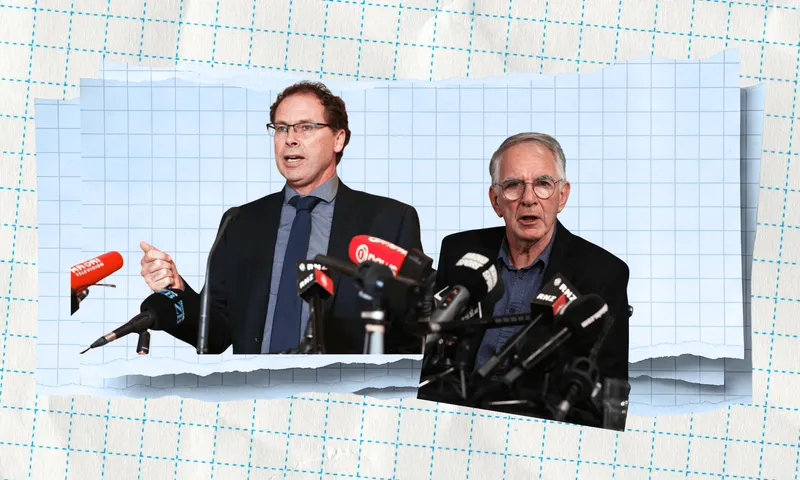
Former RNZ chief executive Paul Thompson left early after an $11.8m financial blowout was revealed. (Composite image: The Spinoff)
Every step it took before RNZ's $11.8m financial hole was revealed.
Sometimes, you forget rent is due, an office coffee shout costs more than you think, or you neglect to cancel your Sky Sport subscription. We’ve all had moments when we’ve checked our bank account and found far less money in there than we thought there would be.
But it’s unlikely you’ve ever logged into your banking app and found nearly $12 million missing. That’s what happened at RNZ when, on November 9, the publicly funded state broadcaster announced it had suffered what board chair Brent Impey described as an “indescribable, incomprehensible ... inexplicable” budget blowout of $11.8 million.
The 200 or so journalists employed by RNZ are supposed to be busy reporting the news, but ever since that announcement their employer has been starring in more headlines than it possibly ever has. The chief executive was doorstepped by his own presenters then stepped down early, and leaked emails have detailed the drastic staff cuts planned to counter the shortfall.
Here’s how the saga unfolded.
May 22, 2025: In the annual budget, finance minister Nicola Willis cuts RNZ’s annual funding by $4.6m a year, or $18.4m over four years. In a press release titled Investing in Local Journalism, media and communications minister Paul Goldsmith describes the cuts as a “savings initiative” and issues RNZ a challenge to do more with less. “I expect RNZ to improve audience reach, trust and transparency. I am confident the organisation can do so while operating in a period of tightened fiscal constraint,” he says.
May 22, 2026: RNZ chief executive Paul Thompson announces he’ll leave his position at the end of the year after 13 years in the role. "The end of the year is the right time for a change for both me and RNZ,” he says. On Q&A, Act leader and deputy prime minister David Seymour, a shareholding minister in RNZ, tells Jack Tame: "I've long said that as their listenership, and until recently, their trust, has been in decline … they clearly need to change their direction; perhaps this is part of that."
May 28, 2026: On budget day, Willis announces further cuts of $1.4m to RNZ’s baseline funding. NZ Herald’s Media Insider column reports outgoing RNZ chair Jim Mather as saying: “We will need to make further changes to ensure RNZ remains financially sustainable and can do the best possible job for audiences.”
June 26, 2026: RNZ’s Auckland staff move into their new home, several refurbished levels above TVNZ at 110 Vivian Street West. "This building is much more than a new office. It represents RNZ's ongoing investment in the future of public media and our commitment to serving audiences wherever they are,” says Thompson. "These new facilities give our teams the tools they need to create outstanding public media content for years to come."
August 7, 2026: Susie Ferguson and Mihingarangi Forbes are confirmed to be leaving their high-profile roles as Saturday Morning co-hosts, to be replaced by a single host. Production roles on the show will also be reduced from five to three. “I really just have a lot of aroha for anyone who loses their roles in this kind of horrible environment of the media at the moment, because it’s pretty tough,” Forbes tells Media Insider.
August 14, 2026: Thompson announces 25 to 30 roles at RNZ are set to go to counter the government’s funding decreases. "This will involve a reduction in staffing of around 10% over the next financial year,” he tells RNZ. "We have already taken steps over the past year to reduce spending, including a reduction in workforce size last year.”
October 2: RNZ’s chief financial officer Hilary Parker resigns at 8.46pm, a move RNZ reports as “unexpected”. Asked if other agencies like the police or or the Serious Fraud Office are involved, board chair Impey replies, "No, there's nothing in that realm whatsoever." Impey declines to answer questions about the reasons for Parker's departure, calling it an employment matter.
October 4: RNZ’s board holds an emergency meeting. Impey tells RNZ that Paul Goldsmith and Treasury have been advised.
October 8: Impey agrees to be interviewed on Checkpoint, then bails 45 minutes before he's supposed to go on air, according to RNZ's Mediawatch.
November 6: Patrick Gower is announced as the new host of Morning Report. “Regular RNZ National listeners are going to get all the stuff they already love – just with a Paddy vibe,” he says.
November 9: RNZ publishes its annual report detailing an astonishing $11.8m deficit. Its shortfalls include $2m of land sales incorrectly counted as revenue, personnel expenses $3.2 million above budget, and operating expenses $6.4m above budget – including $1.85m relating to the office relocation. “Internal financial reporting during the year did not accurately reflect RNZ’s underlying position,” the report notes.
At 3.30pm, Paul Thompson hosts an all-staff Teams call in what some describe as resembling a hostage video. All mics are switched off as Thompson, from a dimly lit room, reads a prepared statement about the issues RNZ faces. To deal with the shortfall, he announces additional staff cuts of 40, taking the total to 58, nearly one in six of its 347 staff members. “With every line, the same question pops into your mind: how? Just how? How!?” says one staff member on the call.
Later, in a terse exchange with Lisa Owen on Checkpoint, Impey says it is “almost indescribable, incomprehensible to have got to this position… This is unique in my whole experience over many, many years. I've never seen anything like this, and it's almost inexplicable.” Owen then responds, “Yet you’re all sitting here with your jobs?” Says Impey: “Yes, someone’s got to run the place, don’t they? What do you suggest?”
November 10: Owen continues on the warpath, doorstepping Thompson as he arrives for work. “How could you not know the company was in such financial trouble?” asks Owen. “We were relying on incorrect information,” replies Thompson, who carries a takeaway coffee cup and flees Owen and a camera operator through a rotating door. Her brief interview makes international headlines.
Meanwhile, Goldsmith rules out a bailout, calling the deficit “pretty shocking”. "They obviously haven't been paying attention properly to their money," he tells RNZ. "It's their problem. They broke it. They need to fix it."
November 11: Newsroom co-editor Mark Jennings refers to the situation as a “clusterfuck" (though he avoids using the actual expletive). "It's going to end up as a cluster of problems and then of course the second word of that phrase, the F word comes in, is what do we effing do about it?” he tells the podcast The Detail.
Meanwhile, a $5 million overdraft approved by RNZ’s board on June 9 comes under scrutiny. RNZ says it was assured by CFO Parker it didn’t need ministerial approval for the overdraft, but Impey agrees the overdraft broke the law, requiring sign-off by two ministers. "Now, how did that happen? That's very difficult to explain,” he tells Checkpoint. “The Crown Entities Act was breached."
November 13: RNZ confirms an independent inquiry will be held to examine how the budget blowout happened. The Post reports Thompson received a 5.6% pay rise to $528,000, while staff received a 1.8% pay rise.
November 14: Thompson announces he’s leaving RNZ earlier than his planned December 31 departure, saying it’s the right decision for him, his family and RNZ. "The last few weeks have, of course, been difficult,” he says. “As chief executive and editor-in-chief I take responsibility for the financial issues we are dealing with. It is a sad note to end on. I will contribute to the independent review to help ensure RNZ robustly examines what went wrong and identifies improvements."
November 17: Six RNZ staff tell The Spinoff they want management jobs cut before any journalists are made redundant. “There are people whose job titles are essentially meaningless who are earning a lot of money that I think will scrape through this unharmed,” says one. “If me or any of the many people on my level at work had lost, let's say $11,000, we would be gone immediately. We'd be let go. The fact that this is $11 million, and there's just going to be no consequences? I'm just so mad,” says another.
At 1pm, RNZ staff walk off the job in Auckland and Wellington in a union-planned strike over the proposed cuts. RNZ senior journalist and union delegate Melanie Earley tells Stuff they want accountability. “There’s been a lot of uncertainty, and I would say a little bit of anger, sadness,” she says.
On the same day, RNZ chief news officer Mark Stevens becomes acting CEO. In an email to staff, he warns RNZ costs more to run than is funded and “this needs to be addressed”. "We cannot achieve the level of staffing reduction required to sufficiently reduce our expenditure in line with the approved budget by proposing to protect any specific parts of RNZ,” he warns. "We recognise that the changes being proposed, and the uncertainty around them, will be difficult." Staff will begin to be told later in the week which jobs might go.
November 18: The unions representing RNZ staff, the PSA and E Tū, call Stevens’ email “predetermination” and “a breach of the collective agreement and a breach of good faith”. “This is a serious unlawful act by RNZ,” Media Insider reports the unions saying in a leaked letter sent to RNZ. “This is a sham.” In an email leaked to The Post, Stevens replies: “I don’t agree.”
November 20: Thompson and Parker had a falling out several months before her abrupt resignation, RNZ's Checkpoint reports, with chief people officer Sarah Neilson acting as intermediary. It is understood that Neilson's authority to sign off significant expenses has been revoked, and "questions are being asked about whether spending limits had been exceeded or were too generous", according to Checkpoint.
November 24: "I would hope that it will be wrapped up by Christmas,” says Seymour about the independent inquiry, as he calls for a tougher, faster timeframe than Impey, who previously said the inquiry would be ready in early 2027. “You do have to give people the time to do it properly. But we also don't want paralysis by analysis,” Seymour tells RNZ.
Meanwhile, Labour says it will wipe RNZ’s deficit and put a stop to the 58 redundancies if it is able to form a government once the special votes are released on Friday. It calls for the board to be sacked and an interim board to be put in place until the review is finalised, The Post reports.
RNZ reports that Neilson is now leaving the broadcaster, with her last day set to be this Friday.
November 25: RNZ staff plan further strikes in Auckland and Wellington outside their offices from 1pm today.

Chris Schulz
Chris Schulz is a contributing writer at The Spinoff. He's an award-winning journalist from Tāmaki Makaurau who has spent 25 years working for local publications. His specialties include live events, pop culture, infrastructure and Aotearoa music.
Sign up to The Bulletin, delivered straight to your inbox.


