Why do 0% beer fans keep getting asked for ID?

ID is often required for the purchase of 0% beers. Why? (Photo: Getty Images. Composite image: The Spinoff)
It is ‘ridiculous’, ‘a joke’, ‘very odd’ and ‘absurd', say those who have been caught out.
On weeknights, Mark* enjoys a drink over dinner. The Hawke’s Bay resident regularly picks up a box of his favourite tipple, Heineken 0.0, from his local supermarket, and he’ll often be asked for identification to prove he’s over 18. “It’s always a bit ridiculous as a 35-year-old,” says Mark.
Recently, Mark was on his way to the checkout when a stranger accidentally bumped into him. They apologised and moved on. When Mark went to pay for his 0% beers, he was told he’d need to show his ID – and ID from the person who’d bumped into him as well, in case he was buying the non-alc beers for them.
“I explained I had no idea who that person was,” Mark later posted on social media. “I couldn’t believe how absurd it all was.” When The Spinoff got in touch, Mark admitted he left the store without his drinks that day. He was still confused about what had happened. It’s “very odd”, he says.
He’s not alone. Wrangles over 0% beer purchases have made frequent appearances in headlines. A 50-year-old told Te Ao News he was denied by an Auckland supermarket because his 16-year-old daughter was with him. A 40-year-old told Newsroom he was denied because his wife didn’t have ID. A 22-year-old told Stuff he “thought it was a joke” when he was turned away over a box of non-alcoholic beers.
The Spinoff thought getting to the bottom of this 0% beer-buying saga would be easy. Surely there’s a law, a regulation, a document or some kind of rule explaining how all this should work? After all, the Sale and Supply of Alcohol Act 2021 runs to 221 pages, 418 sections and many more sub-sections.
Yet, aside from a requirement that licence holders offer low- and non-alcoholic options, nothing in the act covers restrictions over the sale of 0% beers. The Ministry of Justice confirms this. “There is nothing under the Sale and Supply of Alcohol Act … that covers products that do not meet the definition of alcohol,” a spokesperson says.
The Spinoff approached multiple agencies to clarify why 0% beer fans are being asked for ID.
Most gave us the runaround. The Ministry of Health suggested we try the Ministry of Justice. The Ministry of Justice suggested we go back to the Ministry of Health. NZ Police didn’t want to talk on the record. Neither did a spokesperson from Food Safety NZ. Instead, they suggested we try the Ministry of Justice or NZ Police.
Flummoxed, we called someone who would surely know more. Grant Caunter started New Zealand’s only dedicated 0% beer brewery in 2021. He’s seen the industry grow from 1% market share to an estimated 4%. Under the name State of Play, Caunter produces a range of six 0% beers, including summer ales and a chocolate stout. “It’s all go,” he says.
Caunter’s seen confusion around the sale of 0% beers first-hand. Despite containing less than 0.5% alcohol, his products can’t be sold in supermarkets and bottle stores after 9pm. When he sets up his stall at markets, he finds parents offering samples to their kids. “I’m like, ‘Nah, we’re not here for that,’” he says.
There’s no law telling him to do this. Even if kids did try his products, Caunter isn’t breaking any rules. Any product with less than 1.15% of ethanol is not alcohol, according to the law. “There’s more alcohol in a ... ginger beer or a kombucha,” says Caunter.
Instead, Caunter does this because he feels like it’s the right thing to do. “Because it's beer, not kombucha or ginger beer, I'm going to say, ‘This is an R18 product,’” he says. “It’s an adult product.”
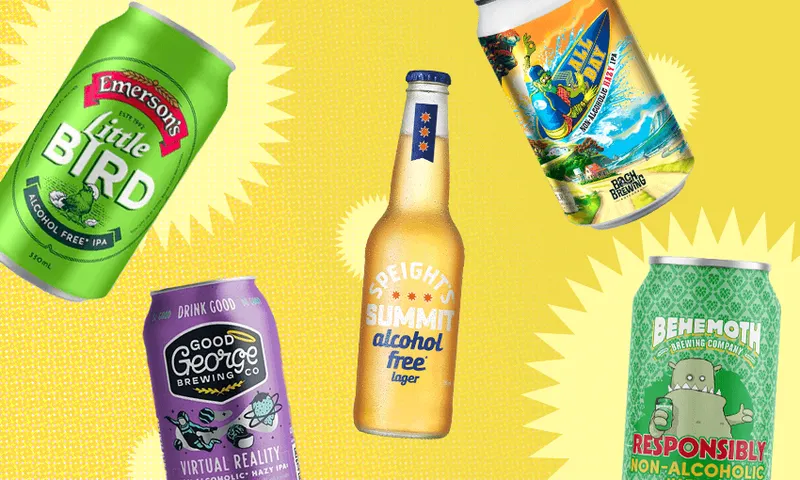
Caunter suggests looking at the Advertising Standards Authority’s Alcohol Advertising and Promotion Code for clues. That code suggests anything that looks and tastes like beer should be treated like beer. “The code recognises that advertising for zero-alcohol products can also promote the alcoholic products they resemble,” says ASA chief executive Hilary Souter.
But compliance with the code is voluntary, Souter admits. Besides, the ASA “does not regulate the sales process for alcoholic, or low- or zero- alcohol beverages”. Souter had another suggestion: how about directing our queries to the stores selling non-alcoholic drinks?
It’s there we finally received some answers. Without guidance, the rules are instead being made in-house. “These products are often packaged, branded, and can closely resemble alcoholic beverages, and we believe it’s important not to sell alcohol-like products to customers who are under 18,” a Foodstuffs spokesperson confirms.
Woolworths has a similar policy. “These products are stocked in the alcohol section of our stores and sold with similar restrictions [to alcohol] because they are marketed as adult alternatives to alcoholic beverages,” a spokesperson says. “This policy helps us ensure that these products, which are intended for an older demographic, are not sold to underage customers."
Kate Kersey, a research fellow at the University of Auckland's School of Population Health, says supermarkets are doing the right thing. She agrees the "law has been slow to catch up on regulating these products" and points out nothing is stopping a store from selling 0% beers alongside soft drinks.
"This increases the possibility of young people being exposed to alcohol branding ... which could encourage brand loyalty and knowledge," Kersey says. She points to research that shows "seeing them also may make teenagers more likely to consume alcohol".
So those pesky ID requests, despite not being required by law, do serve an important purpose. Mark says he’ll keep buying his 0% beers while enduring those checks. But he still finds the whole thing ridiculous. “Soy sauce, kombucha [and] vanilla extract all have more alcohol,” he points out. The Spinoff checked: depending on the brand and potency, his statement appears to be true.
*Not his real name.

Chris Schulz
Chris Schulz is a contributing writer at The Spinoff. He's an award-winning journalist from Tāmaki Makaurau who has spent 25 years working for local publications. His specialties include live events, pop culture, infrastructure and Aotearoa music.


