


Viewers of the 6pm 1News bulletin on Saturday were subjected to multiple replays of a teenager falling nearly three metres onto his head.
The clip is like a scene from a horror movie. Or, worse, a viral video from the early days of YouTube as teenagers learned that you really could find footage of anything online.
A young gymnast, teenager Gabriel Langton, swings up from the high bar during a routine. One hand lets go of the bar to complete a 180 rotation upside down but he fails to grasp it again. Instead, with his head well above the bar (2.5m up) he plummets to the ground like a falling rocket. His arms don’t break his fall and he lands fully on the top of his head, his neck seeming to compress and his body folding in on itself until it’s a motionless heap on the mat. There is a horrified gasp from the audience and the commentator as a team of medics rushes to his aid.
Even that written description feels like it needs a warning. And without having even seen it, you’ll know exactly how horrific it must have looked, let alone felt. It’s the type of accident that, were you to witness it happen in front of you, you’d be forgiven for assuming you’d just seen someone die.
So why, then, did our national broadcaster play the clip not once, not twice, but three times, on the 6pm news on Saturday?
After a couple of pieces from reporters in Glasgow speaking to New Zealand athletes, sports presenter Andrew Saville wrapped up the Commonwealth Games segment with this: “A horror injury has overshadowed England’s silver in the men’s gymnastics team event. Warning: these, uh, may be distressing images for you.”
Then the clip played while Saville explained that the gymnast fell three metres onto his head. Then it played again in slow motion. Then for good measure, it played a third time at full speed.
Call me a prude but is that not insane? Saville noted at the end of his voiceover (as the gymnast landed on his head a third time), that after being checked by medics on the mat, he had moved his limbs, but was transported to hospital by ambulance shortly after.
What makes the decision to show a potentially gruesome injury on the news for wow factor even worse is that it could literally only be broadcast to shock people. The gymnast, as Saville noted, was not from New Zealand. No other non-New Zealand updates were shared from Glasgow. And no final update on the English gymnast’s health was shared. It was as immature and pointless as your friend at school showing you a graphic clip on their phone.

A spokesperson for TVNZ told me it’s an “editorial call” whether or not to show sporting injuries. “In this case, we included a verbal warning and showed the moment of head impact once.” That’s wrong. The moment of head impact was clearly shown, in full, twice during the segment, and the slow motion replay cut a split second before impact. “The footage was already widely available and the injuries sustained were minor, helping inform our choice,” the spokesperson added.
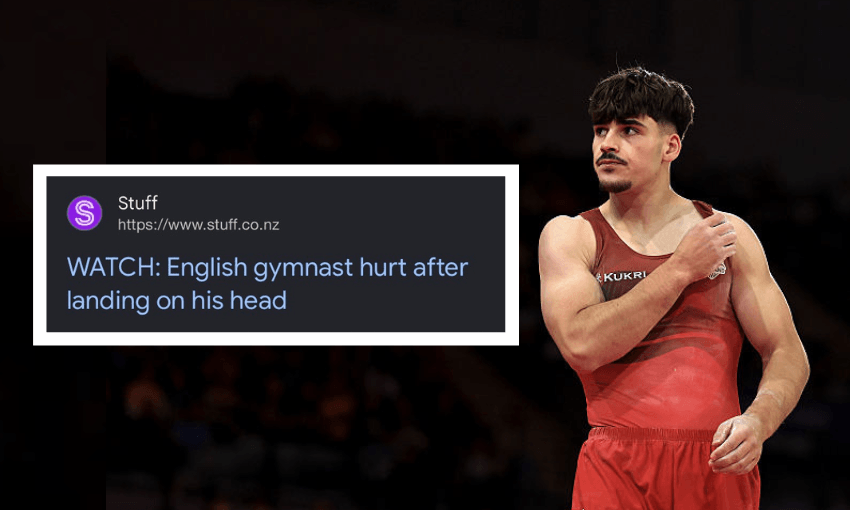
Having just watched it live on the news on Saturday, I needed reassurance that this was a blip in the otherwise reasonable world of New Zealand media. I googled “gymnast comm games fall” and the first result revealed that Stuff had also published the video, with even less context or relevance.
“WATCH: English gymnast hurt after landing on his head.”

Turns out, while this is apparently the norm for some New Zealand outlets, reputable international news outlets have chosen not to show it. In England, where Langton is from and therefore where interest in his fall would make the most sense, both the BBC and the Guardian reported on his injury. Both noted that he fell horrifically on his head. Both added updates about his health (eventually cleared of serious injury), and both used pictures of Langton at the Commonwealth Games.
Neither outlet included footage of the fall. They didn’t even include stills.
US cable sports network ESPN reported on the fall but used just a still image of officials gathered afterwards.
On YouTube, where anything goes, there are dozens of results if you search for the clip. None are from news sites, and even the ones from click-mining accounts mostly just use still images (perhaps for copyright reasons more than anything). A couple of dodgy-looking accounts have posted the full clip.
A couple of dodgy-looking accounts – and Stuff and TVNZ. That’s who opted to show a gruesome injury to their audiences for engagement. Why?
Terrible sports injuries aren’t new, and have always been the loophole in broadcast ethics when it comes to showing violence. A person laying in the aftermath of a car crash would never be shown on the news. Someone suffering a horrific accident at work wouldn’t either. But sports is fine, and New Zealand seems to be one of the last sporting nations in the world to implement ethics around showing athletes getting hurt.
When Luke Jacobson was yellow-carded for a dangerous ruck clearout in the All Blacks-Ireland match the other week, I was surprised by how many times his shoulder colliding with the Irish player’s head was shown. Not because I hadn’t seen that in rugby games before, but because I’d become accustomed to new standards overseas.
The Winter Olympics – an event where everyone is acutely aware that sports can kill you – had a strict broadcasting code last year in Italy: any serious falls must be cut away from immediately, not replayed, not speculated on by commentators, and only updated once an official status report was provided by the medical team. I didn’t see any complaints that viewers could no longer watch someone’s neck snap on repeat while waiting for the next snowboarder to start their run.
Even the NFL no longer replays serious head knocks when a player goes down. Both of these decisions were likely influenced by a desire to avoid casting the sport itself in a bad light by showing the harm it can do to its athletes, but a positive side effect has been the lessening of gratuitous footage of injuries during “family friendly” broadcasts.
New Zealand may be slow on the uptake, but evidently viewers don’t mind. At time of writing, Stuff had removed the clip from its website, but solely for copyright reasons. In fact, “it is being republished today for a further news story,” said a spokesperson, suggesting the clip was popular for the period it was live. “As a general rule, Stuff is cautious about the graphic nature of imagery published and ensures the audience is warned in advance.”
The TVNZ spokesperson said this “isn’t a story we’ve noticed strong feedback on”, while Stuff reported “no complaints were received about this video”.
Perhaps we’ve all become immune to the horrors of the world, and a measly fall on the head is nothing to complain about. But if “young athlete you’ve never heard of falls horrifically on his head” isn’t somewhere near the bottom of the New Zealand news barrel, I don’t know what is.