David Seymour on working with ‘that clown’

David Seymour on At Large (Image: The Spinoff)
Three years on, how has that relationship around the cabinet table worked?
Asked three years ago by The Spinoff whether he would work with Winston Peters in government, David Seymour said: “In this interview and so many others, the press are so keen to fixate on one hypothetical … People spend far too much time over-egging it. And I find that in itself quite sad.”
He said: “If you need to make a government work, then you make it work. But I just make the point that we’re not going to sit around the cabinet table with this clown. I mean, there’s so many reasons why you wouldn’t trust them.”
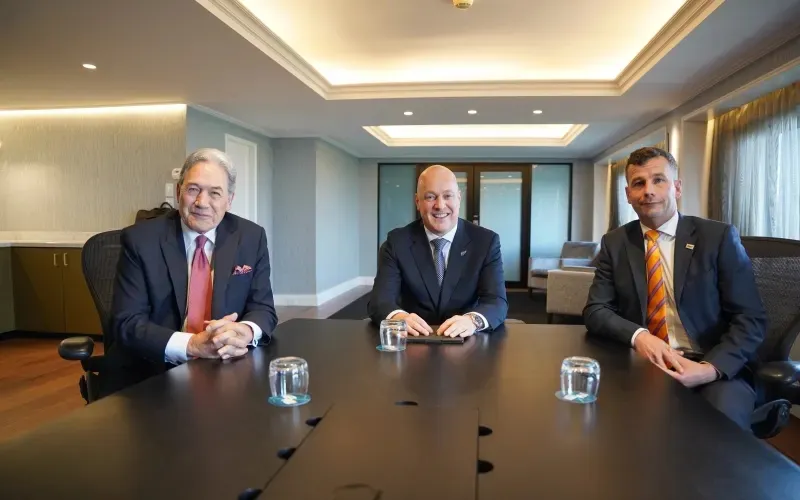
So how has it gone these last three years, sitting around the cabinet table with that clown? “We've made it work because the imperative for the country was to have a stable government,” the Act leader told The Spinoff in an interview for the podcast At Large with Toby Manhire.
“In reality, we've managed to get a huge amount done,” he said, pointing to firearms reforms, the Regulatory Standards Act, the replacement of the Resource Management Act and more. “We have managed to achieve an awful amount of the agenda that we went into government with, you know, despite or perhaps because we've been sitting around the table with Winston Peters and Chris Luxon.”
The coalition, the most complex in the history of MMP, had defied many predictions by holding together, and, when its stability had been tested, Act could hardly be accused of playing boat-rocker. “We've been pointing the finger at what the coalition's achieved rather than pointing the finger at each other."
Referring to a Spinoff tally of the civil battles within the coalition, Seymour said: “I actually went through it and said, you know, how many was Act involved in? About a third of them. But in all of those cases, we're actually being attacked by one of our partners. So we've tried to be constructive.”
It was true, he acknowledged, that those internecine flare-ups made it harder to accuse the alternative coalition of amounting to chaos. “Some of the battles that have carried on [in the coalition] have probably made it harder for us to point at the opposition.”
As far as division is concerned, what about the treaty principles bill? That legislation had absorbed great energy across the first half of the term. Its opponents stretched from Act’s own coalition partners, who pledged to vote it down after select committee hearings, to a haka that reverberated around the world, and on the streets, where tens of thousands marched across the country and to parliament.
In those terms, was the undertaking a net positive or a net negative?
“I think it was a net necessary,” said Seymour. “If people were so sure that it wasn't going to pass, why was there so much angst about it? Because people didn't want this issue to be openly debated, and now it is. People can [now] say, what does our treaty mean, and do we have to be slavishly following these court rulings that say it effectively divides New Zealand into two races for all eternity? Maybe we don't. Now I compare this with homosexual law reform, with end of life choice. In both cases, there were three bills: two that were voted down, and the third one passed. Because you have to get this discussion started, and I do believe it's essential to the future of New Zealand.”
A change to the rules in this election period has seen enrolment close a fortnight before the election. When those changes went through, Seymour said that those who didn’t enrol in time were “dropkicks”, comments Paul Goldsmith, the justice minister, called “unhelpful”.
Seymour said he stands by his dropkick characterisation. “Every one of these people who doesn't fulfil the basic legal requirement to be on the electoral roll, which the law says you have to do once you turn 18, is actually neglecting the duty to be called for jury duty and ensure that our society functions,” he said.
“And then you've got all these people who say, having neglected that duty, my right is to show up on election day, cast a vote, take other people's money through taxes by voting for some leftwing party that thinks the solution to all our problems is to take from others, and if you even require me to to register two weeks before that's somehow an affront to my democratic right – give me a break.”
Speaking last Friday, he added: “There are people in foxholes right across the Russian front in Ukraine fighting for democracy. There are people that Amnesty International will tell you about locked up by tyrannical governments. There are people who are tortured. There are people who are fighting, and and we've got people who are too lazy to do something as simple as ordering Uber Eats, go on vote.nz and get enrolled. So I'm sorry, I actually do think they're dropkicks.”
Other subjects covered in the At Large episode:
- Epsom and the overhang strategy.
- Supermarkets and Adam Smith.
- Pharmac.
- Working with Erica Stanford.

Toby Manhire
Toby Manhire is editor-at-large at The Spinoff. He loves to cast a pod, whether it's Gone By Lunchtime, At Large or Juggernaut. He is a former editor of The Spinoff and has worked as a journalist in NZ and the UK since the last millennium.


