All the dust-ups in the Luxon-led coalition so far, ranked from least to most seismic

David Seymour, Christopher Luxon, and Winston Peters in an MMP environment. Original image: Getty
Fourteen flashpoints among National, NZ First and Act that have hit the surface since 2023.
Six months out from the election, the strength of the three-legged coalition is being tested, with some openly wondering whether they might dissolve themselves before the dissolution of parliament.
Others make the point that Christopher Luxon has achieved something remarkable. A fully fledged three-party MMP coalition has never been attempted before, and the prime minister has achieved wonders in holding the unconventional political marriage together. Have there been fights? Of course. Has Luxon had to swallow a dead rat or two? Occupational hazard.
But with the election hurtling towards us, the glue is being tested, in large part by a New Zealand First Party enjoying buoyant polls and with the deputy prime minister baton long since passed on by Winston Peters to David Seymour.
Casting back across the two-and-a-half years so far gone, these are the differences that have lurched into public view, ranked from the least to the most earth-shaking.
Further nominations or complaints about the order are welcome in the comments.
14) ‘He hasn’t thought this through’ – May 2026
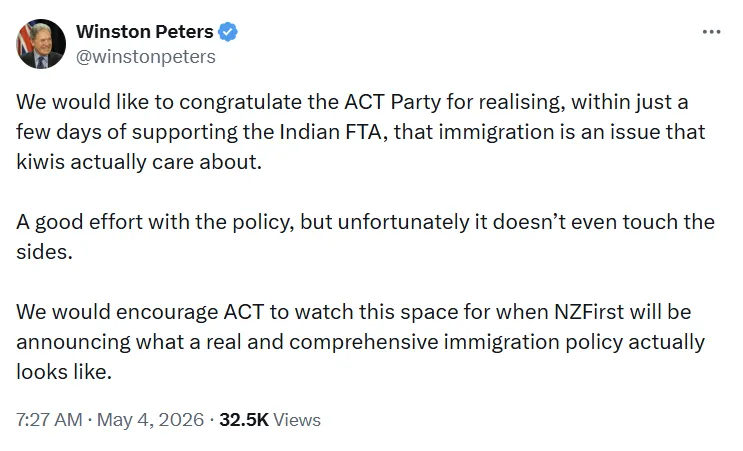
After a fortnight during which the intra-coalition air was hoovered up by NZ First and National, Act sought some ventilation an old-fashioned way, by releasing a bunch of policies. Including immigration.
“He hasn’t thought this through very well,” said immigration minister Erica Stanford, following up with a shake of the head. “That’s a little bit typical sometimes.” It looked to her as if Act might just be looking to pick up a bit of the NZ First vote on the subject, what with the flickers of “kneejerk” and “populist” thinking.
Seymour responded with a sigh of his own. “Rather than belittling Act or writing off genuine voter concerns, Erica ought to engage constructively and heed those concerns.”
Peters, needless to say, was hardly about to sit this one out …
And yet whatever the hints of animus, this is the stuff of pre-election party policy, rather than anything resembling a coalition crack. Not a big deal. Carry on.
13) Cut lunches – March 2025
Speaking of Stanford and Seymour, in their roles as minister and associate minister for education, things got a bit tense for a moment there over the school lunch programme. At first Stanford refused to say whether she backed his handling of the scheme; then they seemed to be avoiding holding a meeting together to talk it through.
Fortunately Luxon came to the rescue, distracting attention from any inter-minister tension by banging on about Marmite sandwiches.
12) Dashboard crap – December 2024
Among those adjusting to a ninth floor seemingly engorged with management consultant literature was deputy PM Peters. “I don’t have this sort of dashboard crap that I see other people perform on and a 50-point plan, or a 100-point plan, or a quarter-year plan,” he said. That might seem innocuous but this is the beating heart of the prime minister’s philosophy we’re talking about.
11) ‘He’s struggling’ – November 2024
In interviews at the end of the first full year of the term, Peters criticised National’s signature tax cut policy, saying “we couldn’t afford them”, and adding that Luxon was “struggling”, before qualifying that commentary: “Now, when I say struggling – not in a bad way. But when you’re so new to politics, you’re occupying the top job, it is foreseeable to take a little while to bed yourself in and that’s where he is.”
10) The loyal We – October 2025
When Luxon tweeted proudly about sealing a deal at a southeast Asian summit, the foreign minister helpfully posted his own annotation, offering an alternative pronoun to the singular first person, writing simply, “We …”
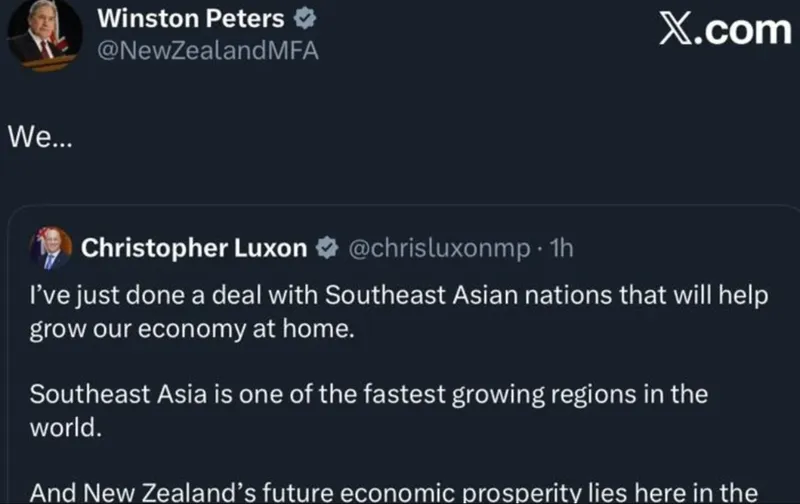
It’s a small thing, perhaps, but a clue to the sensitivity over foreign relations territory, which is, as we’ll see, something of a theme.
9) ‘Simplistic and divisive’ – 2024
The advancement of the Treaty Principles Bill to select committee was in the coalition agreement. It was clear from early on that it would not go further but it nevertheless created coalition tension, albeit nothing compared with the public fury on the streets.
Luxon called Act’s legislation “simplistic” and, numerously, “unhelpful” and “divisive”.
8) ‘Don’t you understand diplomacy?’ – July 2025
Seymour withdrew a letter decrying criticisms by a UN observer of his party’s Regulatory Standards Bill. He did so in order that Peters could formally respond as foreign minister on behalf of the government, but there was no resile from the sentiments. The Act leader was incensed by the suggestion from the rapporteur for the rights of indigenous peoples that the bill was part of “a persistent erosion of the rights of the Māori Indigenous Peoples… through regressive legislations”. Seymour was “deeply aggrieved by your audacity in presuming to speak on my behalf and that of my fellow Māori” and called the concerns raised “misleading and offensive”.
Peters’ response would make essentially the same points, insisted Seymour. To which the foreign minister replied: “That’s not true. Why would he say that? … We don’t do megaphone diplomacy in this business. Don’t you understand diplomacy? You don’t speak to other countries via the media.”
7) ‘He’s getting ready to go with Labour’ – November 2025
The second act of NZ First versus Act on the Regulatory Standards Bill came four months later. New Zealand First, in keeping with coalition commitments, voted in support of the legislation. A couple of days later, Peters announced that his party would campaign to repeal the law. Seymour’s assessment? “It sounds like he’s getting ready to go with Labour again.”
6) On Netanyahu losing the plot – August 2025
The Act and New Zealand First leaders both distanced themselves from comments made by the prime minister about Benjamin Netanyahu. By launching “utterly unacceptable” attacks on Gaza, said Luxon, the Israeli prime minister had “lost the plot”.
It would be “better just to keep your thoughts to yourself”, said Seymour.
Peters said it was “not language I use” and “I am the most experienced guy you’ve met on this matter”. When asked if Luxon’s remarks were the result of inexperience, Peters said: “Next question.”
5) Differences over Trump’s war, part one – March 2026
When Luxon made a mess of his responses to questions about New Zealand’s stance on the Iran war, Winston Peters, at the time travelling overseas, was asked by a Three News reporter for his thoughts.
And those thoughts were: “Why didn’t you call the foreign affairs minister, then no one would have misspoken, would they? Why didn’t you and your journalistic colleagues call the foreign affairs minister, the person who’s in charge of these issues, and save all the agony of misunderstanding?”
This was small beer at the time, a passing glance, but in retrospect it portended a big beer, a head-on thump. We’ll get to that.
4) ‘Shame on you, Shane Jones’ – April 2026
The coalition agreement includes provision to agree to disagree and for the most part it would be silly to suggest that category could constitute a coalition flare-up. On the contrary, it’s grown-up mode. Until it isn’t.
Such as in the way that the NZ First opposition to the India free-trade agreement played out. Shane Jones, in a rhetorical flourish more jfc than JFK, warned of a “butter chicken tsunami”.
Luxon, who had previously rolled his eyes at a series of questionable comments from Jones and co, said such remarks were “alarmist” and “unhelpful”. National MP for Mt Roskill Carlos Cheung said the word he’d use is “racist”. In parliamentary debate, Nicola Willis said: “Shame on you, Shane Jones … That kind of race-based rhetoric has no place in New Zealand politics.”
3) Trade war hysteria – April 2025
A little over a year ago, just before he surrendered his deputy PM Stetson, Peters took exception to the prime minister’s public response to the Donald Trump tariff spray.
Luxon had condemned an emerging “trade war” and declared that he would work to bolster the rules-based order and New Zealand’s interests by getting a bunch of like-minded world leaders on the blower to see how they might work together.
Did Peters like that? He did not. Such talk was “premature”, he said. “Our job is to be ultra-careful, ultra-forward-thinking in the interests of – guess what! – the New Zealand economy. That’s what matters, not our egos. So my advice to politicians is: tone down, wait till you see and know what’s going on.”
The prime minister, said Peters, “didn’t check it out when he made that speech and made those phone calls. And so I hope that he’ll get my message and he’ll call me next time.”
There was more to come. Peters chided those who used words like “trade war” and who expounded “the imperative to form alliances in order to oppose the actions of one country”. Such language “has at times come across as hysterical and short-sighted”.
Nothing to see here, insisted Luxon. They were aligned and it was all a “media beat-up”.
2) ‘An ego trip’ – April 2026
Just when Luxon was enjoying a moment of relief after a ghastly few days ended with him drawing a line under whispers about his leadership by winning a caucus confidence vote that he’d called himself, Peters was on the line, telling media that the National leader had made a mistake. He should have runs his caucus plan past his coalition partners. And if he had asked, Peters would have told him it was a bad idea.
“It promotes doubt, it promotes uncertainty, it promotes division,” said Peters. It was all an “ego trip” when “voters want stability”. He said: “This is unprecedented in New Zealand politics. It invites another [confidence vote] and you know when the next one will come out? Not long after the next polls come out.”
All hell broke loose, with Willis striking brutally back, telling voters: beware Peters, for he could install Labour, he’s done it before. Luxon chimed in with, “They’re the guys that claim to be socially conservative and then put Jacinda Ardern into power.”
It all got so unseemly that at one point Jones was distracted from the soaring oratory over Indian cuisine and ended up apologising to Willis for making a slight about her weight.
1) Differences over Trump’s war, part two, ‘crisis talks’ edition – April 2026
It got worse. A week ago today, a bombshell official information release came from the office of the foreign minister to the Herald. Messages revealed that Luxon had sought in early March, as he struggled to articulate New Zealand’s position on the Iran conflict (see Differences over Trump’s war, part one, above) to shift to a stance of supporting the action. Peters’ advisors had conveyed, in a perturbed tone, that this was a very bad idea.
Luxon said the messages “mischaracterised” things, but he was understandably inflamed, and “crisis talks” were held with the foreign minister. Peters, according to the PM’s office, acknowledged he’d messed up by issuing the messages without, you know, running it past them.
Peters’ office told the Herald he’d regarded Luxon’s “suggestion to be an imprudent course of action, which would run counter to New Zealand’s national interests”, adding: “Experience matters in foreign policy.”
A spokesperson for Luxon said the decision to release the emails “clearly put politics ahead of the national interest”. And: “The PM would expect Mr Peters to show better judgement after more than 40 years in politics.”
When Peters said he had been mistaken in not going through the right channels, and then seemed to say he wasn’t mistaken before again saying he was mistaken, Willis chipped in by returning to an earlier theme. He seemed “very, very confused”, she reflected. “He’s said that he won’t support a Labour-Green-Te-Pāti-Māori government, but what if he gets confused?”
Taken together, the substance of the differences over the war, the means by which they were released, and the messages both offices provided to media, this was a serious escalation in the clash of the two men.
Mercifully, Luxon had a pre-planned trip to Singapore so he couldn’t stick around. Still, this was a deeper breach than any before. How it lands with voters is yet to be seen. But the wound will not easily heal.

Toby Manhire
Toby Manhire is editor-at-large at The Spinoff. He loves to cast a pod, whether it's Gone By Lunchtime, At Large or Juggernaut. He is a former editor of The Spinoff and has worked as a journalist in NZ and the UK since the last millennium.


