Rates rise opponents shot down in brutal Q&A at Auckland Council

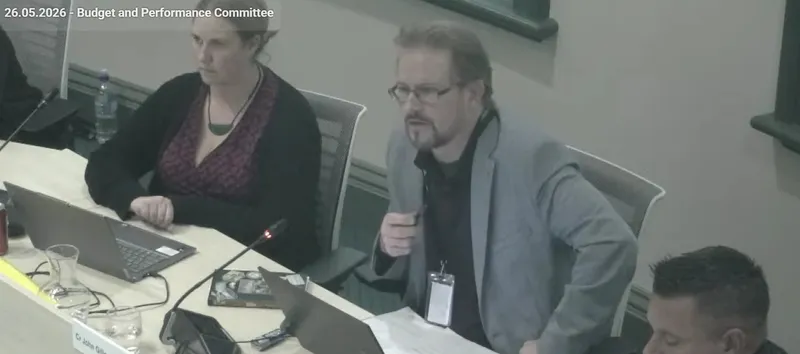
Clockwise from centre, John Gillon, Alf Filipaina, Sarah Paterson-Hamlin, Richard Hills, Lotu Fuli, Shane Henderson and Julie Fairey captured on the livestream of the council meeting
After the interrogation was over, one councillor was compelled to give his beleaguered North Shore counterpart a pick-me-up.
Desley Simpson looked a bit queasy. Auckland’s deputy mayor had just been asked to second mayor Wayne Brown’s plan to raise the city’s rates by 7.9% and she wasn’t keen to look in love with the idea. She’d spent the lead-up to the council’s budget day on Tuesday fretting about the effect of rates rise on Aucklanders, telling colleagues this was the most concerned she’d been over a budget. Privately, she was allegedly a little less cautious with her wording. Brown arrived at his impromptu NZ Music Month gig the week prior complaining Simpson had told him she was worried about Ōrākei constituents having to pull their kids out of private school. He added that Simpson had been told that if she voted against the budget, she’d no longer be deputy mayor.
So here she was, kindly being invited by budget committee chair Greg Sayers to sign her name to Brown’s proposal, which conveniently also meant Sayers wouldn’t have to do so himself. Simpson leaned back in her chair and, following a brief bout of nervous laughter, said “yes”.
She needn’t have worried. The next six hours were a parade of humiliations for the budget’s opponents. They were led by North Shore councillor John Gillon, who put forward an amendment he claimed would lower rates rises from 7.9% to 5.9%. He started off with a bang, delivering a speech bemoaning the effect of Brown’s budget on homeowners and renters, while arguing it doesn’t deliver for his area. Brown has sold his plan as a 0% rates rise “plus a train set”, arguing almost the entire 7.9% rise was down to the cost of running the soon-to-open City Rail Link. “While I acknowledge that the CRL will be well-utilised and will be of benefit to parts of Auckland, for many of my constituents on the North Shore, it is not relevant,” Gillon said.
He went on to propose 11 potential cuts and savings to lower the proposed rates. But his speech was followed by a question-and-answer session that several of his more progressive colleagues used as an opportunity to subject his proposals to a thorough vivisection. By the time it was over, many of the suggestions were little more than gooey remains on the council table.
The backbone of Gillon’s plan was a move to delay the council’s efforts to fully fund its depreciation. It would potentially save millions of dollars. But Gillon’s North Shore colleague Richard Hills noted the council’s Moody’s credit rating was already on watch, partly thanks to the government’s rates capping announcement. Couldn’t Gillon’s proposal trigger a downgrade? “That could put our credit rating at risk,” answered the council’s finance chief Ross Tucker.
The general thrust was that in saving some money now, the council could end up costing ratepayers more for years to come. Gillon’s other proposals didn’t fare a lot better. He’d asked for advice on cancelling all regional and local grants for a year, potentially saving the council around $7 million. Whau councillor Sarah Paterson-Hamlin noted that those grants had gone to a host of worthy causes, including the Santa parade. Hills listed other events that relied on the council’s major events funding, including NZ Fashion Week, the Auckland Marathon, Pasifika, Auckland Writers Festival and the ASB Classic. “Do you understand that deferring the $7 million, that would mean that those events don’t happen?” he asked. “I assume that information will be included in the chief executive’s response to this amendment if it passes,” Gillon replied.
Waitākere’s Shane Henderson noted that Gillon had proposed setting up an independent taskforce to look into potential extra cost savings. He wondered whether that would double up on work already being done by the council’s value for money committee, which is led by the deputy mayor. Wouldn’t these new committee members also expect to be paid, potentially costing ratepayers? “I’m eagerly anticipating the chief executive’s advice on this,” Gillon said.
The Q&A continued for half-an-hour in that fashion, with the answer to nearly every question put to Gillon being deferred to a future report from council chief executive Phil Wilson.
Albert-Eden-Puketāpapa councillor Julie Fairey was withering over the proposed amendment’s lack of detail, implying the council would be essentially failing in its legal duty to pass a budget. “This would be saying ‘we’re passing a budget today but we’re not passing all of the budget today’,” she said.
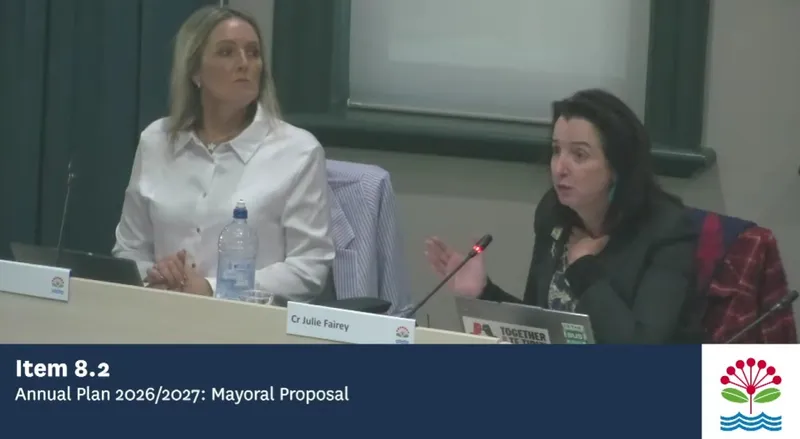
The combined effect of the grilling was to make Gillon’s proposals look threadbare, poorly evidenced or redundant. Toward the end of the session, Manukau ward councillor Lotu Fuli asked how much money actually carrying out the cuts suggested would save the average ratepayer. The answer, as it turns out, was just over $80 a year or around $1.70 per week.
It was sufficiently brutal that in the debate that followed the Q&A, Manurewa-Papakura ward councillor Daniel Newman felt compelled to give his North Shore compatriot a pick-me-up. He accused his colleagues of carrying out an interrogation straight out of “Perry Mason”, which a Spinoff internet search has revealed was a 1957 American legal drama. “I thought as the interrogation continued, you did very well,” he told Gillon. “I think you got stronger and stronger.”
Not strong enough. By the time the debate rolled around, Simpson looked a lot less uncertain. She delivered a robust defence of the 7.9% rates increase, saying that while she wanted to see lower rates, she didn’t think what Gillon and his supporters were proposing was feasible. She derided deferring depreciation, while saying other ideas – like cutting travel and catering budgets and reducing staff numbers – were already under way. “I like some of your suggestions, I really do,” she said. “In fact, I like them so much we’ve already started looking at them.”
After she spoke, the budget passed 14 votes to seven. It was a tough sell during a cost of living crisis. Backing Brown’s budget wasn’t easy for a lot of councillors, least of all right-leaning ones like Simpson and Sayers. But it sure got a lot easier after seeing the quality of the alternative.

Hayden Donnell
Hayden Donnell is a senior writer for The Spinoff. He previously worked at RNZ, TVNZ and the New Zealand Herald, alongside other media companies that have since closed down or been renamed. His primary passions are local politics and the Big Fresh animatronic fruit and veggies.


