Eight parties vie for students’ votes in raucous Dunedin election debate

The OUSA political leaders debate (Photo and composite image: The Spinoff)
Featuring an orange man, curtains and the politest protest in history.
As an orange guy roamed the aisle of the Union Hall on Tuesday afternoon and Justin Timberlake’s ‘Can’t Stop The Feeling’ played over the speakers, there was standing room only for the Otago University Students’ Association (OUSA) political party leaders debate. You didn’t have to be zipped into an orange onesie with your eyes drawn on in black vivid to know that this was an important event. Today’s university students face a challenging job market and are skipping meals and classes to pay bills, and Dunedin’s students turned up in their hundreds to hear what candidates from across the political spectrum could offer them in the upcoming election.
OUSA had invited all political party leaders to attend, but only two made it – the Green Party’s Chlӧe Swarbrick and Victor Billot from the Alliance. Six other parties sent representatives (including sitting MPs Penny Simmonds, Shanan Halbert, Andy Foster and Parmjeet Parmar, the tertiary education spokespeople for National, Labour, NZ First and Act respectively), and OUSA rep and silly hat fan Flynn Nisbet welcomed all eight candidates, telling the crowd the upcoming election was “a big one”. After some quick warm-up questions from debate hosts Maddy Barnes and Sam Soppet, it was straight into a series of questions about the big issues concerning students, like rental affordability, tertiary funding, changes to voting enrolment and climate change.
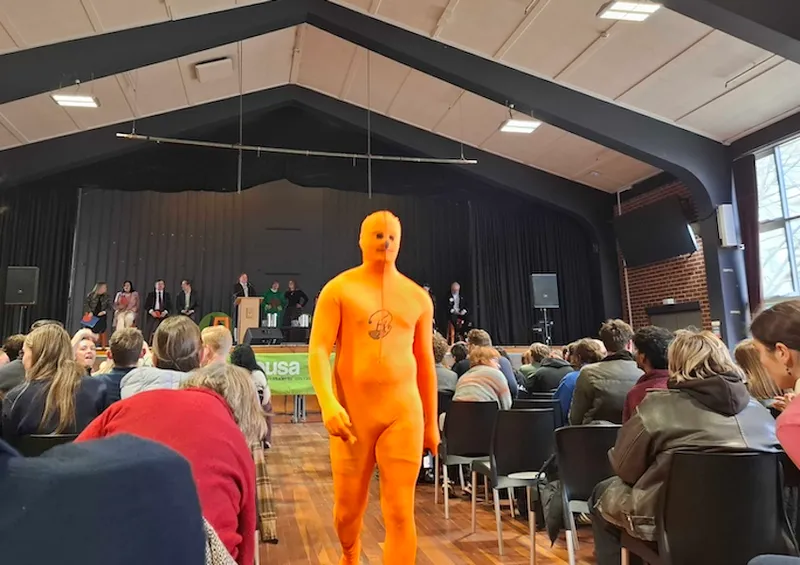
The first question about housing kicked off two hours of verbal jostling, and suggested some candidates could read the room better than others. Swarbrick (who received the biggest round of applause when she was introduced) began by saying that housing was a human right, while Foster touched on a topic that everyone knows students won’t shut up about, which is the importance of curtains. National MP for Invercargill Penny Simmonds scored the first laugh of the afternoon when she reminded students of the great news that rental affordability had improved by 7% since National got into government.
“Has your rent actually gone down?” Halbert asked the crowd, who were probably still thinking about curtains. “NO!” they shouted in unison.
Soppet and Barnes then gave the candidates a chance to introduce themselves and explain why they deserved the student vote. Billot stood and urged people to vote for those who don’t have a voice. Swarbrick said the Greens care about students, while Te Pāti Māori Te Tai Tonga candidate Lisa Marie Murch promised te tiriti would be at the heart of every policy. Halbert mentioned Labour’s policies of public transport caps and free doctor visits, Daniel Eb from The Opportunity Party promised they act as a circuit breaker to the broken cycle of politics (and switched seats so he was more in the centre of the stage), while Foster said education needs to improve so New Zealand can become a prosperous country.
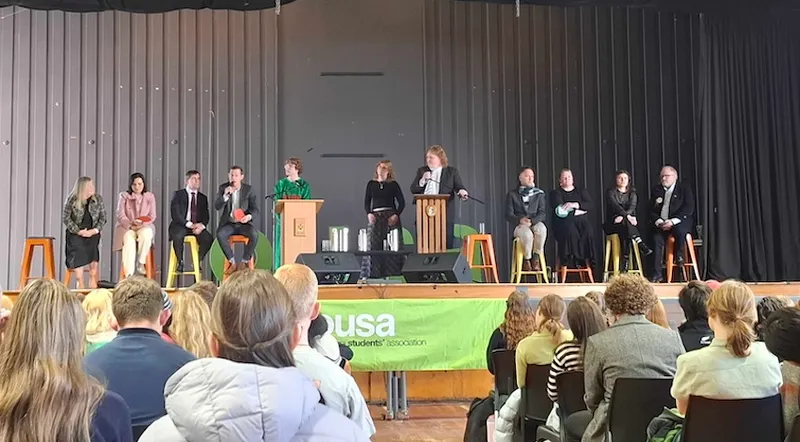
Parmar said education should add value. “Education should be about equal treatment. Taxpayers’ money should follow merit, need, circumstances and not ancestry,” she said, earning a round of “boos” from the crowd.
As Simmonds began to speak, a protester wearing a black “climate emergency” T-shirt silently climbed the stairs to the stage and stood in front of her. One by one, two more protesters followed, while Simmonds continued to speak about her government cutting $50 billion in wasteful spending. After a few seconds, host Soppet asked anyone who wasn’t participating in the debate to please leave the stage. “Thank you so much for coming, guys,” he added. The handful of protesters obediently turned and walked away, thus ending the shortest and politest protest in the history of tertiary education.
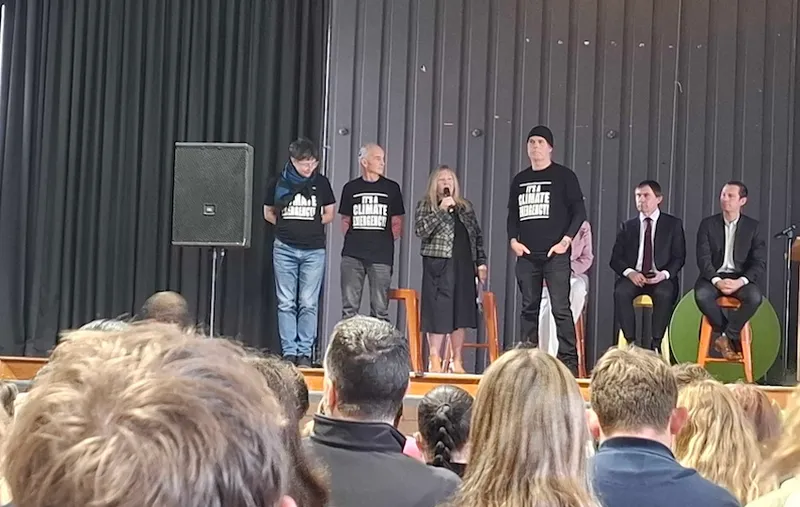
“They didn’t look like students to me,” Simmonds said, before the questions and arguing continued. Parmar accused Halbert of spreading dangerous misinformation when he said the government was passing laws under urgency to remove the voices of New Zealanders on key issues. “She’s a cooker,” he responded. On the topic of voluntary student union membership, Parmar said organisations needed to prove their worth to attract membership, but Swarbrick didn’t buy it. “We are New Zealanders, we work together to ensure everybody has their basic needs met,” she said, garnering a hearty round of applause.
The heckling from the audience grew as the event continued. On the topic of increasing Māori participation in tertiary education, Halbert and Foster talked over each other repeatedly, Foster’s tone growing higher as the duo of dissenting voices went on. A question to Simmonds about whether the government should regulate AI brought fierce rebuttals from Swarbrick and yelling from the crowd. The government already had plenty of existing strategies around AI in place, the minister for science, innovation and technology believed. “If you want to go back to the dark ages and have no TV and no streaming, then you’re welcome to it. I want to be part of a modern society.”
Simmons didn’t elaborate on whether there would be curtains in this modern society, so it was just as well that the event finished with audience questions. A student wearing a green onesie with DEBT MONSTER written across the chest took the microphone around the room, and the students stood and politely introduced themselves, asking candidates whether they would renationalise key industries or whether they used generative AI to do their job. The event ended with a round of applause for the candidate who the students reckoned had won the debate, with Billot earning huge cheers for the way he sprang off his stool for each question. Victory was his, curtains for the rest.

Tara Ward
Tara Ward has written about television and culture for The Spinoff for several years. She lives in Ōtepoti Dunedin, where she tries to avoid walking up hills.


