Chinese space institute tried to set up monitoring station in New Zealand

A new report warns of a ‘voracious appetite’ for NZ information, especially from China.
This article was first published on Anna Fifield’s Substack, Between Giants, and is republished with permission.
A Chinese space research institute tried to trick a New Zealand company into letting it install satellite monitoring technology that could be used to collect militarily-useful information, according to New Zealand’s spy service.
Purple Mountain Observatory, a research institution within the Chinese Communist Party that is particularly interested in Antarctica, was last year found trying to install ground-based space infrastructure in New Zealand.
They “worked with a local company that was likely unaware of the equipment’s capability to collect intelligence of military value and would have no idea who was receiving the data,” the New Zealand Security Intelligence Service says in its 2026 Security Threat Environment Report.
The report, published Thursday, outlines China’s “voracious appetite” for information it can use to gain an advantage either in New Zealand or against its partners. The efforts to get information about critical assets “cannot be described as benign,” it said.
Over the past four years, the spy agency has steadily stepped up its warnings about Chinese intelligence activity targeting New Zealand, including efforts to acquire information for political or corporate use, gain influence and repress Chinese communities in New Zealand.
In fact, New Zealand has called out China by name in its intelligence warnings so often that officials joke they’re tougher on Beijing than Australia is. The Australian Security Intelligence Organisation does not name China explicitly in his equivalent threat assessments.
New Zealand’s latest report was clear about Beijing’s growing interest in accessing information here: “There are several states that conduct espionage against New Zealand, but the People’s Republic of China (PRC) is the only country we have detected doing it at scale,” it says.
The New Zealand spy agency was able to disrupt Purple Mountain Observatory’s attempts to install ground-based space infrastructure in New Zealand.
But it was not the first time Purple Mountain had attempted to install its own ground-based space infrastructure in New Zealand and “is unlikely to be the last,” it said in its report.
“A foreign state illicitly exploiting our space industry in this way undermines New Zealand’s sovereignty, and the information gathered has the potential to be used against our interests, such as covertly informing another country’s military activity,” it concluded.
What is ground-based space infrastructure?
Ground-based space infrastructure, or GBSI, enables tracking and observation of things in space, and can include satellite dishes and radar systems, telemetry and other space surveillance systems, telescopes and sensors, and – increasingly – laser communications.
New Zealand has a booming space industry, incorporating companies like RocketLab, Dawn Aeropsace and Kea Aeropsace.
But it also has a growing number of monitoring facilities.
For example, SpaceOps, owned by the Southland Regional Development Agency, offers to host antennae at its Awarua Satellite Ground Station, based between Invercargill and Bluff.
The Awarua site is considered New Zealand’s most strategically significant commercial GBSI facility because it is one of the southernmost commercial ground stations in the Pacific. Its limited electromagnetic interference and fibre connectivity make it particularly useful for polar and other low earth orbit satellites, according to its website.
Awarua “is an important location in the world that is great for supporting [low earth orbit] satellites, especially spacecraft in polar orbits,” SpaceOps says.
SpaceOps has international connections: It was built with European and French space agencies in 2004, but became a standalone company in 2021. This year, Awarua has been installing two 11-metre antennas for a new satellite positioning system, with Lockheed Martin Australia. A control centre is being established in Invercargill.
Concerns about foreign military-linked interest in New Zealand’s emerging space industry, the government last year hurriedly updated the Outer Space and High Altitude Activities Act, requiring GBSI operators to get authorisation to carry out regulated activities. They are also required to include annual reporting verifying that protective security and due diligence arrangements remain up to date.
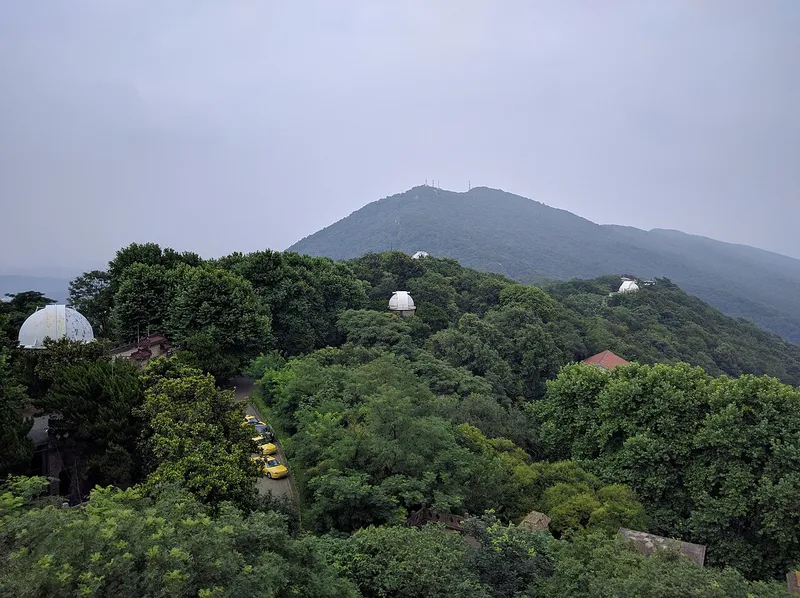
What is Purple Mountain Observatory?
Purple Mountain Observatory is part of the Chinese Academy of Sciences, a state research institution within the Chinese Communist Party structures. It describes itself as focusing on astronomical research and “strategic high technology,” and working toward “national strategic needs”.
A recent notice about a recruitment drive said that the Purple Mountain Observatory will “consolidate its leading position in space astronomy and Antarctic astronomy; address major national strategic needs, break through key technologies in the fields of aerospace security.”
Purple Mountain Observatory planning documents explicitly state that it intends to build a Chinese Antarctic Observatory.
It is located atop Purple Mountain in Jiangsu Province and is known as the “cradle of modern Chinese astronomy.”
As an institution affiliated with the ruling Chinese Communist Party, its organisation structure includes a “Party Committee Office” to carry out “ideological and political work, and the development of socialist civilization.”
“It takes the lead in coordinating responses to public opinion, promoting Party conduct and clean governance, united front work, and work involving mass organisations,” its website says.
The United Front Work Department is the unit charged with managing the CCP’s external influence operations.
In June, the observatory celebrated the 105th anniversary of the founding of the Communist Party of China. Local Communist Party Secretary and Deputy Director Mao Ruiqing “led five new Party members in a solemn oath before the Party flag, while veteran Party members renewed their oath of joining the Party,” the observatory reported on its website.
“Guided by their oaths, the Party members pledged to always remember their identity as Party members and forever maintain the political integrity of Communists,” it said.
While links between the observatory and China’s military are not explicit, the observatory reported a research visit to the National University of Defense Technology, a Chinese military university associated with the People’s Liberation Army, in May this year “for a special exchange on scientific research and talent cultivation.”
The observatory has multiple research units devoted to technology that is “dual use,” or can be used for both civilian and military applications.

Anna Fifield
Anna Fifield is the former Asia-Pacific editor and Beijing bureau chief of the Washington Post. She is bow the editor of The Spinoff’s World Bulletin newsletter and writes on New Zealand’s place in the world on her Substack, Between Giants.


