What will voters take away from Luxon’s chaotic two-day caucus crisis?

Christopher Luxon is still leader going into the election (Photo: Getty Images. Image design: The Spinoff)
The prime minister leaves an urgent caucus meeting with his leadership intact, and his political mojo torn.
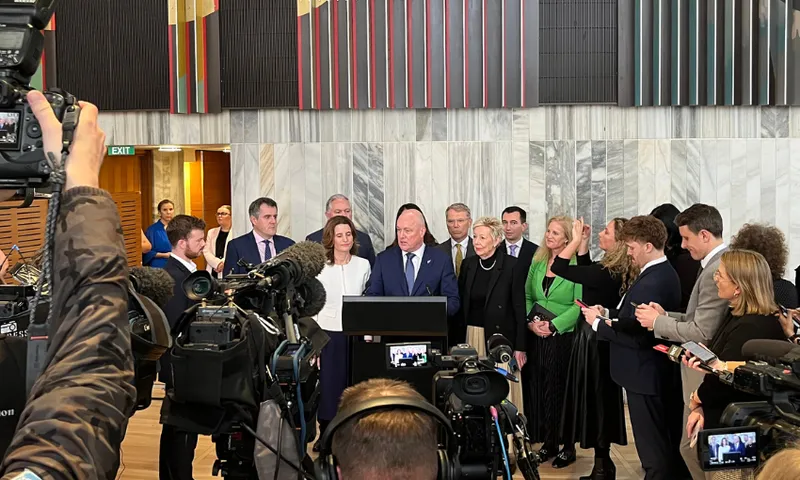
In 76 seconds, Christopher Luxon drew a two-day political meltdown to a close. The outcome of the National Party’s urgent caucus vote on the prime minister’s seemingly unstable leadership was straightforward: Luxon gets to remain as the top dog. What’s not so straightforward is the political mess it leaves for the electorate.
Appearing in parliament’s banquet hall alongside a squad of senior ministers, Luxon confirmed a vote was held but he had emerged with the “full support of our caucus”. The leader described his party as “united”, but walked off before his ministers could be asked a single question. Suffice to say, 76 seconds really isn’t enough time to get that message of unity across. Luxon may have won the confidence of his caucus, but that doesn’t mean he’s won the confidence of the public.
Despite previously saying he’d rather let these soap operas play out in the media than in the workplace, Luxon went for the nuclear option this time around: announcing an urgent caucus meeting on social media. It was all relatively fast-moving from there – MPs were stopped at airports to confirm they supported their leaders, and a ticket of Erica Stanford as leader, Mark Mitchell as deputy and Chris Bishop as finance minister was reportedly taking shape.
That, of course, never eventuated. And rather than a united party, the image of National that the electorate will most likely have after today is a party at war with itself. Perhaps the rosiest thing you could take away from this palaver is that Luxon is a leader who sticks it out until the bitter end. But the worst case is that the public will be wondering why they should support someone who has had to double-check whether his own caucus does.
It’s no secret that Luxon is an unpopular leader with the public and, at times, his own caucus. But the rift with the latter appears much more dramatic than it did late last year, when the first coup rumours emerged, and in April this year, when the rumours ramped up again and Luxon called a confidence vote in himself. In April at least, Luxon was able to undermine his agitators by saying they were simply a few moaning MPs. This time around, he hasn’t had the same grip on the narrative.
Let’s imagine an alternate universe in which Stanford had taken the leadership. The party might have been able to hope its Jacindamania moment had arrived – a young(ish), female challenger rising to replace a man whose missteps had become too much of a distraction. They probably wouldn’t have been able to recreate that Ardern’s 2017 momentum, but they could have landed somewhere close: a fresh face after weeks of government gaffes.
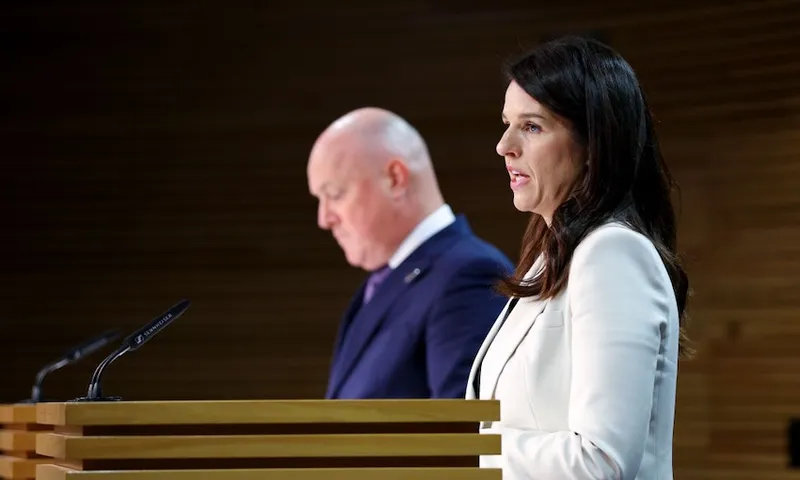
Still, Stanford stepping in would have come with its own political risks. A switch at the top could have made the party look more unstable. We’ll simply never know.
This tension happening at the party’s top level is also clearly also being felt lower down the rungs. Despite describing Stanford as a “friend”, minister for women Nicola Grigg told reporters that her colleague was “not a prime minister”. Stanford has been touted as a potential frontrunner to replace Luxon, but clearly didn’t have the numbers to pull it off. Neither did Bishop, in an alleged would-be coup late last year (Bishop has always denied he was going for the leadership).
The best-case scenario here for the National Party is that Luxon’s promise of a united party convinces voters. Current polling has the coalition ahead – if on uninspiring numbers – so if it truly is smooth sailing for National from here, they could still form a government post-election. Who knows? A second term and a second chance could bring a different Luxon, one who can prove he has learned the hard lessons of MMP and party politics.
The idea that Luxon is evolving as a leader will be helped by his decision to sack his defence minister, Chris Penk. A statement from the prime minister’s office confirmed Penk was the one who had launched the challenge, making his role in cabinet “untenable”. In a way, that’s the most prime ministerial thing Luxon has done of late. He’s been widely criticised recently for failing to keep coalition partner NZ First in check, and for steering clear of punishing any MPs who sparked April’s confidence vote. By stripping Penk of his portfolios, Luxon looks like he’s taking control. He’s also – finally! –sending a message that he’s not the kind of leader you want to fuck with.

If voters rewind back past the last few dramatic days, they will remember that it was only on Saturday that National announced its list ranking. It’s not unreasonable to believe that part of this week’s agitation has been down to backbenchers who might fancy they deserved higher places on the list than they got. If that’s the case, the threats to Luxon’s leadership seem less credible, though not less embarrassing.
So, all and all, the National Party has created a mess, but that doesn’t mean the opposition should assume they’ve been handed the election on a silver platter. Some National voters turned off by the disunity, may take their votes to coalition partners NZ First or Act, rather than over to the left bloc. Plus, there’s still 87 days until the election, which means there’s ample time for further cock-ups on all sides.

Lyric Waiwiri-Smith
Lyric is an award-nominated politics reporter at The Spinoff. She covers parliament from the press gallery, pens the weekly column One MP, One Pint and is endlessly curious about what makes our decision-makers tick. Off the clock, Lyric loves a live gig, a cold brew, and being a Wellingtonian (on a good day).


