The best and worst voting booths for each party, plus other data details from Election 2026

All the juiciest data from Election 2026.
The right won votes in sports clubs, the left won in libraries, and shopping malls swung more than any other type of polling place.
A total of 2,418,565 party votes have been counted from 2,670 voting places across New Zealand, but the final outcome of Election 2026 is still too close to call. There are around 400,000 special votes outstanding and the final vote count won't be confirmed until November 27. So, in the meantime, The Spinoff has been picking over the Electoral Commission's results with a fine-tooth comb in a desperate attempt to find some small certainty in an increasingly unknowable world.
An important caveat: these figures are based on the preliminary vote count which may include errors and does not include special votes.
The best and worst voting places for each party
Labour
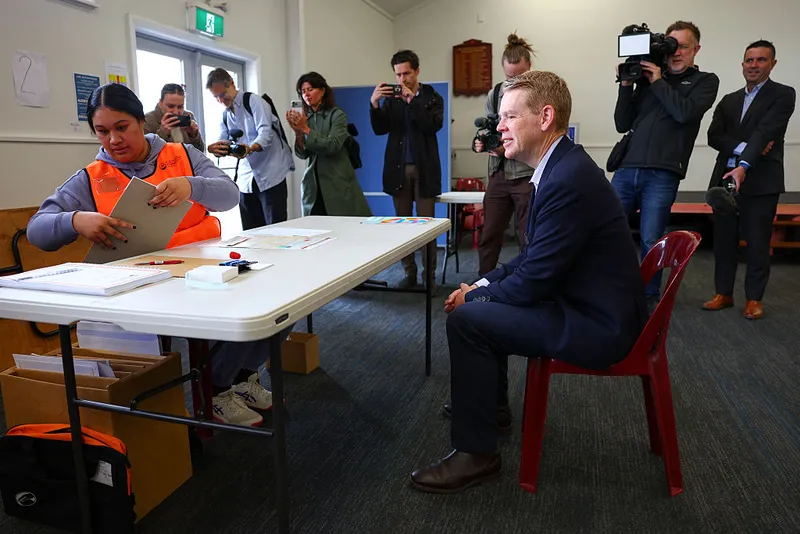
Labour’s strongest polling place was Queensgate Shopping Centre (Hutt South) where it picked up 6,792 party votes, or 40.4% of all votes cast at the booth. The party’s best performance by percentage among standard polling places was St Therese Catholic Parish Hall (Māngere), where it received 77.5% of 1,115 votes. Its worst booth among those with at least 300 party votes cast was Riversdale School (Southland), with 12 out of 317 votes (3.8%). Labour won or tied 1,120 booths nationwide.
National
National’s largest source of party votes was Westfield Mall, Albany (East Coast Bays), where it received 8,093 votes, or 48.1% of the booth's total. Its strongest polling place by percentage was Poolburn School (Waitaki) with 71.4% of 78 votes cast. Its worst was the Cook Islands Community Centre in Cannons Creek (Kenepuru), where it received 16 out of 1,175 votes(1.4%). National won or tied the party vote at 1,437 booths nationwide.
Green
The Greens dominated the party vote at the newly opened Te Matapihi ki te Ao Nui Central Library (Wellington North), receiving 5,371 votes, or 40.2% of all votes cast at the booth. The party’s best booth by percentage was Te Kura o Waima (Northland/Te Tai Tokerau) where it won 53.3% of the 30 votes cast. This was narrowly followed by the much larger booth at Victoria University, Kelburn, where the party won 52.5% of 3,175 total votes. The Greens' worst booth was a pop-up voting station on the Hibiscus Coast, where the party received just four out of 458 votes (0.9%). The Green Party won or tied the party vote at 86 booths nationwide.
Act
Act’s largest booth was Westfield Mall, Albany (East Coast Bays), where it received 1,984 party votes, or 11.8% of all votes cast. Its most successful booth by percentage was Waihōpai Valley Community Hall (Kaikōura), where it received 57.1% of 42 votes. The party's worst booth was Mayfield School, Ōtara, where it received 0 out of 342 votes. Act won or tied the party vote in 19 booths nationwide.
New Zealand First
New Zealand First’s top booth was The Mall Upper Hutt (Remutaka) where it received 1,420 party votes, or 21.6% of all votes cast. Its strongest booth by percentage was the votes taken at Burnham Military Camp (Selwyn) where it won 35.9% of the 117 votes cast. Its worst was Island Bay School, where preliminary results show it received two out of 304 party votes (0.7%). New Zealand First won or tied at 19 booths nationwide.
Opportunity
Opportunity’s best booth was Te Matapihi ki te Ao Nui Central Library (Wellington North) where it received 1,936 party votes, or 14.5% of all votes cast. There was a strong correlation between Opportunity’s vote and the Green vote – the two parties shared 15 of their top 25 booths.
Opportunity’s best booth by percentage was Christchurch Bridge Club (Christchurch Central) where it received 27.7% of 137 votes cast. It was the only booth nationwide where Opportunity was the outright winner.
Preliminary results show Opportunity's worst booth was Blockhouse Bay Primary School, where it is recorded as winning 0 out of 509 votes. However, this may be an input error. The booth recorded a 7.9% party vote share for the Outdoors & Freedoms Party, which may have been intended for Opportunity, and 10.2% for the Free Palestine Party, which was probably meant for New Zealand First. The same abnormality showed up at St Johns Presbyterian Church, Arrowtown (Southland).
The opposite problem may be in play at the Pokororo Public Hall near Motueka (West-Coast Tasman); the small settlement is near the home of NZ Outdoors & Freedom's leader Sue Grey and results currently show Opportunity has 21.1% of the vote while Outdoors & Freedom sits on 4.2%.
Te Pāti Māori
Te Pāti Māori didn't campaign for the party vote but its best result by totals was at Rotorua Central Mall, where it picked up 327 party votes (2.5%). By percentages, its best result was among votes taken in Manurewa care homes, with 45.5% (5 out of 13 votes). Its worst booth was West Melton Community and Recreation Centre (Selwyn) where it received zero of 3,543 party votes.
The best voting places for minnow parties (by %)
Alliance: Te Wānanga o Aotearoa, Spotswood (New Plymouth) – 3.4%
Animal Justice: Votes taken in Mt Roskill Care Homes (Mt Roskill) – 11.8%
Legalise Cannabis: Te Kura o Kimi Ora Hall, Flaxmere (Tukituki) – 7.1%
Conservative: Kaikohe West School, Kaikohe (Northland) – 4.5%
Free Palestine: Whangamarino School, Okere Falls (Rotorua) – 19.3% [Note: This puts the party at second overall this booth behind the Greens but it is possible this is a data input error.]
NZ Loyal: Kaeo Primary School Hall, Kaeo (Northland) – 6.3%
NZ Outdoors & Freedom: Little Wanganui Hall (West Coast-Tasman) – 10.3%
Te Tai Tokerau Party: Te Kura ā-Iwi O Pawarenga (Northland/Te Tai Tokerau) – 9.5%
Vision NZ: Heddon Bush School, Invercargill – 6.5%
Women’s Rights: Bruce Bay Hall, Haast (West Coast-Tasman) – 4.2%
The busiest voting place in New Zealand
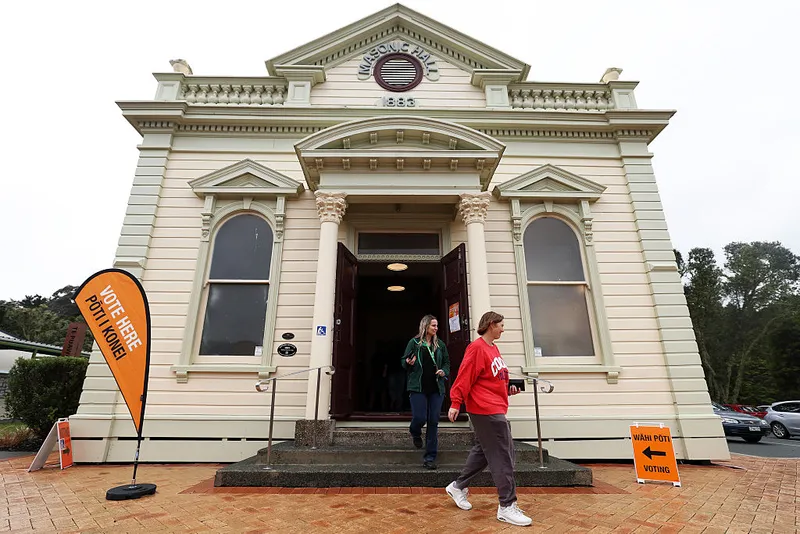
The most-used polling booth in the country was Lower Hutt's Queensgate Shopping Centre (Hutt South) with 16,976 votes counted on preliminary results. Queensgate leapt up from third place in 2023 to dethrone last election’s busiest booth, Westfield Mall in Albany (East Coast Bays). About 90% of votes at Queensgate were advance votes. The busiest booth for election day voting was Bayfair Shopping Centre in Mount Maunganui with 1,785 votes.
The quietest voting place in New Zealand
The least-used voting location in the country is a tie between Rakino Community Hall on Rakino Island (part of the Auckland Central electorate) and the Timaru Islamic Centre (Rangitata). Both of these booths recorded only nine advanced votes. The polling place with the fewest election day votes was Te Awamaarahi Marae in Port Waikato with 10.
The voting place that was closest to the nationwide vote
Voters at the Esk Eats food court in the Invercargill Central Shopping Centre (Invercargill) were almost perfectly representative of the nationwide view. Each of the top five parties were within 1% of their national party vote percentage. This is likely to change after special votes are counted.
The voting place with the most evenly split vote
Voters at Little River School, Little River (Banks Peninsula) shared their party votes as fairly as they could across the major parties.
The largest voting place to produce a perfect tie
Showlands Shopping Centre, Timaru (Rangitata), where National and Labour got 910 votes each. Swanson School Hall (Henderson) produced an exact tie between the three coalition parties and the four opposition parties with 526 votes for each bloc.
Which types of voting places favoured the left vs the right?
Votes cast in sports clubs and RSAs favoured the right, while votes cast in public libraries and council buildings favoured the left. University campuses went strongly for the Greens and Opportunity, care homes and retirement villages went right, and hospitals leaned left.
Which types of voting places produced the biggest swings compared to 2023?
There was a general swing away from the right bloc and towards the left bloc (including Opportunity) at almost all types of polling locations, but the size and shape of the swing differed. At schools, religious venues and sports clubs, most of National's lost vote went to its coalition partners Act and NZ First rather than swinging to the left. At libraries, council locations and community halls, the Greens and Opportunity over-performed relative to Labour.
Labour's largest source of party vote pickups came from suburban shopping malls, which also saw the largest swing overall.
How shopping malls swung the election
Among all types of polling places, voting booths in malls and shopping centres swung the furthest away from National and the right bloc broadly. Critically, shopping malls were the largest source of votes gained for Labour, which underperformed in several other types of polling places. National's share of the vote fell in all of the 48 malls which were used as voting locations in both 2023 and 2026, while Labour's vote share increased at 44 of the 48.
The mall with the largest swing in party vote by percentage was Ormiston Town Centre, Flat Bush (on the border of Botany and Takanini), where National's party vote fell from 67.2% to 42.8% while Labour's rose from 17.6% to 34.1%. By total votes the mall with the largest swing was Queensgate, Lower Hutt (Hutt South): National led Labour by 896 votes in 2023; Labour led by 2,587 in 2026.
As inner-city areas fall further towards the Greens and Opportunity and rural areas embrace Act and NZ First, suburban shopping malls could be the key battleground of the future for the two major parties.

Joel MacManus
Joel MacManus is a senior writer for The Spinoff. He previously worked at RNZ and Stuff, and began his career at Critic Te Ārohi. His writing explores the political, economic and cultural systems that underpin modern New Zealand. He won the 2025 Voyager Media Award for Best Columnist, Opinion or Critique.


