What’s central Auckland and where do you draw the line?

Where does it end?
Wayne Brown, Chlöe Swarbrick and more weigh in.
There’s a lot that can be said about central Auckland. There’s extreme wealth and extreme poverty. It’s the economic engine of New Zealand’s largest city, with the city centre alone now generating 21% of Tāmaki Makaurau’s total GDP. Visitors flock there for events, like the recent Auckland Marathon and Diwali, and everyone agrees central Auckland is where much of the action happens. Where “central Auckland” actually is, however, is harder to pinpoint, due to this somewhat arbitrary concept resting largely on vibes. Surveying the boundary is challenging. Do you use gut instinct? Logic? Planning documents? Maps? Topography? Reckons? Let’s try all of them.
Central Auckland and Auckland Central sound similar. To vote in the Auckland Central electorate – where there are 51,662 people enrolled – you must live within a boundary that includes central suburbs like the CBD and Ponsonby, but also Waiheke and Aotea Great Barrier Island, even though Aotea is a four-and-a-half-hour ferry ride from downtown Auckland. But Grey Lynn, though traditionally central, hasn’t been electorally “Central” since the 2011 election, after which the boundary was redrawn. More changes in 2025 meant some of Arch Hill (very central) moved over to Mount Albert. Auckland Central MP Chlöe Swarbrick was “gutted” to lose that part of her electorate and its constituents. She flatted in Eden Terrace after leaving home but grew up around Onehunga, and says that back then central Auckland referred to “basically the isthmus”, meaning this bit:
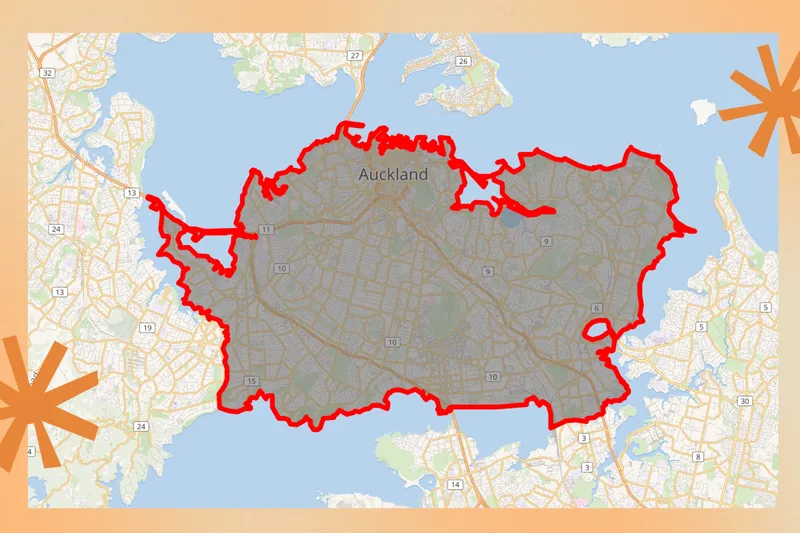
However, these days, “central Auckland” aligns more with the “loose boundaries” of her electorate. “I emphasise the loose bit, because there’s a lot of people on the fringes who identify with living in central.”
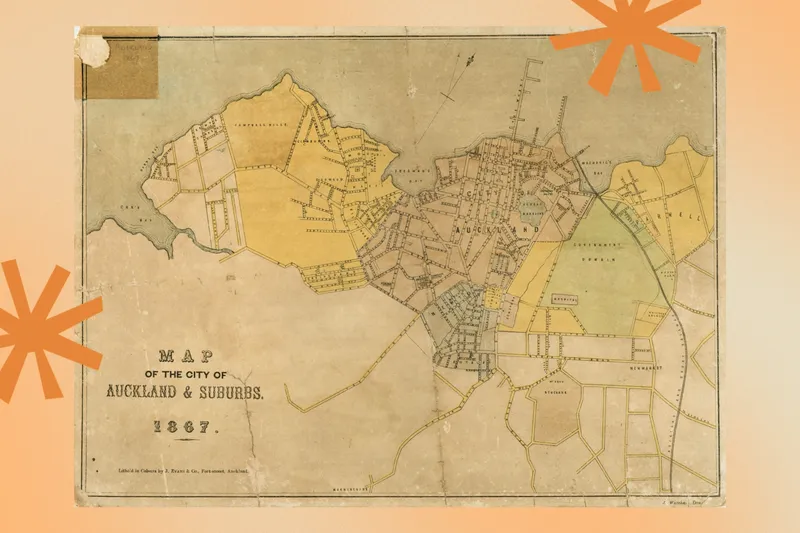
The electorate is one of the country’s oldest and dates back to when the city was a lot smaller. The original perimeter of Auckland was constituted in 1871 on land offered by Ngāti Whātua Ōrākei. The city boundary ran up Symonds Street, along Karangahape Road, through Ponsonby Road and down Franklin Road.
Over the years that followed, maps of the city’s boroughs and wards also drew a line around central Auckland. A 1967 map has the central borough stretching from Mt Albert’s Chamberlain Park to Parnell’s St Stephens Ave. Two decades later the Hobson Ward of Auckland Regional Council, which was established in 1989, captured a larger chunk of central; it ran from Beaumont Street up to New North Road and across Green Lane to Orakei Creek. Auckland City Council, established in 1989, was larger still (that was folded into the Super City in 2010).
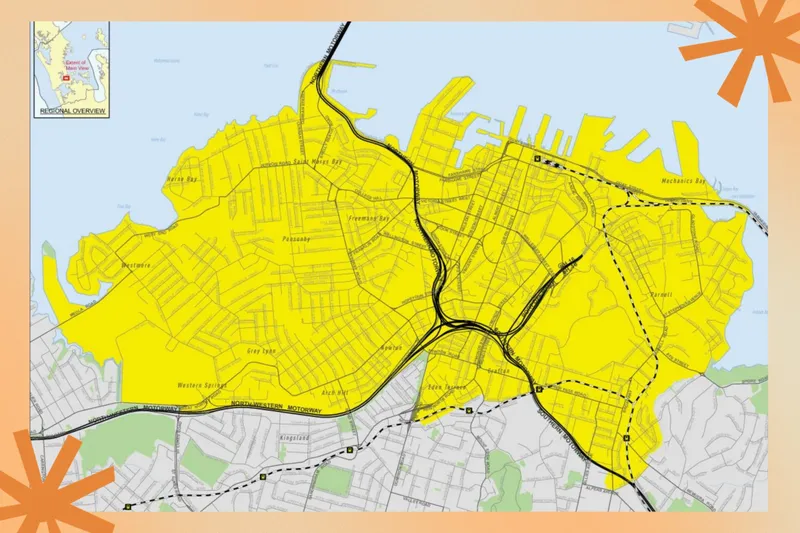
The current Waitematā Local Board boundary is the closest to my perception of central Auckland. This runs from Parnell around the Southern Motorway, catching Eden Terrace, the Northwestern Motorway and Western Springs. It’s a highly walkable catchment (although some board members reckon that technicality should be reduced for zoning density purposes).
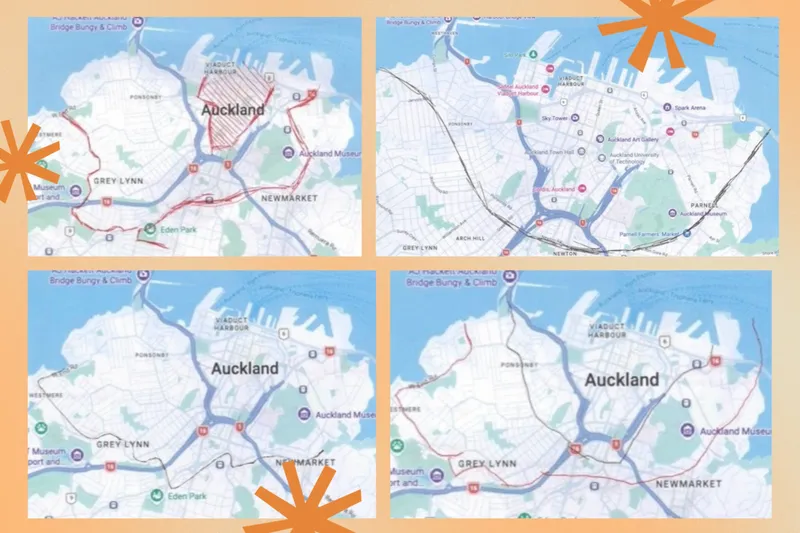
Is walkability critical to centrality? At the Spinoffice, where debate raged, that was one rationale. “Can you walk to the Sky Tower?” asked Zoe Madden-Smith, drawing a line on her worksheet from Newmarket through to Eden Park and Motat (the Museum of Transport and Technology). Lyric Waiwiri-Smith had a more anthropological assessment: “People from Grey Lynn just have a central vibe,” she insisted, placing a boundary from West End Road through to Garnet Road and Surrey Crescent to Great North Road, through Eden Terrace and around to Auckland Museum and Parnell. Joel MacManus consulted a topographical map to draw his border along the ridge that runs through Grey Lynn, Newton and Parnell. Robbie Nicol simply went off the gut instinct of “going to town”.
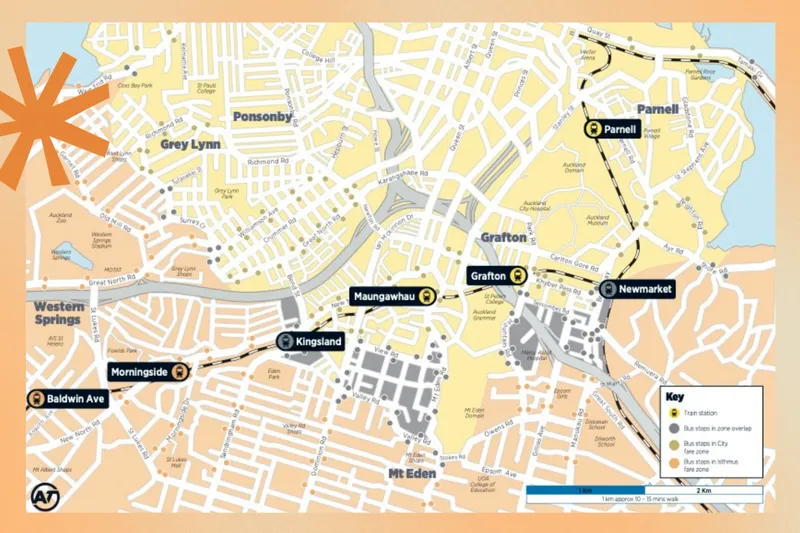
That’s another place to start. People come to central Auckland for all sorts of reasons: work, leisure and education. Auckland Girls Grammar teaches students from all over the city, however the actual school zone is markedly central, running from The Strand up through Grafton to Balmoral, around to Morningside, Grey Lynn and Herne Bay.
Like state schools, the postal service and public transport also rely on geographic boundaries. The 1010 postcode boundary clings closely to the Northern Motorway and Spaghetti Junction before looping in Auckland Domain and Mechanics Bay. Auckland Transport’s most central fare zone, “City”, includes Grey Lynn, Grafton, Parnell and some of Mount Eden.
Certain suburbs can test perception. Is Mount Roskill central? Liam Ratana says absolutely yes. He casts a wide net, placing the perimeter of central Auckland as far as Mount Albert, Onehunga, Remuera and St Helliers. Sacha Laird included Penrose and Ellerslie, pointing out that you really have to cross a bridge to leave central Auckland.
By that reasoning, the whole isthmus should be considered. Settled by Māori in the 1300s, it’s defined by the watery boundaries of the Tāmaki and Whau Rivers and the Waitematā and Manukau Harbours. Thanks to these geographic landmarks, no matter how many times bureaucratic boundaries are redrawn and opinions shift, the isthmus itself remains largely unchanged. And central.
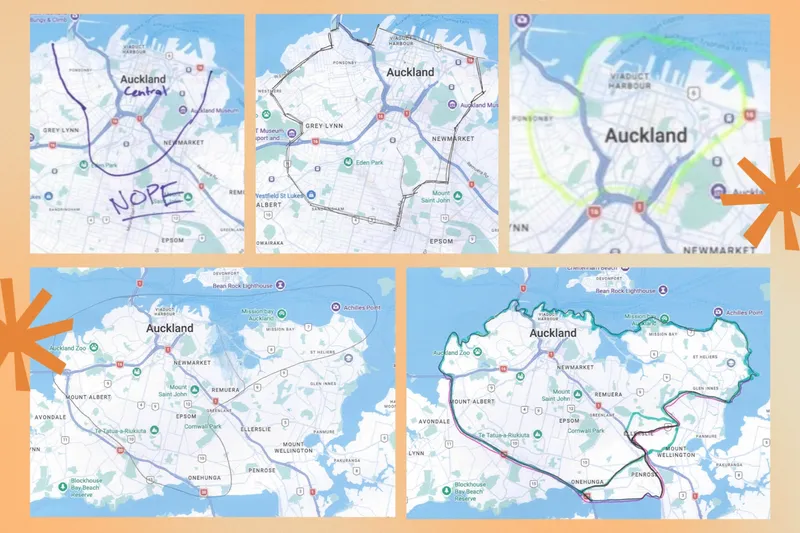
Where you live can influence perceived boundaries. Mayor Wayne Brown sees central Auckland as stretching east to west, from Ponsonby to Parnell, then south to Mt Eden. “Obviously, there are exceptions, but my general rule of thumb is the city centre extends to where people stop living in buildings and start living in houses,” he told The Spinoff. There's a personal rationale behind his definition. “I live in an apartment in Ponsonby and I would class this as being in central Auckland, but just a bit further up Jervois Road, that’s where there are houses and villas, so I wouldn’t call that the city centre.”
Many people use “city”, “centre” and “town” interchangeably, though for some there are clear distinctions. Comedian Chris Parker is a staunch advocate for “Uptown”, a subsection of central Auckland that includes Eden Terrace, Newton and Grafton. He has plenty of ideas about where to draw a line. “I think central Auckland starts on Karangahape Road and cuts off at the Grafton Bridge side of Symonds Street, but includes the universities,” he says. “I would cut it off around where all the motorways start and where that big pōhutukawa sculpture is… which I consider to be Auckland's Bucket Fountain.” The waterfront is central, he says, but Herne Bay isn’t – nor are the Ports of Auckland, which he associates with Parnell. He does, however, consider Waiheke as central Auckland. “Now I’m getting freaky.”
Someone who’s well-versed in the spaces of central Auckland is Graham Tipene, an artist who’s created work for Te Waihorotiu Station, Waterview Tunnel and the entrance to Myers Park. “As a Ngāti Whātua descendant we have always known the central Auckland area to be Maungawhau to Taurarua, Taurarua to Opoutukeka, Opoutukeka to Maungawhau. Mt Eden to Mechanics Bay, Mechanics Bay to Coxs Bay, Coxs Bay to Mt Eden.” This is the land given in 1840 to have the city built, he explains. “If we use the boundaries mentioned above you can see that old settlements of Auckland are all included; Grey Lynn, Herne Bay, Ponsonby, The Domain and the Parnell Rise would be considered as part of central Auckland.”
Do we need to agree on a definitive boundary? “Gummon, don’t make me draw a line around my communities,” said Swarbrick. Although she “officially has the privilege to represent those who fall within the electoral boundaries”, her net is cast wider than that. “Our boundaries are porous. Our joy and talent and creativity is all inviting.”
People from central are proud of it. And there are more than ever, with recent Statistics NZ estimates showing the population has increased across most of the isthmus – a marked change from last year. It seems they all want to be in central Auckland too, wherever that is. Who’s to say?
Agree? Disagree? Share your perceived boundary of central Auckland – including rationale – in the comments.

Emma Gleason
Emma Gleason is a staff writer at The Spinoff and an award-winning fashion journalist. But it’s not just clothes that interest her, you’ll find her exploring tasty cheese, influenza outbreaks and more important things right here. She has experience with some of the country’s leading media outlets as well as the toaster in our kitchen.
Sign up to The Bulletin, delivered straight to your inbox.


