
Chlöe Swarbrick with former Auckland mayors Phil Goff and Len Brown at the opening of the City Rail Link (Photo: Phil Walter/Getty)
A decade into her career, the former political prodigy is knocking on the door of cabinet – and trying to manage her intensity. Joel MacManus profiles Green Party co-leader Chlöe Swarbrick.
“Everyone on talkback radio thinks we’re really angry,” complains Green party co-leader Chlöe Swarbrick. We’re sitting down the back of Ima Cuisine, a Middle Eastern restaurant in downtown Auckland run by the chef and activist Yael Shochat. She’s telling a story she heard from fellow MP Mike Davidson about a woman he'd met in his Ilam electorate. She'd said she couldn’t vote Green because its leaders are always angry.
“It’s just kind of crazy because I feel like …” She trails off for a moment. “I don’t know, man, I have no idea how people perceive me." It's "pretty buzzy having this job where you are your own person and you’re trying to do your work", she says, only to look up and see a version of yourself that's only "somewhat tethered" to the reality.
As we speak, the Green Party is polling at a record high 16% in the 1News/Verian poll, enough to get 20 MPs into parliament. Were the left bloc able to form a government after November 7, the Greens would likely secure the first cabinet posts in the party’s history.
There has been a media storm across the last fortnight in response to Swarbrick’s remarks that she wants to be the minister of finance in the next government. Green Party insiders suggest a more realistic coalition arrangement could see co-leader Marama Davidson as deputy prime minister while Swarbrick takes the role of associate finance minister and a couple of other meatier portfolios such as climate change and economic development.
At this moment, however, Swarbrick isn’t thinking about any of that. She’s still stuck on the woman from Ilam who thinks she is angry. "I don't like the soundbite clips that end up on the six o'clock news,” she says. “You don't see the constructive work that I do. One of the things that I'm proudest of over the last nine years in parliament is that, even under this government, I have made a doggedly concerted effort to walk across the aisle.”
Anger, she says, goes against her theory of change. “No one is ever going to be amenable to understanding your worldview if they feel under attack, if they’re in fight-or-flight mode. The only way that we're ever going to be able to collaborate with our fellow New Zealander is if we can come back to this place of calm and go, OK, what are the basic things that we have in common?”
Does that mean she’s able to put politics aside and have a beer with an opposition MP after a heated debate in the house? Her face strains as she chooses her words. “It’s really hard to see the humanity in people who are unwilling to see the humanity in some of the most vulnerable and marginalised, who they’re actively harming.
“Sure, I can compartmentalise and we can work together on certain things, but in engaging with some of the National, Act and New Zealand First MPs … I just see a lot of cognitive dissonance. I don’t mean that as a slight or anything, it’s just the only way I can explain that someone is a nice guy and also hurting other humans."
Some people, like that woman from Ilam, might interpret that as anger. Others might call it outrage, frustration, passion or some mix of the three. The word that keeps coming up when you ask Swarbrick's friends and colleagues to describe her is “intense”. Conversations with her can veer off on wild tangents about the ills of the world and how to fix them. Even when she’s laughing and chit-chatting you can sense that she’s operating at full throttle.
That intensity has been on full display in parliament this term. She’s been kicked out of the house twice: once for implying that government MPs were spineless for not supporting her bill to sanction Israel, and again for accusing speaker Gerry Brownlee of “double standards”.
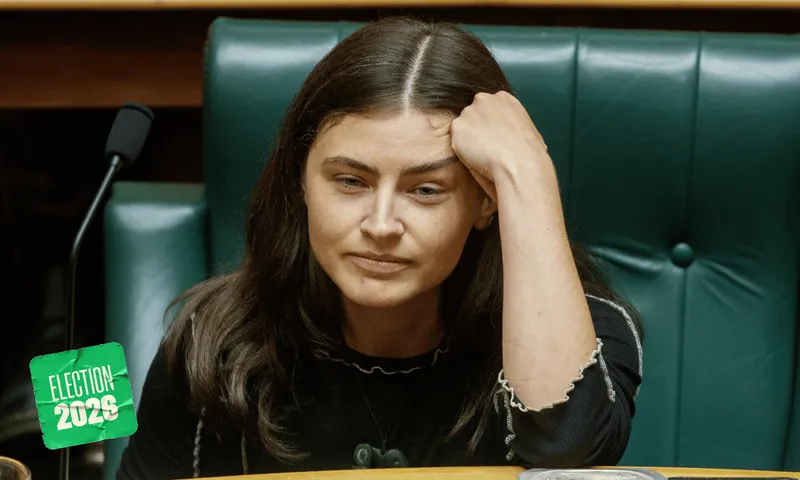
During Question Time, she often appears to be near the end of her tether; interrupting, pulling faces, throwing her hands in the air. She asks the same questions over and over again, about the government’s response to climate change, rising homelessness in central Auckland, and New Zealand’s international response to the genocide in Gaza. The predictability means ministers have little trouble dodging her questions or turning them around into a quippy comeback. This just frustrates her further.
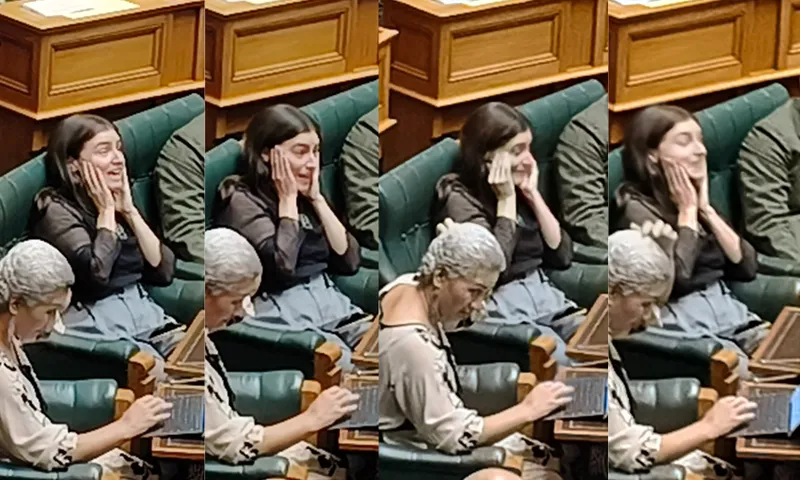
“She has never had a poker face. That’s to her benefit sometimes and probably a negative at other times,” says Green campaign director Leroy Beckett, who has worked with Swarbrick since her 2020 Auckland Central campaign. “Parliament is kind of the worst situation for her. It’s a very performative sort of politics, it’s all about playing this sort of game. She likes being out on the campaign trail, meeting people and discussing the big issues. Being in the house doesn’t put her in the best mood."
“I'm a very expressive person,” Swarbrick says. “The thing that is most offensive is the lies. You can criticise Jacinda [Ardern] for whatever gloss or PR spin machine was behind her, but at least with her or [John] Key there was, at the very least, an attempt to address the question. I think there is such a grotesque warp of reality and I just feel it's so goddamn disrespectful to the New Zealand public.”
Does it ever become too much? Is she burning out on the flame of her own intensity? Swarbrick doesn't answer directly, instead recalling an interaction with Te Pāti Māori co-leader Rawiri Waititi during a particularly frustrating debate in parliament. “I would have had my head in my hands or something and Rawiri was like: ‘Oh bro, it's a game to them. But we carry the weight of expectations of our people on our shoulders.'”

The 54th parliament was Swarbrick’s third term as an MP, second as MP for Auckland Central, and first as party co-leader. She stepped into the top job while the Green Party caucus was in a rolling maul of chaos.
It began when MP Golriz Ghahraman was caught shoplifting from several fashion boutiques. Then Efeso Collins, just 49 years old, collapsed and died during a televised charity fun run on Queen Street. Darlene Tana was accused of migrant exploitation at her e-bike business and quit the party in protest. Her replacement, Benjamin Doyle, was hounded over his sexuality and social media posts and left parliament citing safety concerns.
And, perhaps most significantly, longstanding co-leader James Shaw retired from parliament in May of 2024. He’d signalled his intention to leave several months earlier, but it was awful timing considering everything the party was going through.
Internally and externally, Swarbick was seen as the obvious candidate. Traditionally, the Greens maintained one male and one female co-leader. Swarbrick was eligible thanks to a rule change in 2022 which changed the policy to one woman and one person of any gender.
As it turned out, she was the only serious contender to put their hat in the ring. At 29 years old, she became the youngest leader of a parliamentary party in New Zealand history and pledged to overtake Labour as “the leading political party of the left”.
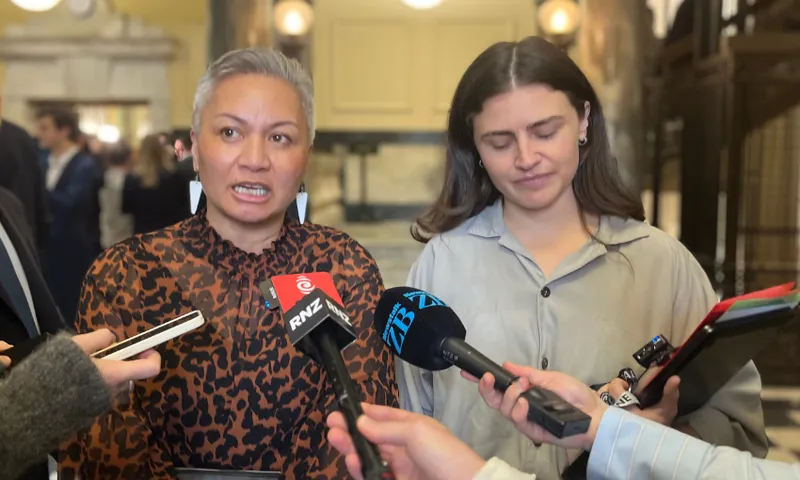
Just three months after Swarbrick began the new job, her co-leader Marama Davidson called a press conference and announced that she had been diagnosed with breast cancer. She took eight months away from politics to undergo a partial mastectomy, leaving Swarbrick as solo leader. Right around the time, Swarbrick split up with her longtime fiancée – though she doesn’t want to talk about that.
“It was a real harsh initiation for her and it really took a toll,” says Beckett. “It was a really hard time.”
“She’s someone who feels the weight of the world on her shoulders," says Tory Whanau, the former Green Party chief of staff and mayor of Wellington, who is now living in Melbourne and working for the Australian Greens. "Sometimes I’d want to be like, 'just care a little less!’ I wouldn’t say that to her, it would just be what I was thinking – to take the pressure off herself and share the burden ... It’s just about trying to help her maintain that intensity.”
Early in her career, Swarbrick was unusually open about her mental health. In high school, she struggled with depression and anxiety. “Drinking was an escape. It did get very bleak, and I was suicidal for a while and thought I was a psychopath,” she wrote in 2022.
“If you want to talk about how naive I was, talking to a journalist about my history of anxiety and depression was pretty fucking dumb in terms of how much I opened myself up for criticism,” Swarbrick says now. “I remember one day I must have done some kind of interview on mental health, and I was walking into the chamber and Judith Collins was walking with me and she goes: ‘Chlöe, don’t ever give them something they can use against you’.”
“Judith was a funny one. She was always looking out for the girls, at least on a personal level. When it comes to the politics of pulling up the ladder behind her, that's different,” she says.
Collins declined an interview, citing her new role as president of the New Zealand Law Commission. Over text, however, the former National Party leader recalled the conversation and stood by that “good advice”. In the spirit of Swarbrick's across-the-aisle aspirations, Collins said she strived to help younger MPs where possible. “I’m happy to say that I’ve found that almost everyone goes into parliament believing they will make a difference for others and it’s always worthwhile remembering that.”
These days, Swarbrick says she prefers to keep the more personal stuff to herself. “I’ve been asked to talk about it so many times, and I’ve actually turned down a lot of quite personal interviews because, in my experience, it tends to just open me up to vitriol – and my family as well.
“The honest truth is, I have the privilege of access to resources, which means that I get to see a counselling therapist. I've done a lot of work on understanding myself … I live in a very different place now.” One thing that has helped, she says, is live music. “Going to gigs now is more of an intentional wellbeing political maintenance strategy.”

Swarbrick emerged into the world of politics at age 22 when she entered the 2016 Auckland mayoral race and finished a respectable third with 29,098 votes, or just over 7%. She was a fresh-faced kid with an oddly mature haircut, no party backing, no political experience and the only public profile she had was from hosting a show on 95bFM.
“Who does she think she is?” was Green Party campaign director Beckett’s first impression upon seeing she had entered the race. Then, after meeting her: “Oh yeah, she’s the real deal. She has that thing that makes you good at this.”
She had an almost impossibly long CV for her age, completing a Bachelor of Laws and a Bachelor of Arts from the University Auckland, and founding three small businesses: a fashion label, a magazine and a cafe. Her platform included rates calculated on land value alone, rail to the airport within a decade and full backing for the newly passed Unitary Plan. And she argued for them with that trademark intensity.
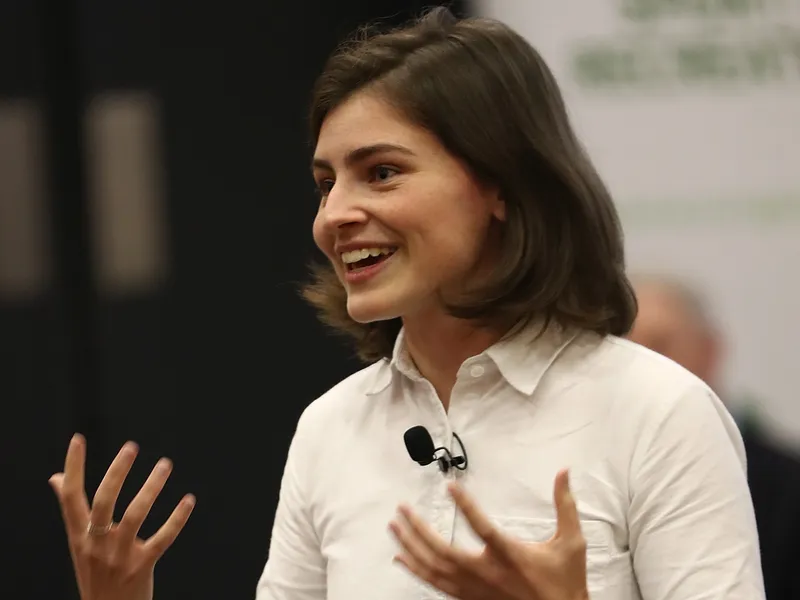
“Part of the reason I cut my hair was to be taken seriously,” Swarbrick says while reflecting on that first local election. “I was, not just perceivably but probably genuinely, a Lisa Simpson caricature. I was hyper conscious that if you don't look or sound like the archetype of someone who is in politics, then you have to work harder to be considered legitimate. So I always came armed with hours of reading. I had the facts and the figures and the reports, and I could cite them. I think that jarred some people with me coming across as very intense.”
Swarbrick says she has tried to tone down that part of her personality. “What I've learnt though politics is about vibes. Evidence doesn't tend to – surprise, surprise – change people's minds as much as I would love it to.”
As an example, she points to her then-policy of removing mandatory bike helmet laws. It’s an idea that is supported by bike advocates, who argue that compulsory helmets have reduced cycling numbers and taken the onus of safety away from other road users.
"I was very clearly politically naive with how I put that argument forward, and I just didn't anticipate that people would be so angry. I had people say that I wanted to kill children and stuff,” she says. “That was my first experience of a hot-button issue that gets taken to a point where we're not actually talking about this thing any more. We're talking about people's emotions. And that makes sense, right? Especially when you're talking about people who have experienced brain injury and death as a result. So I get that, and I guess that goes to the Lisa Simpson caricature thing.”
Before polls had even closed in 2016, the NZ Herald was asking: What does the future hold for Auckland mayoral candidate Chloe Swarbrick? With a general election the following year, several parties wanted to bring her on board.
Labour Party leader Andrew Little said her campaign was “impressive” and that he wanted to meet with her. Greens co-leader James Shaw said she was “phenomenal”. Opportunity Party founder Gareth Morgan reached out via Twitter direct message. And there was a “strange approach” from someone within New Zealand First – “not Winston, obviously,” she says.
Swarbrick insists she wasn’t thinking about career progression. She had settled back into running Olly, an art gallery and coffee shop in Mt Eden, with her business partners. "I was just like, maybe I'll just do this a little bit,” she says. “But I also felt this bizarre sense of privilege, which would be crazy to waste, where for whatever given reason some people were listening to me, and I just thought that it was important to not give up on the hope that they vested in me.”
The great recruitment battle took the form of a series of coffee meetings: with Labour’s then-deputy Jacinda Ardern at Frankie’s on Sale St, James Shaw at Chuffed on High Street and a follow-up with Green MP Julie Anne Genter in Mt Eden.
What does she remember from those meetings? “Jacinda was so warm and so kind, and incredibly caring to a young woman who's like, 'What the hell did I do with my life?'" At first, “I didn't actually resonate particularly strongly with James,” she recalls. Mostly, she remembers the way he'd emphasised how much wasn't in his gift to offer. The party’s democratic structure meant that he couldn’t promise a safe placing on the party list or her preferred choice of electorate.
In the end, she says, she made the decision by sitting down in front of a computer and reading the parties' policies. “It was the evidence-based approach that I liked about the Greens. It was the fact that there was clarity in terms of values.” And she was concerned about the hierarchies within the Labour Party. “You have to sit down, shut up and wait for 10 years to have an opinion. By which point, you don't necessarily know what your opinion is any more. If you wear the mask for long enough, it becomes your face.”
As soon as Swarbrick joined the Green Party, she began ruffling feathers. She challenged to be the candidate for Auckland Central, despite sitting MP Denise Roche already having claims on the electorate. “She came in with quite some force, which may have rubbed up some members the wrong way. It was different to how we did things, but it was the energy that we needed,” Whanau says.
Swarbrick lost the challenge and instead ran in nearby Maungakiekie, where she won 12% of the electorate vote – double the Greens’ party vote in the same area. She entered parliament via the party list, ranked seventh. It made her the youngest MP since Marilyn Waring 42 years ago, a fact which Swarbrick says she was “acutely aware” of because “everyone kept bloody telling me”.
The next election, she challenged again to be the candidate for Auckland Central and succeeded. But again, she wanted to push further by running a two tick campaign, chasing the electorate vote and the party vote. With the exception of Jeanette Fitzsimmons’ 1999 campaign in Coromandel, which was aided by strategic Labour voters exploiting the rules of MMP, the Greens had never seriously tried to win an electorate.
“We had people running numbers who said it was impossible,” Beckett says. “People trying to water down her expectations. But she said no, this is a thing I want to do.”
Swarbrick won Auckland Central by 1,068 votes in a three-horse race against Labour’s Helen White and National’s Emma Mellow. She extended her margin further in 2023.
What does the future hold for Swarbrick? Whanau sees her going international. “I wouldn’t want her to stay in parliament for more than another decade or so. Her way of thinking needs to be more global in my view. She’s a talent that shouldn’t be contained,” she says. “She should be looking at the UN or something like that.”
Swarbrick is not entertaining thoughts that far ahead. For the minute she's focused on November 7, and people like that woman from Ilam who need convincing the Greens are more than angry wokescolds. “We just need to have some goddamn fun because that's the thing that will bring people together and break down barriers.”
Swarbrick's electorate office on Karangahape Road is part of that project. Nicknamed “Chlöe’s Clubhouse”, the space is filled with neon lights and couches, in a neighbourhood of gay bars and vintage shops. Well-known artists and comedians always seem to be popping in.
“We have to be the party everyone wants to be at,” she says. “We need to take ourselves less seriously. And I know how profoundly ironic that might sound coming from me, but I’m working on it, man."

Joel MacManus
Joel MacManus is a senior writer for The Spinoff. He previously worked at RNZ and Stuff, and began his career at Critic Te Ārohi. His writing explores the political, economic and cultural systems that underpin modern New Zealand. He won the 2025 Voyager Media Award for Best Columnist, Opinion or Critique.


