Are we about to elect our least popular prime minister for 33 years?

People don’t much love our leaders.
Polling suggests the head of government for the next term of parliament will arrive on a wave of meh.
Strictly speaking, the answer to the question of the headline is no. We don’t elect prime ministers in New Zealand; we vote for candidates and parties. But you know what I mean. Is the government sworn in after the next election going to have at its head someone who scores lower in preferred prime minister polling than we’ve seen for decades?
In the latest Verian poll for 1News, the purple tide continued to go out. The support for National and Labour, combined, was just 61%.
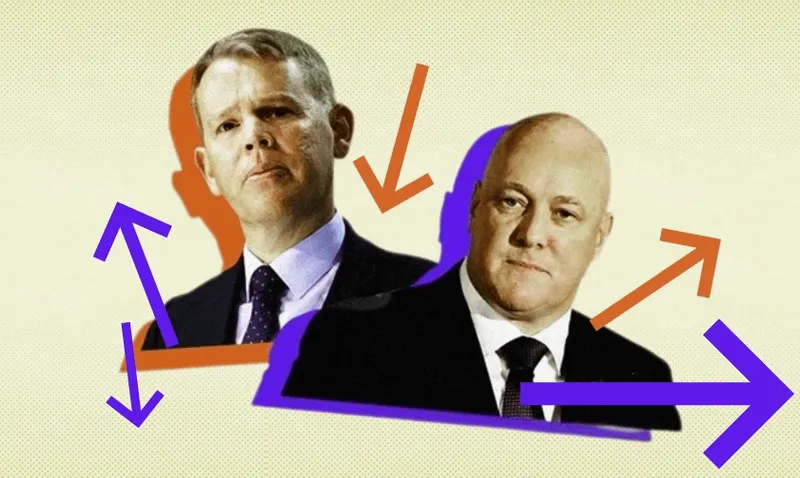
But that’s for party vote. On the preferred prime minister question? Well, 61% combined would be a dream. Christopher Luxon and Chris Hipkins, the two men vying for the office of prime minister, registered 18% and 16% respectively, or 34% together in the same poll.
It’s fair to say that around the world, establishment party politicians are not popular. But it’s still grim. Basically, two in three people prefer neither Chris.
Which does suggest the prime minister for the next term of parliament will arrive on a wave of meh.
When was the last time a PM arrived to such muted personal enthusiasm?
Let’s flip back through the triennial numbers, starting with 2023. Then, the leaders were – this might sound familiar – Chris and Chris. In the last poll before the election, each of Hipkins and Luxon were preferred by 25%, or 50% combined – hardly stratospheric but measurably healthier than today.
Remember 2020? That was the Covid election. Ardern was riding high, on 55% in Colmar Brunton’s preferred prime minister poll for 1News. Judith Collins, who had stepped in at the 11th hour and was lampooned by many, was on 20%, higher than either of the contenders today.
The last such poll before the 2017 election had Bill English on 37%, and the newcomer to the Labour leadership, Jacinda Ardern, on 31%.
In 2014, a campaign most memorable for being paintballed in Kim Dotcom and Dirty Politics, John Key just kept cruising, on 43%, with David Cunliffe 10%.
Key was in even better fettle back in 2011, on 56%, ahead of Phil Goff on 12%. In 2008, when he became prime minister, Key had been preferred as PM by 40%, ahead of Helen Clark’s 36%.
Helen Clark led Don Brash as preferred prime minister going into the 2005 election, with 40% to his 31%.
In 2002, Clark had 48% to Bill English’s 19%. Three years before, in 1999, just ahead of Clark’s first term on the ninth floor, she had 30% in Colmar Brunton’s preferred PM polling, ahead of Jenny Shipley on 27%.
Clark had leapt in the preferred prime minister metric over three years. Through the 1996 campaign her popularity jumped to 17% (earlier in the term she had polled as low as 2%), with the incumbent Jim Bolger – who would return to the prime ministership after negotiating a coalition deal with Winston Peters’ NZ First – at around 30%.
To find someone who became prime minister despite being preferred by a number lower than Luxon’s 18% and Hipkins’ 16%, we need to travel back to 1993. Immediately before the election, Heylen (who polled for TVNZ before Colmar) had Bolger on 15%, equal with Jim Anderton and trailing Mike Moore’s 22%. Winston Peters was on 14%, four points higher than his result 391 months later.
The fact that National won re-election in 93 despite the lack of enthusiasm for its leader offers both Luxon and Hipkins some solace. Especially when you consider that 15% was at the time a splendid result for Bolger. He was routinely battered in the popularity polling, and these days he is a man remembered with great fondness,.
A couple of years earlier, in late 1991, Heylen had put Bolger on 7%, prompting Labour MP George Hawkins to write to the Guinness Book of Records asking if that might be a global low for a sitting head of government. Radio New Zealand at the time brought reassurance, of a sort – they’d done their research and found a 4% rating for the Japanese PM in 1989. So maybe 18% isn’t so bad after all.
There are still four months to go to the 2026 election. The plates could yet shift – a late change in personnel, say, or a sudden outbreak of Chrismania. But if not, to return to the question, and in breach of Betteridge’s law, yeah, we are about to elect our least popular prime minister for 33 years.

Toby Manhire
Toby Manhire is editor-at-large at The Spinoff. He loves to cast a pod, whether it's Gone By Lunchtime, At Large or Juggernaut. He is a former editor of The Spinoff and has worked as a journalist in NZ and the UK since the last millennium.


