‘An excellent PM and an even better person’: memories of working with Jim Bolger

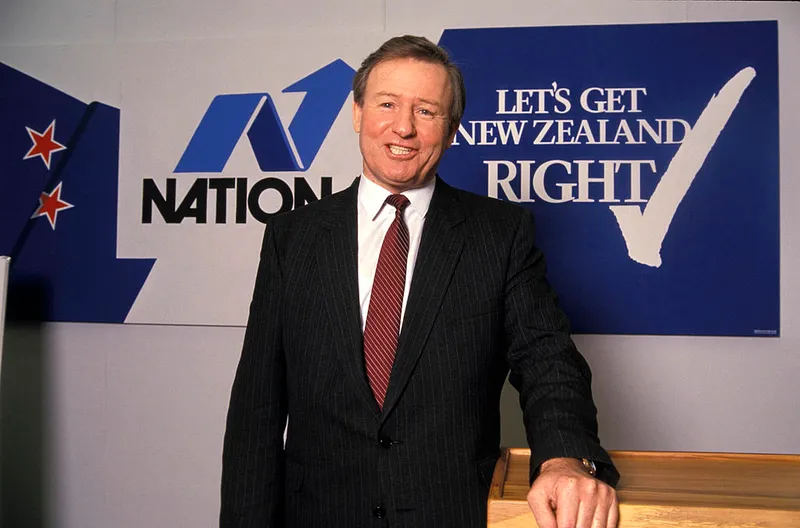
Jim Bolger in 1991 (Photo: Peter Morris/Fairfax Media via Getty Images)
Jim Bolger, prime minister from 1990 to 1997, has died at the age of 90. We asked those who worked alongside him for their reflections.
Bill Birch
“He was a mate. A good mate. We both came from rural backgrounds, had a lot in common. We were both candidates for the National Party in 72, met at candidates’ conference in Waikanae at the scouts’ camp, and coalesced very quickly.
“He was absolutely passionate about doing things right for New Zealand – dedicated but also pragmatic. He was transparent and honest and straightforward. Never let you down.
“He always had a sparkle about him. When he was prime minister, at the end of the day he would often come down to my office and kick the door down and pour a Scotch before we’d go home – talk about the events of the day. We had absolutely nothing between us – we were very close colleagues, we’d just work our way through the issues. We’d share confidence right through those 60 years. About the only thing we had difference on was the royalty. He had his views about the Irish and the English. That’s why he was a republican.
“Our families were very close. We used to holiday together at our cottage up in Snell’s Beach – me and Rosa and Jim and Joan and the kids. The kids would go fishing together. It leaves a big gap in my life, and a big gap in New Zealand.”
Sir Bill Birch worked alongside Bolger throughout their respective careers in politics and held several senior roles in his government.
Doug Graham
“He was a very intelligent, fair-minded, decent Kiwi. It was a joy to work with him.
“I remember going to a cabinet meeting just after we were elected in 1990, and all ministers were told to save millions of dollars in their budget because the BNZ had nearly gone broke and we were in terrible trouble. As minister for the arts, I had gone along to try and get $250 million for Te Papa. My colleagues looked aghast. They couldn’t believe the nerve that I had while they had to cut funding. And Jim Bolger listened to the debate and said: there’s never a good time to build a museum. Let’s get on with it. That was outstanding leadership.
“Of course I had a lot to do with him over the treaty negotiations. He was always very supportive. He understood what the need was. It was a time when the government was trying to enhance Crown-Māori relations and do the right thing and hopefully help Māori escape from grievance and move into development. We seem to be going back the other way at the moment, but that’s another matter. It was fascinating, emotionally draining, and deeply satisfying.
“I came to regard him as a very close friend. In the last few years I’d ring him every every few weeks or he’d ring me and we’d solve the world’s problems, the same old problems, we’d solve them each time. But a great New Zealander. He’ll be sadly missed.”
Sir Doug Graham was a senior minister in Bolger’s governments.
Ruth Richardson
When we took office in 1990, Jim and I faced a baptism of fire. Inflation was raging (double digits), far from the promised surplus what was revealed was a dirty great deficit, the BNZ was broke and New Zealand was drowning in debt. Urgent, decisive and corrective action was called for and when Jim had to show policy bravery he did.
Yes, circumstances forced his hand but Jim didn’t flinch to do what was right. All the more to his credit he gave to reformers licence; for us it was a matter of conviction but for him it was a matter of necessity.
Had successive administrations been equally brave on raising the age of eligibility for super as his government did then, we wouldn’t be facing the fiscal firestorm that Treasury now warns will surely occur if nothing is done.
Te Papa is Jim’s and I suspect Joan’s physical monument, but for me his willingness to embrace fiscal responsibility is his policy monument.
Ruth Richardson was finance minister in the Jim Bolger led government 1990-1993.
Don McKinnon
“In retrospect, we achieved a lot from 1990 to 1999. The Bank of New Zealand was virtually going out the back door. We were offside with the Americans, the French and the British, and the Australians were gritting their teeth. We needed to make some huge changes to employment law to get some more movement in the workplace. And of course the commitment to really be serious about Treaty settlements and land compensation – that took a lot of doing and took a lot of taking our whole caucus with us. He was the guy who in the end said: we’ve got to do it, and we’ve got to do it properly.
“His leadership style changed over the years. He came in, country boy from Te Kuiti, hadn’t seen much of the world at that point, was certainly influenced very strongly by Rob Muldoon’s leadership. In the end, he developed his own leadership style. On those more difficult issues, he made sure he heard everyone, and then came to the conclusion himself, and came back to us and said: I think this is where we’ve got to go, and I think we’ve got enough on our side to make it work.
“I spoke to him every week this year, and it was only when I rang him up the other night I realised he was speaking from a hospital bed. So there we are.”
Sir Don McKinnon worked closely with Jim Bolger including as deputy prime minister from 1990 to 1996.
Tipene O’Regan
Jim Bolger played a significant role in securing our settlement with the Crown in 1998, as well as the two earlier fisheries settlements.
He took a pragmatic but sincere approach to restorative justice and was driven by the desire to do what was right for Māori and all of New Zealand. You can’t turn back the clock, but you can remedy past defects.
Jim was probably one of the most widely read and widely informed people that I have ever dealt with. I was hugely impressed with his intellectual courage. He certainly had a deeply inquiring and thoughtful mind.
We were able to trust each other implicitly and I highly valued the nature of the relationship that evolved between us. We became very good friends and enjoyed long conversations on all sorts of topics, such as indigenous rights, New Zealand history, and global issues.
My thoughts are with his wife Joan and whānau at this sad time.
Tā Tipene O’Regan led Ngāi Tahu treaty negotiations with the crown in the 1990s.
Jenny Shipley
Jim Bolger was a highly effective leader who made a defining impact on the New Zealand we are today through his leadership of the major economic and social change in the 90s, establishing the settlement and reparation process of Māori land settlements and the referendum and then introduction of MMP electoral system.
He lived his values. He and his wife Joan served New Zealand tirelessly together and were one of the great political partnerships New Zealand has seen. My deepest sympathy goes to Joan and the family.
Dame Jenny Shipley served as a senior minister in Bolger’s cabinet from 1990 and succeeded him as PM in 1997.
Wayne Eagleson
Jim was an excellent prime minister and an even better person. So many of the staff who worked with him more than 30 years ago have remained loyal and lifelong friends to him and Joan which tells you so much.
As a boss, Jim was clear on his expectations but never felt the need to bully or scream. Disappointing him – as I did on one notable occasion – was met with a sad look in his eyes and the comment, “I expected so much more from you Wayne,” which cut deeper than any stern telling off. It made me even more determined to do better for him next time.
Jim’s political life spanned massive changes in New Zealand. Not least technology – I vividly remember walking down the main street of Oamaru in the 1990 campaign holding my brick of a mobile phone to the very large “portable” fax machine while the office sent through speech notes for the coming event. No email, no text and no social media.
Jim had unbelievable energy. He could and did go all day, often enjoying a late-night whiskey only to bound up again first thing in the morning. His ability to sleep in cars and on planes was legendary.
Sometimes Jim’s political opponents underestimated his intelligence because of the fact he had little formal education. What a mistake that was. Jim was incredibly bright, sharp as a tack and was able to work through an official’s brief as well as anyone. He was curious and well read. In the opposition days when he had a little more time, we swapped US political biographies to read, and he worked his way through the first volume of Robert Caro’s The Years of Lyndon Johnson in no time at all.
The Jim Bolger of the late 1980s increasingly enjoyed wearing nice suits – perhaps it was Winston’s influence! He wore double-breasted suits often as was the fashion of the times, and the male staffers in the office knew that if they came in wearing a particularly flash tie it could easily be commandeered for the next TV interview. We may or may not get them back.
No thoughts on Jim would be complete without a word on Joan. Without Joan, Jim couldn’t have been as successful. Joan was in many respects his key political adviser – Jim valued her opinion and actively sought it out. Joan travelled to so many places around New Zealand with Jim, often in campaigns having her own schedule because she was popular in her own right. What an asset to Jim and the country Joan was.
Wayne Eagleson worked in Bolger’s office in opposition and the Beehive.
Todd Muller
I was only 25 when I started work at the Office of the Prime Minister for Jim Bolger and it still rates as the most fun I have ever had in my career. My job was to plan his visits throughout the country, usually on a Thursday, Friday and Saturday, and travel with him to ensure it ran smoothly. Often it was just Jim and Joan, a driver and I in the car and my abiding memory is their love for each other and their infectious sense of humour. Tears of laughter was common not only in the car, but on the ninth floor and Premier House with both the staff and his family. He was an absolute professional and statesmen but he had a love of the slightly absurd. I can remember him showing off a gift of a rugby jersey for a prop from the club he played for when he was young. When I retorted it must have shrunk in the wash – his eyes sparkled then he roared with laughter.
He was demanding but fair. I can still remember like yesterday forgetting to double-check media were allowed at a visit during the tough 1996 election. They weren’t and I stood in horror with the media pack idling, eating sandwiches as Jim had a personal tour around the business. His response, a blunt reminder we weren’t playing a game of tiddlywinks and to sharpen up. Then he carried on with the day with me and everyone else as if nothing had happened and we were 40 points ahead in the polls.
The atmosphere in the ninth floor was similarly invigorating. Everyone worked hard with high expectations managing difficult issues, but there was always this seam of humour that lightened the space.
He has been a tremendous mentor to me throughout the last 30 years, regularly chatting about NZ and global politics and trends. I will miss him deeply.
Todd Muller worked in Bolger’s prime ministerial office.
Helen Clark
Jim was an honourable man who was prepared to update his own views where it mattered.
After National lost the 1987 election opposing New Zealand’s nuclear-free stance, he led his party to accept it. He reached across the aisle when considering whether New Zealand should take a case against French nuclear testing to the International Court of Justice in The Hague. I recall being invited to his office with other party leaders to discuss this. We all supported the move, which enabled the case to proceed with broad support domestically.
The finalisation of the first major Treaty settlement of modern times – with Tainui – was on Jim’s watch.
He was a republican – a position I shared with him. I implemented the outcome of the report he commissioned on the abolition of royal honours on New Zealand – his own caucus had refused to support it.
In areas like these, he was pushing well beyond traditional National Party positions. Jim had his ear more to the ground than many, and could move with the times.
Helen Clark, who became PM in 1999, was opposition leader during Bolger’s government from 1993.
Tau Henare
“At no time would he be embarrassed about putting his hand around your shoulder – just a good man to talk to, with that Irish and farming background. People like him and McKinnon were the best people I worked with. Their humanity – their ability to just sit down and have a yarn. That’s missing these days.
“In cabinet, if you had done your work, read your papers, and you were advocating something, he would give you 100% support. He was no dictator. He will go down as one of New Zealand’s best prime ministers.”
Tau Henare was a NZ First minister in the first MMP government, led by Bolger.
The above are drawn from written contributions and, where in quote marks, from interviews conducted today. This post will be updated as further recollections arrive.

Toby Manhire
Toby Manhire is editor-at-large at The Spinoff. He loves to cast a pod, whether it's Gone By Lunchtime, At Large or Juggernaut. He is a former editor of The Spinoff and has worked as a journalist in NZ and the UK since the last millennium.


