Are Luxon’s struggles special, or is he a victim of a global incumbency curse?

Clockwise from centre: Christopher Luxon, Emmanuel Macron, Donald Trump, Friedrich Merz, Keir Starmer, Anthony Albanese.
Do we really hate them all?
At the end of a week Christopher Luxon would like to forget, the most persuasive defence of his prime ministership came from Nelson. Nick Smith, senior National minister turned mayor, argued that Luxon’s struggle in the polls came down to a handful of factors. There was no money to spend. The saturation of social media made it hard to be moderate and sensible. And, wrote Smith (on social media), “it’s a sod of a time to be in government everywhere.”
He explained: “There are stable times globally when being in government is advantageous but others when it is a liability. The world is in its worst state of flux in a generation and most democratic governments are struggling. The UK’s PM Keir Starmer, in office for a shorter time than Luxon, has much worse poll ratings. Albanese in Australia, Macron in France and Merz in Germany are all polling poorly.”
Mike Hosking, host of the Mike Hosking Breakfast, made a similar assessment a few days later. “It’s all over the world,” he told Newstalk ZB listeners. “Trump is underwater, Starmer is underwater, Albanese is underwater and Macron is underwater. Chris Minns, who runs New South Wales, is popular currently because of his handling of Bondi. Apart from that, pick a politician because we hate them all.”

The incumbency curse
The diagnosis of a curse afflicting political incumbents in liberal democracies – observed both abroad and at home – has at its damned core the state of the economy, that sense of an inexorable malaise, of the interminable cost-of-living crisis. All of that began, just as Covid was beginning to subside, when Russia launched its all-out assault on Ukraine, a reality that draws double lines of emphasis under the shockwaves being felt around the world right now from the bombardment of Iran.
The curse wrapped up the world in 2024, the year that half the global population went to the polls. They tended not to discernibly swing left or swing right, so much as chuck the current lot out. As one survey of all those elections put it, the year might best be summed up as one in which “voters used the ballot box to punish incumbents for economic issues that were often well beyond their control”. Another called 2024 a “graveyard of incumbents”.
When the Financial Times parsed the results across the year’s elections in the developed world, it found that “every governing party facing election in a developed country in 2024 lost vote share … the first time this has ever happened in almost 120 years of modern democracy”. The FT research attributed the trend principally to economic challenges faced by all but the wealthiest, but noted also a growth in the appeal of anti-establishment populist parties on both the left and right – a trend that, in lockstep with the ongoing cost-of-living predicament, continues to this day around the world and in New Zealand.
Do we still hate them all?
The curse was real in 2024. Does it continue to haunt incumbent leaders in 2026? Let’s take a quick tour of the nations cited by Smith and Hosking.
But first, New Zealand. If we look at three recent polls (the Taxpayers’ Union/Curia poll that triggered all the talk, and the Post/Freshwater and 1News/Verian polls of last month), the averages are National 30.8% (down from 38.1% at the election) and Labour 34.5% (up from 26.9%).
The Greens are 10.5%, Act 7.5%, NZ First 10.2% and Te Pāti Māori 2.4%. Or if we’re looking at the ruling coalition as whole – the incumbent government – the three-party aggregate is 48.5% (52.8% at the election), ahead of the hypothetical left-leaning three-party coalition on 47.4% (41.6%).
The incumbent prime minister, Christopher Luxon, is the preferred prime minister of 25%; Chris Hipkins is preferred by 29.5%. The Curia poll gives Luxon a net approval rating of -19 (27% approve, 46% disapprove); Hipkins is -5 (36% approve, 41% disapprove).
The latest Ipsos Issues Monitor has the government performance ranked at 4.2/10, but the Luxon government hasn’t breached 5 even once.
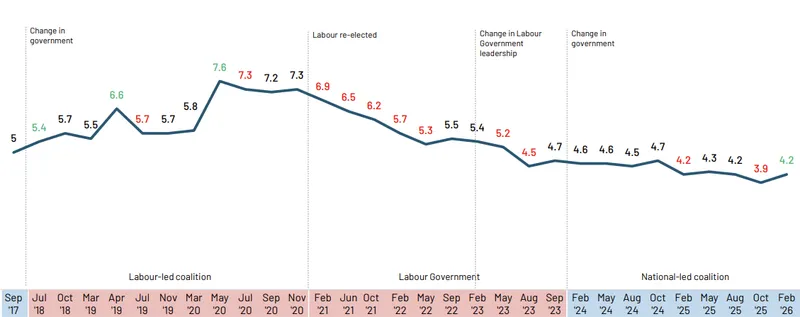
The issue of greatest concern to Ipsos respondents was cost of living, and they picked Labour as most capable of dealing with it. Third (after healthcare) was the economy. On that count, it was a draw between Labour and National.
Over in Britain, Keir Starmer is right up against it, as is his incumbent Labour Party.
At the 2024 election, when Labour displaced the incumbent Tories, it took 33.7% of the overall vote. Today, the Labour Party is polling at 17%, according to Politico’s poll of polls, well behind Nigel Farage’s Reform Party, on 25%, with the Tories also on 17% and the Greens 15%.
Starmer’s approval rating is a dismal -51 (70% disapprove, 19% approve) but none of the leaders has a positive approval rating, suggesting Britons do, indeed, hate them all.
In the United States, Donald Trump’s popularity is nothing like the version of reality he likes to project. Across recent polls he has a favourability rating of -12.7, with 54.6% disapproving and 41.9% approving, according to the Decision Desk tracker. The Republican Party is slightly worse, at -14.4. As for the Democrats, it’s -20.3, per RealClearPolling. There is, of course, no presidential candidate for the Democrats. On congressional votes, the Democrats are ahead by 4.7 percentage points.
And France? Emmanuel Macron has just over a year until his second and final term as president expires, and he can only dream of Trump’s favourability: 76% disapprove and 19% approve, leaving him on a whopping -57.
Zipping across to Germany, the governing grand coalition of CDU/CSU and SPD together won 44.9% in the 2025 election. Today they’re polling a combined 41%. The far-right AFD is the second most popular party, just a couple of points behind the CDU/CSU.
Most of Europe’s leaders are struggling, but Chancellor Friedrich Merz’s support is falling fastest. The YouGov tracker poll finds that 23% of Germans have a favourable opinion of Merz and 71% unfavourable, leaving him on -48, down from -14 in June last year.
Closer to home, the main opposition grouping in Australia, the Liberal-National Coalition, is in a spot of bother off the back of a leadership change, with a YouGov poll this week putting them on just 19% primary vote, down from an election result of 31.8%. That should be good news for Anthony Albanese and Labor, who bucked the incumbent curse last year by winning re-election, right?
Not necessarily. Labor is on 30%, down from 34.6%. That still puts them top of the pile, but the big story continues to be Pauline Hanson’s One Nation, now on 26% (6.4% at the election). As for Albanese, he wins approval from 38% and disapproval from 54%, producing a net -16, which is in the same ballpark as Luxon.
Is there anyone who wins positive approval out there? At least one, in another Anglosphere five-eyes nation, Canada. Mark Carney, like Albanese, swam against the anti-incumbent tide in 2025 – having replaced Justin Trudeau, he rode an anti-Trump wave into office. Today, as the prime minister continues, for the most part, to be measured against his counterpart to the south, polling by Ipsos gives him a net +25 rating, with 33% disapproving and 58% approving.
But in that regard he’s exceptional; Luxon’s polling is much more par for the current global course.

Toby Manhire
Toby Manhire is editor-at-large at The Spinoff. He loves to cast a pod, whether it's Gone By Lunchtime, At Large or Juggernaut. He is a former editor of The Spinoff and has worked as a journalist in NZ and the UK since the last millennium.


