Watchdog without a leash: How Queenstown’s Crux Media became a ‘one-man crusade’

Peter Newport, journalist and founder of Crux Media. Image: Joel MacManus
The strange saga of New Zealand’s most controversial local news startup.
In April, RNZ confirmed something that Central Otago local news startup Crux Media had been reporting for months. E.Coli levels in the Shotover River, near Queenstown’s wastewater treatment plant, were four times higher than the safe swimmable levels. Queenstown Lakes District Council had initially dismissed the reading as an anomaly or a “miscommunication”. Otago Regional Council is now running an investigation.
It was a major victory for Crux’s founder and sole reporter Peter Newport. It came three days after QLDC told him he was blacklisted. He was not allowed to attend media standups or sit in the press benches during council meetings and was blocked from communicating with the council’s media spokespersons. He could still speak to councillors and file official information requests, but the council’s policy would be to treat him like any other citizen, not a journalist.
A legal letter distributed to the mayor and councillors, released to The Spinoff after an official information request, said: “QLDC does not have confidence that Crux is able to function as a news entity operating under accepted professional standards, or to appropriately address the upheld complaints against it.”
Crux has published several significant scoops about local issues in Queenstown, including allegations of the council breaching procurement rules, cases of “slumlords” exploiting migrant workers, and an extensive 10-part investigation into the $2 billion Lakeview apartment development.
Queenstown Lakes District Council has previously accused Crux of making “repeated offensive and damaging allegations against its staff” and “extensive misrepresentations, misleading suggestions and factual inaccuracies”.
Newport’s reporting for Crux has been the subject of 13 Media Council complaints since 2020, eight of which were upheld. For comparison, RNZ and the NZ Herald have each had 10 complaints upheld over the same time period despite running far bigger newsrooms and publishing far more stories.
The Media Council is a voluntary industry body with 148 full and associate members, ranging from mainstream media to student magazines. It can order members to publish corrections if their stories are found to have breached principles of media ethics.
In a recent ruling, the Media Council wrote that “continued findings against Crux brings into question its ability to meet and maintain the required high standards.” Crux subsequently left the Media Council.
Newport told The Spinoff he had been targeted by “vexatious complaints” and that responding to them all was too time-consuming for a one-man operation. He said he would “continue to observe all of the standards of fairness, balance and accuracy” and intended to rejoin the Media Council when it was practical.
QLDC media advisor Sam White told The Spinoff that Crux “was no longer recognised as a media organisation” due to its decision to withdraw from the Media Council, “including the obligation to abide by its principles and the oversight NZMC has over media organisations”.
In most of the rulings, the Media Council found that Newport’s underlying reporting was sound. He breached the rules in follow-up opinion pieces where he mixed fact with comment or used speculative phrasing to imply things that he couldn’t prove, relying on words like “appears”, “might” and “seems”.
Asked if he had any regrets about his reporting in the wake of the Media Council rulings, Newport said “not factually. I think tone-wise, yes… If my writing sometimes comes across as frustrated I wouldn’t deny that”.
Newport launched Crux Media in 2018. He was a senior journalist who had worked internationally and most recently served as a Queenstown-based reporter for RNZ. He’d become disheartened with the fluffy nature of local news and hoped he could develop a business model to sustain hard-hitting local investigative journalism.
It started well. Crux built an online audience, expanded to a team of three full-time reporters and a dedicated sales team. It secured $277,450 from the Public Interest Journalism fund and launched a video production arm which produced 80 mini-documentaries. It all came crashing down when the PIJF money ran out and Crux failed to secure some NZ on Air funding Newport had been hoping for.
In November 2024, he announced that Crux would go into “hibernation”. The staff all left or were laid off and the website was archived. Newport pivoted the operation to a low-cost Substack model with just one employee – himself.
“That was the magic moment because people realised we weren’t bluffing. We really had lost all our government money and we couldn’t get advertising. So the money poured in… we were absolutely rescued by our readers,” he says. The Substack has “just under a thousand” paying subscribers, which he says is enough to pay him “a good comfortable living”.
Newport sees Queenstown as a money-spinning boom town run by a cabal of well-connected business and political leaders who aren’t used to combative media. “It’s still deals on golf courses, it’s still who you know, and that’s not the New Zealand that I particularly want to live in,” he says. “I think what I’ve uncovered is that in Queenstown, and probably throughout the rest of New Zealand, there is little to no accountability with our local government.”
His audience, he says, are the newcomers and forward-thinkers who conflict with the old guard. “They are smart, educated, they came to Queenstown, because they had some money, but they wanted a better society… it wasn’t just the mountains and the lakes they wanted, they wanted a bit of a new type of enlightened democracy. So Crux appealed to them.”
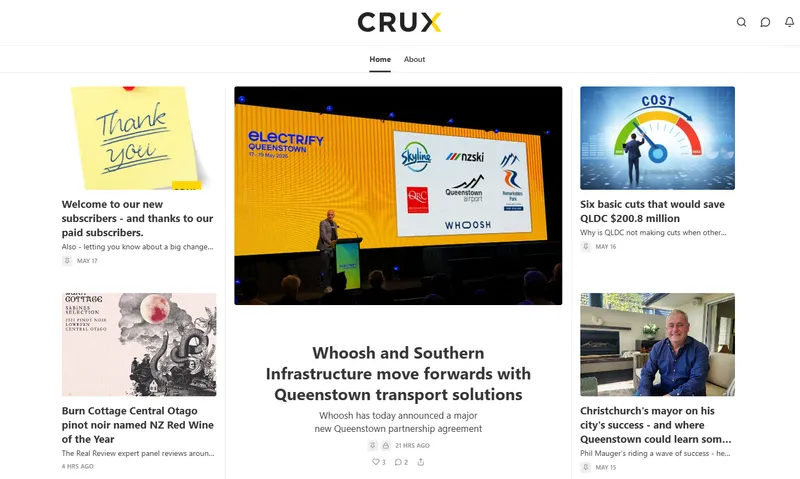
He holds deep grudges against some councillors, staff and former mayors. He claims the council’s decision to buy ads with competitor Mountain Scene rather than Crux “has amounted, in effect, to censorship.” In March, he published an article naming everyone who had liked a post on LinkedIn celebrating a Media Council decision against Crux, labelling them as “against transparency”. That article led to another Media Council ruling against Crux.
At the 2022 local body elections, Newport made the highly unconventional move of running for a seat on the Queenstown Lakes District Council while continuing to cover the council as a journalist. He finished fifth in the Queenstown-Whakatipu Ward, which elects four councillors. He saw the campaign as an extension of his role as a community advocate but in hindsight says, “I think it would have crossed the line”.
“It was an experiment. I was so frustrated because I thought I was trying everything and nothing was improving much. I thought maybe I could tackle the battle from inside the fence. I know a lot of councillors think that they can only change the system from inside. I think with the benefit of hindsight it wouldn’t have worked, but it was pure frustration,” he says.
In a world where local newspapers are increasingly non-existent, Newport has found a way to financially support himself by investigating local issues. His subscribers evidently see value in his work. But he’s doing it without some of the traditional principles of journalism or the industry body that upholds them.
“Is it right that I’m a one-man crusade?” Newport says. “What’s right and what’s wrong? I’m a journalist.”

Joel MacManus
Joel MacManus is a senior writer for The Spinoff. He previously worked at RNZ and Stuff, and began his career at Critic Te Ārohi. His writing explores the political, economic and cultural systems that underpin modern New Zealand. He won the 2025 Voyager Media Award for Best Columnist, Opinion or Critique.


