Pavlova was invented in Dunedin. Or maybe Germany. But definitely not Australia

Is this a pavlova or a schaum torte? Image: Tina Tiller
The origins of the beloved dessert are more complicated than you think.
Of all the New Zealand inventions which Australia has attempted to steal – sausage sizzles, Phar Lap, Russell Crowe – there is none that raises the hackles more than pavlova.
The best known Australian origin claim, once cited in the Macquarie Dictionary, was that chef Bert Sachse invented the pavlova at Esplanade Hotel in Perth in 1935. However, that can’t possibly be true: by 1934 New Zealand newspapers had already published several food columns discussing the various ways to make a pavlova.
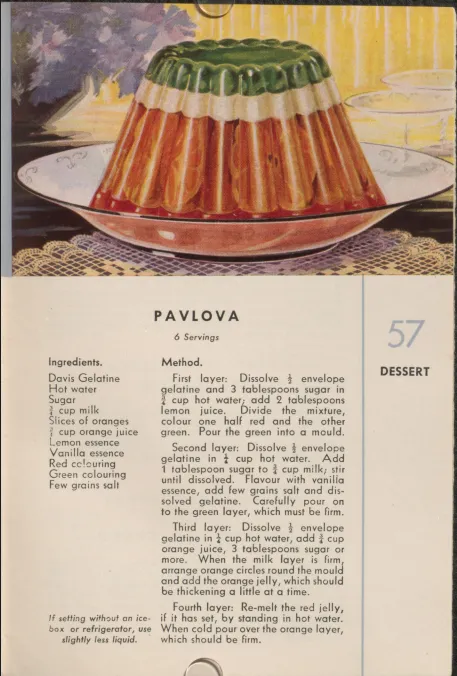
Some Australians have pointed to a 1926 recipe from the cookbook Davis Dainty Dishes, published in Sydney. But the “pavlova” described is nothing like the meringue-based dessert we know. It was actually a multi-layered jelly monstrosity.
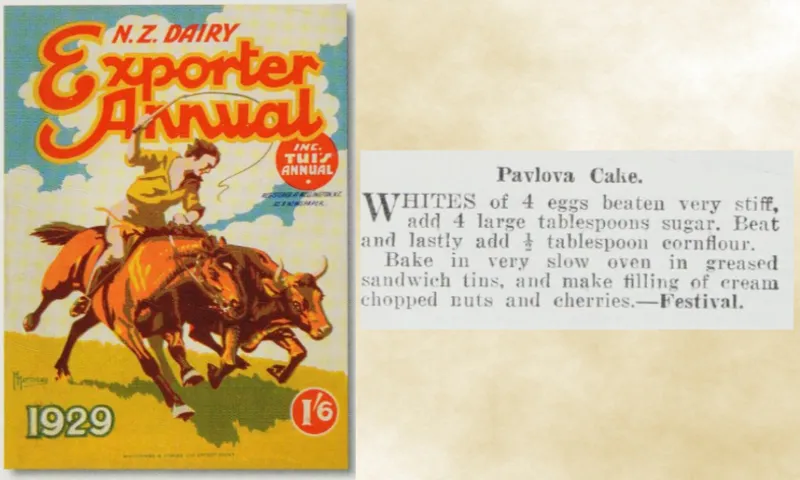
The strongest New Zealand claim is from 1929, when the N.Z Dairy Exporter Annual published a recipe for “pavlova cake” submitted by an author writing under the nom de plume “Festival”. It was a wide, cake-sized meringue topped with cream and fruit. Surely, this was the first modern pavlova? Well, maybe not.
In 2023, US food writer Susan Puckett found a handwritten recipe for “Nana’s Schaum Torte” which her great-grandmother acquired from a friend in Wisconsin around the turn of the century. When Puckett followed the recipe, this is what she made:
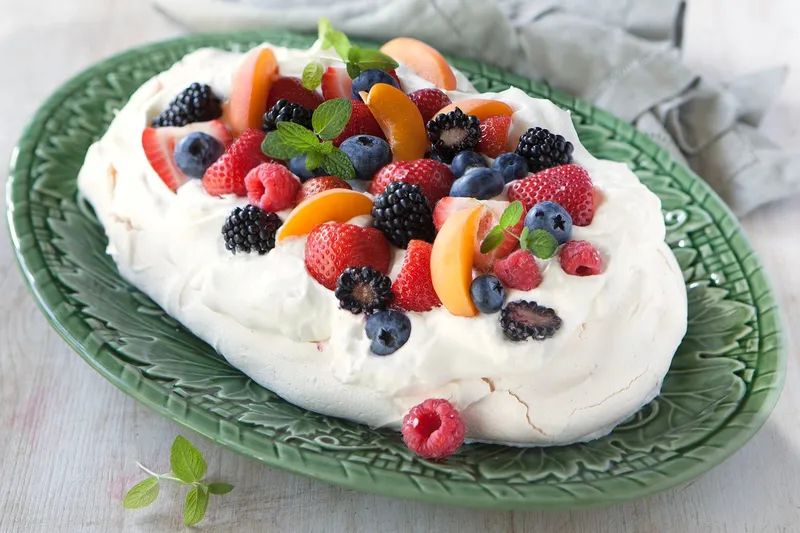
Schaum Torte is exactly identical to a pavlova: a cake-sized meringue base topped with whipped cream and fresh seasonal fruits. And it has a much older culinary history.
A recipe for Schaum Torte, which is German for “foam cake”, appeared in the 1845 cookbook Praktisches Kochbuch für die gewöhnliche und feinere Küche, written by Henriette Davidis. The original recipe was more like a meringue tart with a pastry base, but by the time it was introduced to the US by German-speaking immigrants around the 1870s, it had evolved into a standalone meringue cake.
Schaum Torte is particularly associated with the culinary tradition of Wisconsin, where more than 40% of the population claim German heritage. It’s a staple of traditional midwestern “supper club” restaurants, and is usually served with strawberries as a light dessert after a hearty meal.
The reality may be that neither New Zealand or Australia were the first to create the dish we call pavlova. It may have been imported from Europe or the US or may be a case of parallel invention. In any case, there is a long tradition of meringue-based desserts which predates the first pavlova.
That means the true inventor of pavlova wasn’t the author of the first recipe, but the person who came up with the name. And that’s arguably the more important innovation.
The Russian ballet dancer Anna Pavlova toured the world extensively from 1907 until her death in 1931. Her 1926 tour of New Zealand and Australia was a sensation that gripped both nations. Her global fame, memorable name, and dainty gracefulness inspired many people to name things after her.
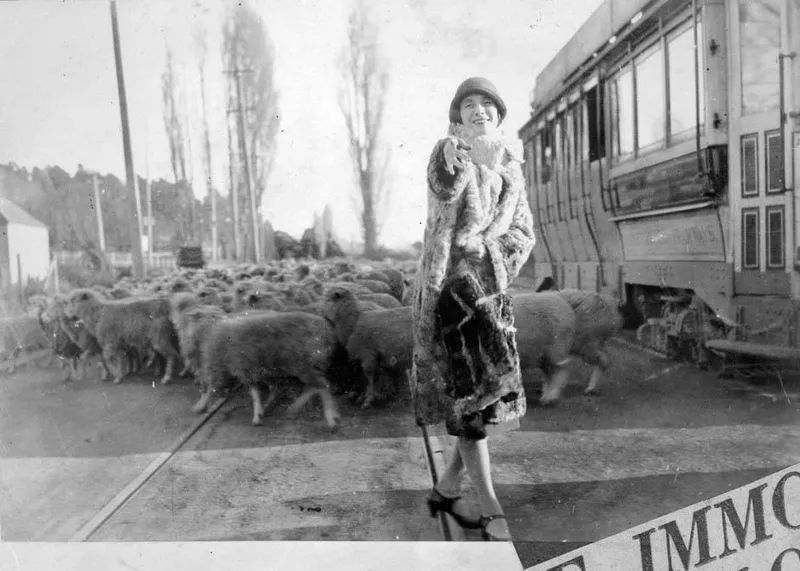
Aside from Australian jelly pavlova, the list of things named after her includes a strawberry ice block, an ice cream, a sherbet, a sponge cake, a shade of blue, and a dish called frog’s legs à la Pavlova. But nothing ever stuck until Rosina Henrietta Rutherford, a 59-year-old Irish immigrant living in Dunedin, got involved.
On September 5, 1928 Rutherford published her original recipe for “pavlova cakes” in the Weekly Press. They were small, brown meringues flavoured with coffee essence and chopped walnuts. The recipe did not call for cream or fruit. It came two weeks after the Otago Witness falsely reported that Anna Pavlova had retired, which may have inspired Rutherford’s choice of name.
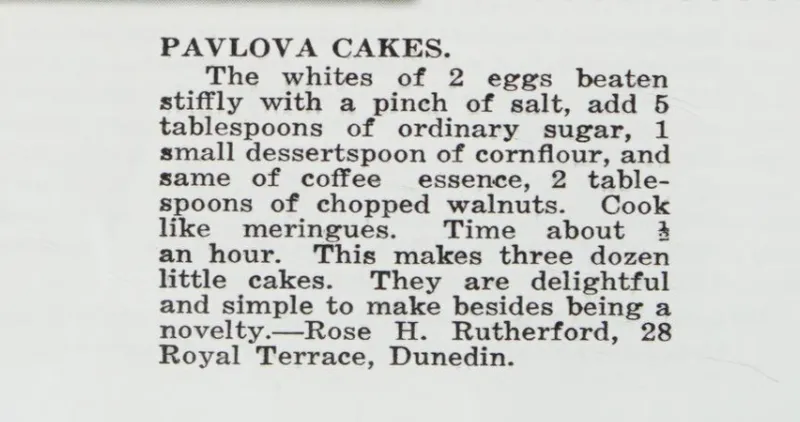
Rutherford’s recipe was an instant hit that was republished in several newspapers and books, including the 1936 edition of the Edmonds’ Sure to Rise Cookery Book – the first time a dish titled “pavlova” appeared in New Zealand’s national cookbook.
New Zealand’s pre-eminent pavlova historian, the late Otago University professor Helen Leach, argued Rutherford’s recipe was so popular that New Zealanders started using “pavlova” to refer to all meringue cakes.
“Renaming the large meringue cake a ‘pavlova’ was simply jumping on the bandwagon,” Leach wrote in her book The Pavlova Story: a slice of New Zealand culinary history. The pavlova recipe written by “Festival” in the NZ Dairy Exporter Annual was really an existing recipe with a new name inspired by Rutherford’s idea.
Leach uncovered what may be considered the “missing link” in the evolutionary chain of pavlova. In October 1928, a month after Rutherford first published her recipe, someone called “Auntie Lis” copied Rutherford’s recipe inside a North-East Valley Presbyterian Church cookbook and gifted it to “Sheila”.
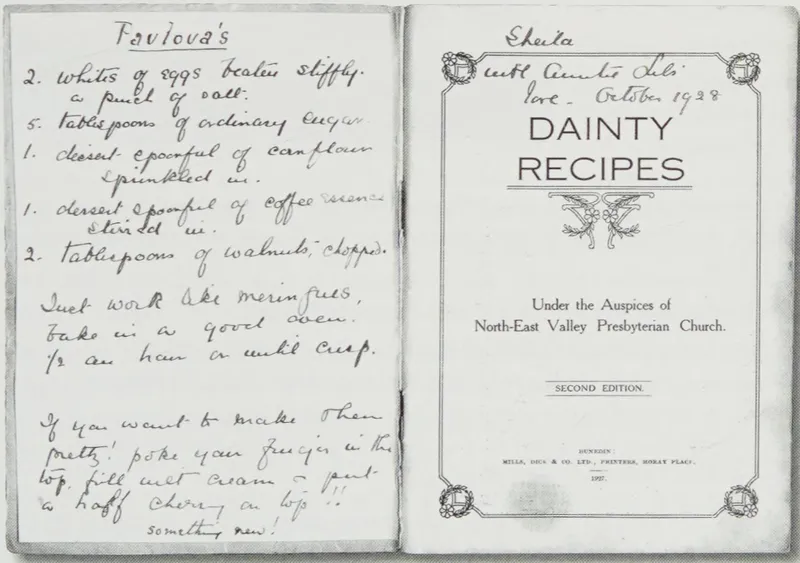
Auntie Lis added a serving suggestion at the bottom of the page: “If you want to make them pretty! poke your finger in the top, fill with cream & put a half cherry on top!! something new!”. This hand-written note is the first evidence of a meringue-based dessert topped with cream and fruit called pavlova.
Pavlova expanded over time from coffee-flavoured meringues to the cream-and-fruit meringue cake which is today enjoyed across New Zealand, Australia and Wisconsin.
The origins of the name can be directly linked to New Zealand and specifically the city of Dunedin. The house where it was invented, which still stands at 28 Royal Terrace, ought to be acquired by the government and turned into a pavlova museum. And Rose Rutherford should be forever recognised as New Zealand’s greatest inventor named Rutherford.

Joel MacManus
Joel MacManus is a senior writer for The Spinoff. He previously worked at RNZ and Stuff, and began his career at Critic Te Ārohi. His writing explores the political, economic and cultural systems that underpin modern New Zealand. He won the 2025 Voyager Media Award for Best Columnist, Opinion or Critique.


