And then along came Winston

Winston Peters, pictured here in a rodeo, or a soap opera, or mustering cattle, who can say?
The saga of Luxon’s leadership simply wouldn’t be complete without the superstar stealing the scene.
Christopher Luxon blasted media’s “soap opera” obsession with the internal discontent around his leadership. But if it is a soap opera, the main character has to take part. If there was a big, soaring scene in the flag-carrier of New Zealand soaps, Shortland Street, you’d expect Dr Chris Warner to play a role, wouldn’t you? And who is the Dr Chris Warner of the great New Zealand political storyline? The Rt Hon Winston Peters, clearly. And so on to the set he walked, declaring, almost, Please tell me this is not your caucus.
Freed from the shackles of the deputy prime ministership, the leader of the New Zealand First Party has mastered the Jedi mind trick of being in government and opposition at the same time. Asked by reporters on his exit from parliamentary question time for a view on Luxon calling a caucus vote of confidence on himself, he said Luxon had made a “very bad move” and “there are going to be consequences for that” – essentially, that he’d broken the seal and further confidence votes would follow.
In a brief dance across the chessboard tiles, the grandmaster upbraided the media for failing to understand the history New Zealand First is making, castigated their polls and invited them to survey the public on whether he should be the one leading the beleaguered National Party. Along the way he flashed three dazzling smiles, the power of which, if successfully harnessed, would be enough to ensure New Zealand’s energy security forever.
At that point it seemed like a dazzling cameo, frustrating for Luxon and co, but fleeting. He can hardly help it if the press pack are hounding him, can he? First of all, yes, of course he can. But also, he was set upon not a guest star billing, but an episode all of his own. He rose like the sun this morning and it’s Winston Peters, everywhere.
There he is on Ryan Bridge Today, elaborating on his comments, saying, “I suppose if you take your eyes off the prize, which is economic and social recovery in New Zealand, then it’s not surprising that this sort of internecine strike within a political party is happening.” Should you wonder whether such comments might destabilise, he’s got news for you. “This country desperately needs stability and we [New Zealand First] represent it in New Zealand politics today.”
Flick across to Breakfast on TVNZ1 and there he is, telling Tova O’Brien why a leader calling a confidence vote on himself is a bad idea. “It promotes doubt, it promotes uncertainty, it promotes division.” It was all an “ego trip” when “voters want stability”. What might the “consequences” be? “This is unprecedented in New Zealand politics,” he says. “It invites another [confidence vote] and you know when the next one will come out? Not long after the next polls come out.”
O’Brien asks Peters if he knows the numbers from the secret ballot in the National caucus.
“Do I have an idea of which way and when? I do, but that’s my business and I’m keeping it to myself.”
“Do you know whether it was close?”
“It’s worrying. That’s the point.”
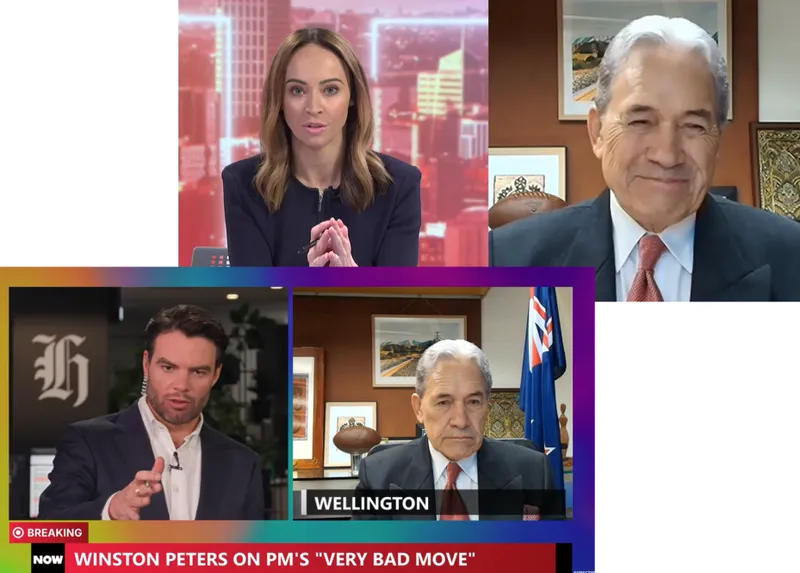
Asked what NZ First might do should Luxon be replaced, Peters says the party’s commitment is to “ensure the government’s political stability all the way to the election”. His parting words: “Well, Tova, there’s no substitute for experience in a crisis.”
John Campbell has the kettle on at Morning Report on RNZ, where he reminds listeners that in the years since Peters was first elected to parliament in 1978, there have been 12 prime ministers, 12 National Party leaders, 12 Labour Party leaders, and one New Zealand First leader. Peters repeats his argument about Luxon inviting trouble. “Unprecedented,” he says.
“Just wait for the next round of polls. And that’s the sad thing … there are seriously predictable consequences. I was astonished that they didn’t seem to understand, sadly, what they were doing. And here we are part of the coalition where stability of government all the way to the 2026 election and beyond is the critical component. And this is not helpful.”
“When I first arrived here, there were people who were conspiring against our leader at the time [Rob Muldoon], even though we had just won the election. And they were, in some cases, people who hadn’t been in politics or parliament for five minutes. So as somebody, you know, with a legal background, I’m sitting there thinking, where’s the evidence and where is the facts … And sadly, it was all to do with what they didn’t know, not what they knew.”
Campbell shuttles us 48 years forward to the present day. Should Luxon, in accordance with the coalition agreement’s no-surprises provision, have privately informed his fellow coalition party leaders that the confidence vote was happening? “It would have been wise to, yes, of course. You’re asking a question that’s on a legal basis, but in the plain ambit of human relations and cooperation, the answer is, of course, yes.”
But, no, Peters would not have ended the coalition if National had replaced Luxon. “Because we have to ensure that the people listening to this radio programme right now have their concerns first and foremost in our minds, not our own egotistical advancement. That’s the point here.”
That is not quite the end of the morning’s rodeo.
Nicola Willis, National’s deputy leader, follows soon after and it’s fair to say she isn’t entirely sold by Peters’ insistence that stability is his north star. “I’ll tell you what invites further instability,” she tells Ingrid Hipkiss. “A vote for Winston Peters that could result in a Labour-Te-Pāti-Māori-Green government, and all he is doing is courting votes and trying to cause mischief that way.”
There’s more: “And it’s my position that if you want a strong, stable government, you should be voting for National, because Winston Peters has a track record of picking Labour over National and that’s the risk you run with him.”
Luxon had a pop himself this afternoon, telling Newstalk ZB Peters was “scaremongering” in opposing the free trade deal with India, and displaying an “anti-immigrant bias”, before adding of NZ First: “They’re the guys that claim to be socially conservative and then put Jacinda Ardern into power.”
The ratcheting of that rhetoric can be pegged to a few things: a coalition partner’s provocations after a bruising few days, that’s a lot of it. But also the fact that, according to research by pollster David Farrar, the lion’s share of the growth in support being enjoyed by NZ First recently is being drawn from the National Party.
Across the three most recent polls, New Zealand First is averaging just under 13%, an astonishing rise when you consider that three years ago the party was polling at 2.5% and at the election won 6.1% of the vote. Part of this is a global phenomenon – Reform, led by Peters’ friend Nigel Farage, has been first in every UK poll, ahead of both the Conservatives and Labour, for more than a year.
So why would Peters think he couldn’t do the same in New Zealand? Why wouldn’t he be boasting that he is about to change history? After all, in Sunday’s Verian poll for 1News, he was the bolter in the preferred prime minister category, up two points to 12% as Luxon slid four to 16%. If that trend were to continue to the next one, Winston Peters would be more popular than the leader of the National Party, and that’s something that does have a precedent, if you cast your gaze back a decade or three.

Toby Manhire
Toby Manhire is editor-at-large at The Spinoff. He loves to cast a pod, whether it's Gone By Lunchtime, At Large or Juggernaut. He is a former editor of The Spinoff and has worked as a journalist in NZ and the UK since the last millennium.


