Review: Caterpillar is an essential love letter to mothers and daughters

Lisa Harrow in Caterpillar
Alex Casey reviews the new local multi-generational drama written and directed by Chelsie Preston Crayford.
There’s something going on with Mum Stuff in our local pop culture canon over the last year. We could look to music, where both The Beths and Lorde released devastating mum anthems in the shattering reflections of ‘Mother Pray For Me’ and the harried ambitions of ‘Favourite Daughter’. In cinemas, Tinā followed a grieving mother rebuilding herself after the loss of her daughter, Pike River brought tenacious real-life mothers to the big screen, and Marlon Williams opened up about his nuanced relationship with his own mum in Ngā Ao E Rua – Two Worlds.
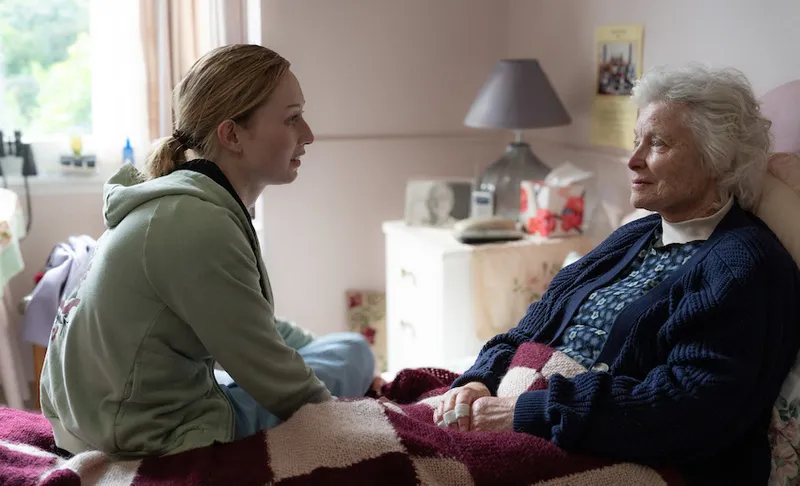
All of those mum-based complexities, joys and pains continue to spread their wings in Caterpillar, the sublime debut feature written and directed by Chelsie Preston Crayford. Set in Pōneke in 2003, the film is centred around a household of three generations of women. Cassie (Anais Shand) is the teenager struggling to find herself amid Shakespeare and house parties, Maxine (Marta Dusseldorp) is juggling life as a single parent and dogged filmmaker, and Huia (Lisa Harrow) is the grandmother secretly navigating the devastating onset of dementia.
Caterpillar will lure you in with its initial lightness of touch, including Cassie’s absurd Mr-G-meets-David-Brent Shakespeare tutor Cam (Matt Whelan) and Maxine’s melodramatic pitch to a baffled bank teller (“If I don’t make films, I start to die”). But just like Cam’s array of capri pants, this film contains multitudes. As the building blocks of their lives start to shift, all three women are forced to confront their changing roles in relation to the world, and each other. “It’s funny how you can feel like a superhero at work and complete shit at home,” says Maxine.
The three leads navigating these rich characters are nothing short of remarkable. Shand’s sassy Cassie expertly captures the wafer-thin bravado of adolescence, cracking the veneer just enough to reveal a girl still figuring out who she is. As Maxine, Dusseldorp is a force of nature in the boardroom, but falls to pieces in her own kitchen. “I thought I’d cook,” she suggests nonchalantly. “…What would you cook if you were cooking?” Balancing them out is the serene calm and childlike wonder of Lisa Harrow’s Huia, quietly fighting the biggest battle of them all.
Adding to the authenticity of the performances is the extremely realistic rendering of 2003 suburban Wellington. Particularly for those who came of age in the mid-2000s, Cassie’s bedroom littered with stacks of CDs, Britney Spears posters and Real Groovy stickers will feel all too real. The soundtrack too is packed with Y2K treats such as Stellar*’s ‘Violent’ and Zed’s ‘Renegade Fighter’, but it’s a party scene opening with Savage’s verse in the ‘Not Many’ remix and ending with Concord Dawn’s ‘Morning Light’ which delivers millennial chills like no other.
There’s so many other scenes in Caterpillar that will stick with you long after the credits have rolled and/or you’ve finally stopped crying. Unapologetically domestic in its scope, this is a love letter to mothers, daughters and the messy, complex space between them. As fictional actress Catherine Berry says of Maxine’s own film-within-the-film, it’s about “the bigness of small things”. In our current hellscape dominated by conflict, violence and the manosphere, watching something so tender and nuanced about women’s lives feels like coming up for air.
And for those of us still lucky enough to have them around, a warning: you will leave the cinema wanting to call your mum.
Caterpillar is in cinemas nationwide now.

Alex Casey
Alex Casey is a senior writer at The Spinoff with over a decade of experience writing about popular culture and social issues in Aotearoa. She lives in Ōtautahi and likes watching reality TV and walking the dog, occasionally at the same time.


