Impressive: Winston Peters is in government and opposition at the same time

Voters dissatisfied with the government are flocking to NZ First. (Image: Tina Tiller)
Finding a way not only to elude anger over the government’s performance, but actively benefit from it, might be the NZ First leader’s most impressive MMP magic trick yet.
The latest RNZ-Reid Research poll result is disappointing for a majority of the government. National’s support is down 0.6% to 31.9%. Just 19.4% of New Zealanders rank Christopher Luxon as their preferred prime minister, roughly similar to the number who don’t believe in climate change. Act’s principled stance against new housing near Epsomites’ pools hasn’t fully arrested its slow downward trend this term, with the party rising just 0.4% to 7.6% in the poll.
Under the circumstances, you’d expect the left to be flourishing. But while Labour’s support has risen 0.7% to 35%, the Greens have more than neutralised that with a 1.2% slide. Instead, it’s New Zealand First that’s surging. Its 1.1% ascent is propelled by dissatisfaction with the government, with more of its voters saying the country is on the wrong track than the right one.
The electorate’s decision to express dissatisfaction with the government by backing NZ First is slightly unusual given, at the time of publishing, NZ First is also in the government. Some eagle-eyed political observers might even recall that the party’s leader, Winston Peters, was the deputy prime minister just seven months ago. He’s actually, according to the website beehive.govt, still acting as the foreign minister and as something called “minister of racing”.
Peters has always been the master of MMP, somehow wheedling his way into holding the balance of power in approximately all of the general elections we’ve held since the system was first used in 1996. But his successful effort to not just elude blame for the country’s current troubles but actively benefit from them might be his greatest political magic trick in a career full of them.
He’s done so by becoming the Schrödinger’s cat of politics, finding a way to serve in both the government and the opposition at the same time. It’s a balancing act he’s never been able to nail before. In 1998, he exploded the governing coalition rather than accept Jenny Shipley’s decision to depose his preferred prime minister, Jim Bolger. Under Labour administrations, he’s often temporarily abandoned firebrand populism to fulfil the functions of office, only reverting to his most pugnacious form during election campaigns or conversations involving Jack Tame.
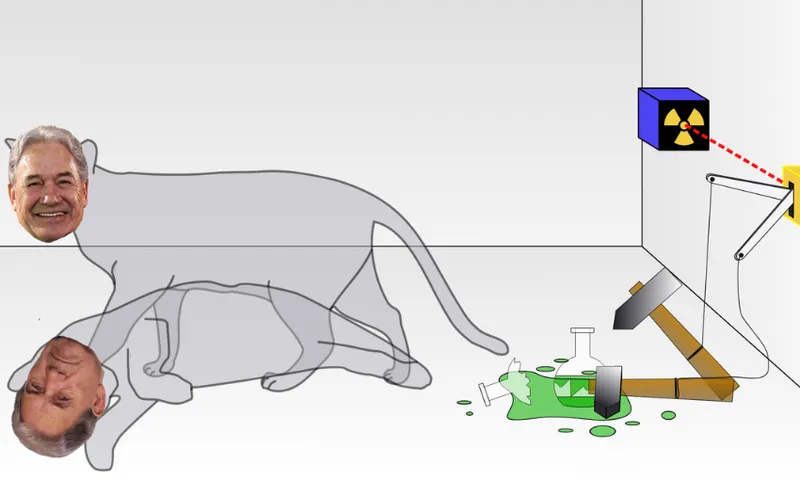
This time round, Peters has pioneered a new method. Instead of saving his friendly fire for one big barrage in election season, he’s been shanking his coalition partners in the ribs at random intervals throughout the term. NZ First’s first time invoking its “agree to disagree” clause came in 2024, when Peters objected to the setup of the government’s expanded Covid inquiry. More recently, he’s vowed not to vote for the free-trade agreement National has negotiated with India, telling the media it’s “far too generous” and has been struck for “political purposes rather than economic advantage for New Zealand”. National is now stuck asking Labour for legislative help.
Other shots have been directed at National’s other minor coalition partner. Days after Act finally achieved its 20-year dream of passing a regulatory standards bill, Peters vowed to repeal it if he got the chance. “It was their deal, the Act Party’s deal with the National Party. We were opposed to this from the word go but you’ve only got so many cards you can play,” he said.
Prime minister Christopher Luxon has made a point of appearing philosophical over the broadsides from his own coalition partner, perhaps recognising that Peters is just trying to ensure his party’s political survival. But restraint might be getting more difficult, given the most painful attacks are increasingly directed at National – and the prime minister’s – sorest spot.
Respondents to the RNZ-Reid Research poll identified cost of living as their most pressing concern, with nearly 60% of them saying it was harder to get by this year than last. The NZ First leader has been outspoken on his coalition partner’s economic stewardship, railing against suggestions that it might look at asset sales to shore up the books. “Because they’ve failed to run the economy properly, they want to go to the assets of a time when the country was run properly, when we were number two in the world and built up by our forefathers and to start to flog those off… to so-called balance their books,” he told RNZ. “This is a tawdry silly argument.”
Why is the economy doing so poorly though? Peters has been clear that National’s tax cuts, brought in to honour a 2023 election campaign promise, were unaffordable and have held the country back. In a year-end interview with RNZ six weeks ago, he announced we’d be in a better place if National had sucked it up and explained to voters the tax cuts had to be delayed. If it had done so we would be “a year on from where we are now”, he said.
National’s tax reductions were enabled through the Taxation (Budget Measures) Bill, which was passed as part of the government’s 2024 budget. All three opposition parties voted against the package, with Labour’s Deborah Russell calling it a “sneaky bill” and the Greens’ Chlöe Swarbrick saying it obscured “the fundamental unfairness of our economy and our tax system”.
They met fiery resistance. “I’m proud to say that we support this bill,” said NZ First’s Tanya Unkovich as she rose to represent her party. “We support this bill, not only because of what it will do for hard-working New Zealanders but also because it’s another example of this government delivering.” Earlier, Peters had announced that “today, our country has just changed gears – from reverse and backwards to forwards and progress”. All the tax measures passed with 49 votes from National, 11 from Act and eight from New Zealand First.
Peters’ efforts to hold National to account for the economy are expected to ramp up as the election approaches.

Hayden Donnell
Hayden Donnell is a senior writer for The Spinoff. He previously worked at RNZ, TVNZ and the New Zealand Herald, alongside other media companies that have since closed down or been renamed. His primary passions are local politics and the Big Fresh animatronic fruit and veggies.


