The reopening of Wellington library Te Matapihi ki te Ao Nui is a game-changer for the capital

Made possible by


Claire Mabey gets a tour of Wellington’s refurbished central library ahead of its reopening on Saturday.
A clear blue sky and a light breeze follows me to the corner of Harris and Victoria Streets where I’m to be let in through the gnarly temporary fencing so I can tour Te Matapihi ki te Ao Nui. The fencing, people in hi-vis and the construction debris still laying around the edges of the building make me nervous that Wellington’s central library may not be ready for its grand reopening this weekend.
Kirsten Mason, principal creative producer for the reopening project, greets me at the fence with a broad smile. She ushers me through the gate and sliding doors into Te Matapihi – I’m instantly struck by the beauty and the strange familiarity of this space.
As we walk into the belly of the building my eyes catch on bookshelves intricately painted with plants and fungi and flowers. They’re in the children’s area which lies adjacent to broad, comfy-looking bleachers that climb up alongside the vast windows on the Harris St side. Then I notice the carpets: sandstone and purply grey swirl underfoot like paint or the beach. I’m tempted to kneel down and kiss the floor. It’s been so long – Te Matapihi shut its doors abruptly in 2019 due to structural vulnerabilities. So long that my nearly-eight-year-old son doesn’t remember the library at all.
When the fences come down and the doors open and Wellingtonians return to Te Matapihi this weekend, they will experience both a rush of familiarity and the awe and pleasure of improvement. The original designers of the building, which first opened in 1991, Athfield Architects, worked in collaboration with Tihei Limited, led by renowned designer and artist Rangi Kipa (Te Ātiawa, Taranaki, Ngāti Tama ki te Tauihu). Kipa’s design kaupapa for Te Matapihi is grounded in te Taiao and you can sense that in every detail, from the font choices on the digital screens, to the manu painted on the walls of the meeting rooms, to the wavy seats designed to mimic the shoreline.
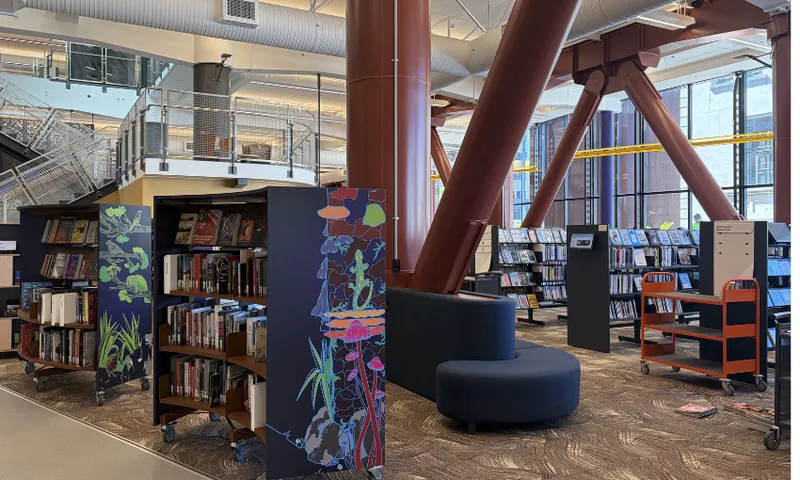
The most striking visual changes are the great, big terracotta bolsters that extend from the floors to the ceilings like the branches of ancient trees: these are the earthquake strengthening measures that have made the building one of the safest in the city. The second striking change is the light: windows, windows everywhere! Sunlight pours in and over the bookshelves and the carpets and people on every floor and offer portals out to our beautiful city. The third striking change, and to my mind one of the most important, is that Te Matapihi now opens directly out onto Te Ngākau. No more stairs, just a flat entranceway from which you can wander from the library’s cafe, Central Ground, out into the open arms of the city’s civic square which is, as I type, having a glow-up with fresh pavings and fountains.
The return of our library, and investment into Te Ngākau is a game-changer for Te Whanganui-a-Tara. To have a dedicated public gathering space hemmed by a swish new library, a strengthened City Gallery and, soon, the long-awaited, upgraded Te Whare Whakarauika town hall (reopening February 2027) is to return the lifeblood to the beating heart of civic art, entertainment and communion.
“The aim is to touch the lives of every Wellingtonian from age 0 to 100,” Gisella Carr, redesign project leader for Wellington City Council, tells me as we mill around the cafe with a clutch of librarians. Sam Huy, who was running Clark’s Cafe before the library closed, and who is running Common Ground at Waitohi, is giving away free coffee and delicious baking to library staff so he can test their machines and processes ahead of the weekend. While we wait for our coffee I take the chance to ask librarians how they’re feeling.
Hibiscus Tupua-Wilson, custom service librarian, is super excited. It’s her first time working at Te Matapihi, having previously worked at Arapaki on Manners Street (one of the two temporary libraries set up while we waited for the refurbish). “I can’t wait to welcome everybody back,” she says, though notes it will be different. Wellington has changed a lot over the last seven years. Zoe Miller, ethnic communities engagement coordinator, is looking forward to showing new migrants and former refugees around Te Matapihi. “We’re really proud of our children’s languages collections,” she says, explaining that they have grown a lot in the intervening years. She’s also excited for those communities to have such a beautiful, free indoor space that’s so well serviced.
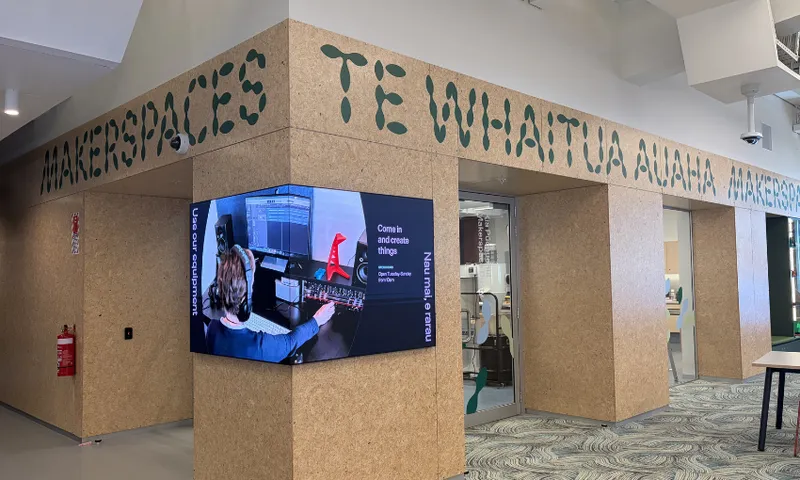
Manaakitanga is a core value of Te Matapihi. Emily Loughnan, founder of digital design company Click Suite, and now freelancer, has been working for a few years on Te Matapihi’s digital footprint. She is virtually glowing as she takes me on a tour of the screens that wrap around columns and corners. “Every screen has a purpose,” she says, pointing to the screen beside Central Ground which invites viewers to learn te reo, one kupu at a time, and that informs visitors of events coming up. “Every screen is about overcoming threshold anxiety and explaining how each space works,” says Loughnan as we arrive at the Makerspace studio which I am told has the “best toys” and is free to use and for schools to book. I ask about the font, which to me looks like a string of beads. Loughnan explains it is inspired by kākano (seeds) and was designed for Te Matapihi by Extended Whanau. It’s called the Pihi font.
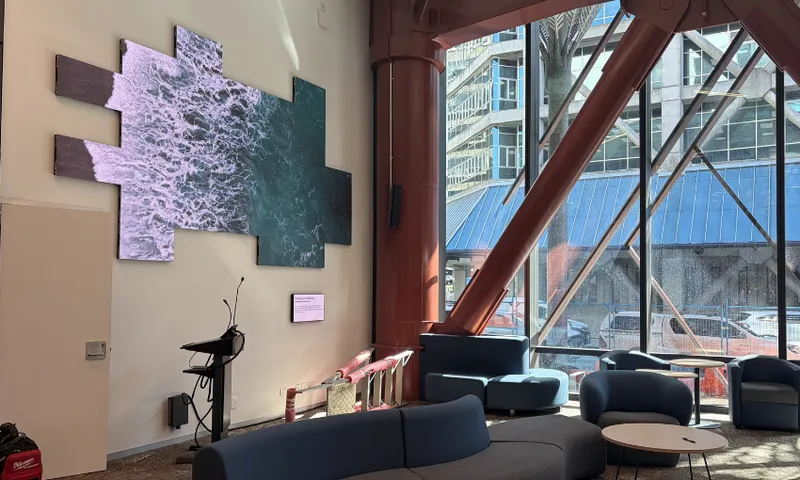
The cherry on Loughnan’s digital cake is the stunning screen that sits on the wall in front of the bleachers on the ground floor: it looks like a large puzzle piece in outline. When we approach, it is showing drone footage of the coastline at Red Rocks, the sea all foam-lacy, flowing in and out of the reach of the sand. “I want to fill people’s cups,” says Loughnan. “I want them to gaze and not scroll.” Every piece of video footage showcases a part of Te Whanganui-a-Tara and comes with an accompanying digital caption that tells viewers where and how to go to see it in real life. The next video that pops up is a stunning three-dimensional model of Victoria St, the ground under our feet, as it would have been in 1800. The shoreline, the harakeke planted by Te Āti Awa, the Waikoukou stream (now underground), the 50 shades of green thanks to the rich variety of trees and shrubs. The video responds to the real weather outside, so today there are soft cotton clouds in a bright blue sky and a light breeze in the nīkau fronds. It is mesmerising.
Back at Central Ground, I join a gaggle of library staff discussing Redmer Yska’s opinion piece published in The Post that morning. In his piece, written on behalf of community group Save Our Library, Yska argues that the lack of security gates and the increase in entry/exits, as well as the decreased number of books held at Te Matapihi, marks “a steady attrition of books” and works against Te Matapihi’s honouring and recognition of Jacqui Sturm, a writer and librarian who built the New Zealand Reference Collection over decades and championed Māori literature. Her poem ‘Brown Optimism’ is proudly installed on the side of the building for all to encounter and absorb.
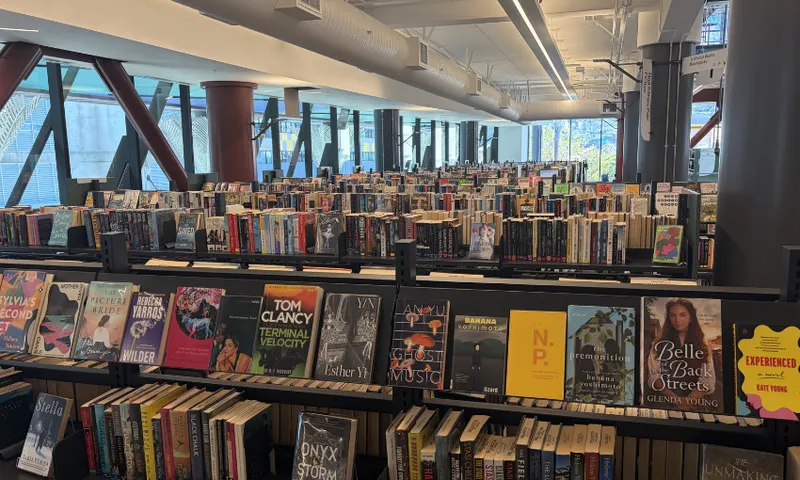
One librarian, who asked not to be named, told me that it costs a lot more to run security gates than it does to replace books, and that visitor data shows that what an upgraded Te Matapihi needed to provide was more space for people. And, they say, there are still a lot of books. There will be 250,000 items housed on over 7,000 shelves in the public spaces; and the total collection size is estimated to be 402,000 with around 152,000 items available upon request. It certainly feels like a lot of books. I immerse myself in rows and rows of standing bookshelves, breathing in that particular library smell, so comforting and so safe.
As for security? What moves me most about spending a day surrounded by librarians gleeful, if not a little anxious, about their new home, is the manaakitanga and the trust. These are people who love people. Te Matapihi is a high-trust model and that is an incredibly optimistic and humane state of being in this world.
Sam calls out my name. My flat white is ready. It looks good. I carry it to one of the generously proportioned tables arranged in a cluster, like berries on a vine, in a sun-soaked spot that looks out the sweeping windows to the activity of improvement happening on Te Ngākau.
I think about how much Wellington needs Te Matapihi. It’s no secret that the city has been through a rough time since the Kaikōura earthquake destabilised infrastructure and the economy paired with the current government’s cuts to the public service leading to about 10,000 fewer jobs.
The buzz of chatter from the librarians fades as they head back to their respective zones to keep preparing: shelving, testing, clearing away boxes.
Te Matapihi is warm and beautiful and ready. All it needs now is people.
Te Matapihi ki te Ao Nui reopens at 10am, Saturday, March 14. Eight choirs, and taonga pūoro artist Alistair Fraser, will perform a new song composed for Te Matapihi by Briar Prastiti. The Explore Te Matapihi festival will take place April 11-12 and will include talks, tours, activities so Wellingtonians can get to know their new home away from home. Details will be on the Te Matapihi website soon.
The Spinoff Books section is proudly brought to you by Unity Books and Creative New Zealand. Visit Unity Books online today.

Claire Mabey
Claire Mabey is a children's author of The Raven's Eye Runaways, The Raven's Eye Rebellion, and a picture book Cass and the Beast illustrated by Jill Calder. For a long time Claire worked on literary festivals and is the founder of Verb Wellington. She lives in Te Whanganui-a-Tara with her partner and son.


