Everything you never knew you wanted to know about critical minerals

Critical minerals aren’t pretty, but they’re necessary in modern economic life (Photo: Paul-Alain Hunt on Unsplash)
Anna Fifield breaks down the issues – and how New Zealand fits into it all.
This story was originally published on the author’s Substack, Between Giants.
Foreign minister Winston Peters and US secretary of state Marco Rubio discussed “the ongoing dialogue between our two governments on critical minerals cooperation” during their meeting in Washington earlier this month.
Resources minister Shane Jones has directed officials to resume discussions with the US on a critical minerals agreement, Newsroom reported this week.
The issue has become somewhat controversial in New Zealand since news of the discussions broke, so I thought it would be helpful to explain the issue in detail. When I was Asia editor for the Washington Post, I edited lots of stories relating to rare earths in particular because it was such a bone of contention between Washington and Beijing.
My key point: the modern world would come to a halt if the supply of critical minerals was disrupted or blocked off. This is China’s Strait of Hormuz. Regardless of who’s in the White House, we need a steady supply of critical minerals and rare earths if we want to drive electric cars, use smartphones and get MRIs.
This is one of the relatively rare situations where, just because it’s a Trump administration idea, it doesn’t mean it’s a bad idea by default.
Don’t just take my word for it. “Being part of the international conversation is always important,” Nicola Gaston, a professor of physics at Auckland University and co-director of the MacDiarmid Institute for Advanced Materials and Nanotechnology, told me. “And of course we have to be sensible about the use of resources that are finite in scope.”
So let me break down the issues – and keep reading for the part about New Zealand.
What are critical minerals?
First up: critical minerals are the non-fuel materials that are considered essential to the modern economy – especially energy, defence, and technology – but whose supply is at risk due to their limited availability or geopolitical factors like where they’re located or processed.
The minerals are central to the transition from fossil fuels to renewable energies as many of them are used to make solar panels, wind turbines and batteries. The International Energy Agency predicts that, by 2030, the world is likely to need double the amount of the critical minerals the world is currently producing. And it would need to quadruple by 2040.
The US Department of Energy includes on its list the critical minerals needed for energy: aluminium, cobalt, gallium, iridium, lithium, magnesium, nickel and platinum. Cobalt, lithium and nickel, for example, are used in battery technologies.
Our Ministry of Business, Innovation and Employment last year published a list of 37 minerals considered critical for New Zealand’s economic and technological needs. The government said it would use the list to make sure New Zealand can process the minerals we have, which are shown in this Geological Resource Map of New Zealand.
“For the minerals on the list that we don’t produce, we will engage with our international partners to support supply chain resilience,” MBIE said.
Minerals that we rely on but don’t produce include boron, gallium and indium, all used to make solar panels; and germanium, crucial for making semiconductors that power all computers, including the ones in your car door; molybdenum and selenium, used for fertiliser and for livestock health.
Here’s more from Earth Sciences New Zealand on our critical minerals list and how we use these elements.
In addition, there’s a subset of critical minerals called “rare earths” – which are actually not rare, it’s just that China has a stranglehold on their supply. These 17 metallic elements include antimony, dysprosium, germanium, terbium and ytterbium (stick with me here.) Many of these are used to make magnets, lasers and other components in high-tech industries that make the products we all use in every day life – like the laptop I’m using to write this on and the speaker that’s playing Billie Holiday in the background.
Why has this suddenly become a geopolitical issue?
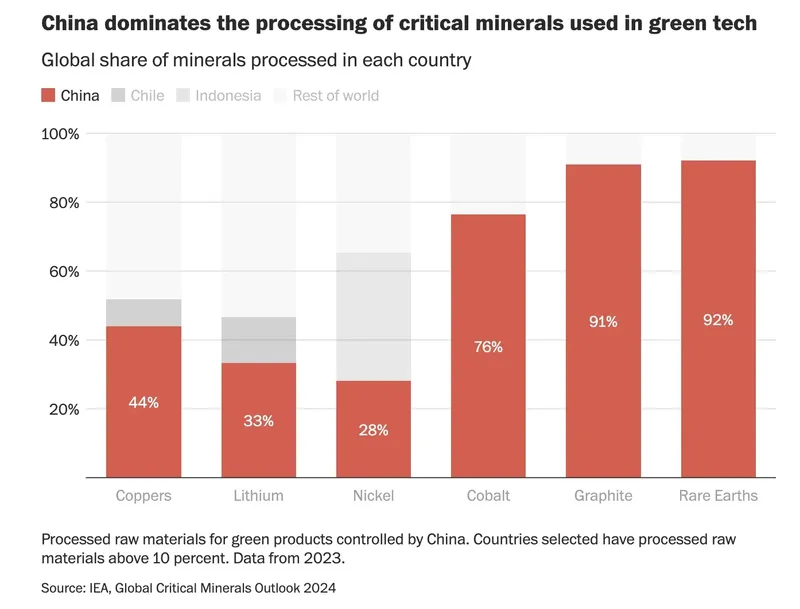
The global supply of many of these minerals has become politicised because of the trade war between President Donald Trump and China. China has a near-monopoly on rare earths in particular, holding about 70 percent of the world’s stocks and processing about 90 percent of them.
China has developed a stranglehold on these minerals in part because it’s the only country willing to embark on the toxic process of chemically refining the metals – and advanced economies were more than happy to let China do the dirty work.
“By the time Western governments grew concerned about their reliance on China for such essential industrial inputs, Chinese companies already processed such vast quantities of the metals at such low prices that refiners elsewhere in the world struggled to compete,” my former colleague Christian Shepherd wrote.
Here’s a chart to illustrate China’s dominance, from one of Christian’s stories for the Washington Post.
Beijing has repeatedly shown it’s not afraid to weaponise these supplies for its political purposes. In 2010, China cut off Japan’s supplies of rare earths during a diplomatic row over disputed islands.
Most recently, China has used rare earths access as a coercive tool after Trump ratcheted up his tariffs on the country, showing it wouldn’t resort to flattery and sign disadvantageous deals like many other countries did but would fight back.
Chinese leader Xi Jinping has called his country’s dominance in strategically important industries like critical minerals an “assassin’s mace” — a weapon that can be used in the case of trade warfare.
China put export restrictions on seven types of rare-earth minerals in April last year, a move that was immediately felt around the world: Suzuki in Japan had to stop producing the Swift for a period. Ford had to scale back SUV production in Chicago. The European Union warned of the need to diversify.
Trump called it “a surprise” and made some concessions on computer chip access to free up rare earths supplies, but the two sides kept going back and forth with their tit-for-tat measures until October, when Trump and Xi met and agreed to a one-year delay in China’s new rare earth export controls during an October meeting to ease tensions.
They are set to cement that deal when they meet in Beijing next month.
Should we build alternative supply chains?
In the year since China started swinging this mineral mace, the US has taken actions to build alternatives to China’s critical minerals supply chain.
The White House has made it a priority to revive and expand the US’s critical minerals industry while also seeking supplies of these elements from allies.
It has deployed nearly NZ$20 billion to create a strategic reserve of critical minerals, a stockpile that could counter China’s ability to use its dominance as leverage. The US has also invested in processing plants around the world, from South Africa to Brazil.
In an effort to create a global network not dependent on China, the administration also invited 54 countries – including New Zealand, and like-minded countries like Australia, Canada, the UK and Japan – to join a preferential minerals trade zone, part of an effort to secure its supply of these metals and elements. Bede Corry, secretary of the Ministry of Foreign Affairs and Trade, represented New Zealand at the talks in February.
Many countries — including Australia, Japan, South Korea and the European Union have signed or in the process of finalising agreements with the United States on critical minerals. (Many have also taken independent steps to reduce their critical minerals vulnerabilities.)
These collaborative efforts show signs of promise but underscore how much remains to be done, according to a new report from JPMorganChase’s Center for Geopolitics. “New processing capacity typically takes two years to come online, while new mines require several years of lead time due to permitting and site preparation,” it said.
So nothing is changing quickly here.
Critics may say this is part of an “America First” trade policy, especially since the US has implemented export controls against China to stop it getting advanced American chips, but it does make sense to diversify the world’s supply of critical minerals to protect against unforeseen disruptions, whether they be political or pandemic-related.
The lessons learned from the critical minerals experience will have implications for other supply chains, the JPMorgan analysts note.
“The core lesson is that concentrated supply chains are not simply a trade or industrial issue; they can become a strategic constraint on commercial resilience, policy flexibility, and national security,” they write. “Concentrated supply chains will remain a source of commercial and geopolitical risk, governments will play a larger role in shaping outcomes, and the search for the next potential chokepoint is likely to intensify.”
What role does New Zealand have to play?
Now, it’s not like we are making semiconductors in New Zealand, but we rely on a steady flow of these minerals into the global supply network to keep our economy going.
These minerals can, however, be controversial for two key reasons.
One, as with any mining, there are environmental considerations. Remember the reason China developed a chokehold on this sector: it was so dangerous and polluting that no-one else wanted to do it. This creates a dilemma because so many of these minerals are used to help make the world cleaner and greener.
Second, many of these minerals have “dual use” applications, meaning they can be used for civilian purposes, like building electric cars, or for military ones, like in the production of fighter jets. One of the critical minerals New Zealand has – vanadium – is routinely used as an alloy to make military-grade steel for submarines, combat vehicles, mortar tubes and howitzer artillery weapons.
Here’s a great timeline on critical minerals used in the defence industrial base if you’re if you’re eager to dig into this more.
So we will want to have a discussion about whether we want to be contributing to the global weapons industry – especially at a time when the US has been chewing through its military stockpiles by attacking Iran.
But New Zealand doesn’t mine that much, Nicola Gaston of Auckland University said.
“Not just because of the environmental concerns but also because we’re not that attractive to international mining companies,” she said. “We do have some deposits and we should consider mining where there is a really big benefit to the local community. But the reality is that returns and royalties in New Zealand are pretty small compared to the investment required, which is quite massive.”
She also noted that State Department advice to American mining companies looking at New Zealand also included guidance about the need to build social licence and to consult with local iwi.
Instead, we could carve out a role in this international industry could be beneficial to us – and the planet.
“New Zealand is not a big player but there might be a niche for us, or we might be able to play a role in a circular economy through recovery and reutilisation,” Gaston said. “On a science and innovation level, there may be ways for our scientific and tech sectors to contribute and leverage international connections, which is a really big, important part of all of this.”
So far, the prospect of New Zealand joining an international cooperative effort to diversify supply chains seems to have become controversial not because of the details of any deal because because of a bureaucratic blunder that has led to coverage of the screw-up but not the substance.
Now, we may decide that we don’t want to be part of this ex-China international effort or that the environmental cost is too high. We may decide we don’t want to contribute our natural resources to war machines. But we should, at the very least, have a public discussion about it.

Anna Fifield
Anna Fifield is the former Asia-Pacific editor and Beijing bureau chief of the Washington Post. She is bow the editor of The Spinoff’s World Bulletin newsletter and writes on New Zealand’s place in the world on her Substack, Between Giants.


