
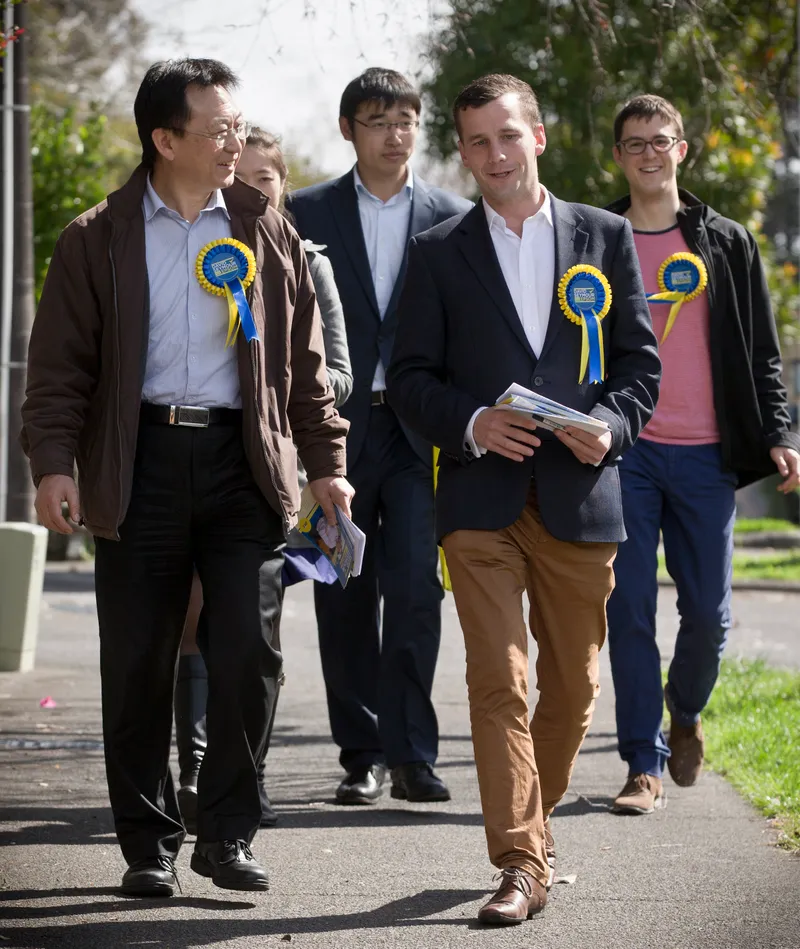
Act leader David Seymour campaigning with candidate James Christmas in Auckland. (Photo: Dean Purcell/New Zealand Herald via Getty Images)
To some he’s a values-driven voice of reason in a sea of political chaos, to others a race-baiting renegade driving division. In the fifth of The Spinoff’s leader profiles, Alice Neville tries to figure out Act’s David Seymour.
One party’s leader has spent a good part of the last year trying to convince the country, including his own caucus, that he’s not totally out of his depth. Another barely goes a week without threatening the coalition’s stability with some transgression or outburst.
David Seymour has some basis, then, for painting himself as the only adult in the room when it comes to the coalition. Launching Act’s election campaign earlier this month, the leader set out his party’s stall: “to steady the ship in a sea of political panic”.
He arrives at his interview with The Spinoff fresh from giving a speech to a business crowd on the unexpected decline of the Kiwi dollar, which he links to “the dumpster fire of a policy debate New Zealand has descended into over the past five weeks”. What has him aghast is that every party except Act is proposing to break up the supermarket duopoly, with National’s recent move to “shamelessly join the pile-on” the most concerning development. “It’s no wonder the New Zealand dollar is in trouble,” he said in the speech. “It’s not just that the coalition might lose office. Ninety percent of the political spectrum has lost its mind.”
The analysis National’s policy is based on is “flimsy”, Seymour says. We’re speaking in his Epsom electorate office – identifiable by a piece of paper stuck to the door saying “David Seymour’s electorate office” – on the second floor of an unassuming office block across the road from the swanky Westfield Newmarket mall. “Maybe consumers will save $13 billion over 20 years in a $27 billion industry. That's 2%, maybe. Food price inflation is 2% a year anyway. So to get one year's food price inflation knocked off, you're prepared to throw out the entire rulebook of politics and policy in New Zealand. Yeah, that seems pretty crazy to me.”
Deregulation, a smaller state, the unfettered market: these are the principles on which the Association of Consumers and Taxpayers was founded 33 years ago. But do the voters care? A clip from the “dumpster fire” speech got 535 likes on Seymour’s Facebook page. A week later, a simple post declaring in bold letters that “Your vote should carry the same weight as anyone else’s, regardless of race” got 1.6K. A grab from last week’s TVNZ leaders’ debate, when Seymour pledged that his “next big reform” would be to “to make New Zealand a country with one law for all and one future together”, and to “unite New Zealand as a country where our common humanity and our understanding of the Treaty of Waitangi is consistent with a liberal democratic worldview”, got 6.4K likes.
To some, that line in the debate felt like a throwback. While ending co-governance was the centrepiece of Act’s 2023 campaign, race and treaty issues have played a comparatively minor role this time around. On the post-debate panel, Newstalk ZB’s Heather du Plessis-Allan said she was “really surprised” by Seymour’s comment, adding, of the treaty debate, “I don’t feel like it’s an issue this election.”
Seymour himself could be forgiven for wanting to move on from race and treaty stuff. His treaty principles bill, which Act’s coalition partners reluctantly agreed to support to first reading during the 2023 post-election negotiations, sparked one of the biggest protests in New Zealand history, attracted record-setting numbers of submissions in opposition, and was hated on not only by the left but by centre-right stalwarts like John Key, Jim Bolger, Jenny Shipley and Chris Finlayson. Even former Act leader Richard Prebble wasn’t fully sold.
But moving on he is not. It’s not like he loved every minute of the treaty principles bill saga – far from it. Asked to choose a lowlight of the parliamentary term, Seymour points to the one that brought his bill global attention: Te Pāti Māori’s haka in response to its first reading in parliament in November 2024. “Regardless of what you think about the issue, it was a suggestion not just in parliament but to the whole society that if you disagree, you don't just have to fight with ideas,” he says. “You can get out of your seat, break the rules that you signed up to, and take it into your own hands.”

He may be a stickler for the rules of parliament, but Seymour has spent his political career saying that he’s not a career politician. “I’m a libertarian, so becoming deputy prime minister is one of the worst possible outcomes,” he says during our interview. “I’m not here because I like politics or government. “I'm here because I want policy to be better for New Zealand, and I think freedom unleashes creativity, which solves problems.”
The idea of Seymour as some sort of political outsider gets a little harder to swallow with each passing year. Now 42, he was president of Act on Campus, the party’s youth wing, when he was barely out of his teens. He graduated from the University of Auckland with an electrical engineering degree in 2006, but – according to his LinkedIn profile – did less than a year’s work in that field before upping sticks to Canada, where he worked for various free-market thinktanks. That period was interspersed with a stint as an adviser to then Act leader John Banks, when he was a minister in the John Key government from 2011-13. Seymour has run as an Act candidate in every election since 2005, even remaining on the party list, albeit ranked 55th, while living in Canada in 2008. An Act MP and the party’s leader since 2014, a minister for the past three years and deputy prime minister for the past one and a half, he’s a politician through and through.
And a good one at that. Under his leadership, Act rose from laughing stock to coalition linchpin, wielding “disproportionate” influence in government over the past term. Though he appears, in a hard-to-pinpoint-exactly-how way, to have aged by more than three years during that time, it’s difficult to imagine him going anywhere any time soon.
Other than to the opposition benches, that is. While Act is polling pretty steadily around 10%, which, if replicated on November 7, would be its best-ever result, the election at this point is anyone’s game. While he professes to be zen about it – “one of the keys to a peaceful life is to differentiate between what you can control and what you can't control” – an ever-so-slight flicker of what might be stress appears from time to time as he sits across from me in his largely unadorned office, a 3D-printed model of the Epsom electorate (made pre-2025 boundary changes, unfortunately) on the table between us.
He’s 15 minutes late to our interview, which isn’t a problem but he apologises for it as he arrives and again at the conclusion, in a sincere, not over-the-top way that suggests he genuinely feels bad about keeping me waiting. His reliability on that front is notable, says a former adviser. “When he makes a commitment, he sticks to it. His diary very rarely changes. He’s got a really well-run office and really good time management, whereas other ministers can chop and change their diary several times, even on the day.”

Seymour, who has Ngāpuhi whakapapa, denies the treaty principles bill was detrimental to Crown-Māori relations, but accepts that people felt hurt by it. “I know people do feel that way, but you have to ask yourself, what is the belief system that underpins that?” The belief system is that my identity and self-worth is tied up with me playing a special role in New Zealand's constitutional history, with a position of greater privilege than other human beings who were born in the same place and time as me.”
The idea that Māori come from “a position of greater privilege”, given the disparities laid bare by statistic after statistic, is, of course, at the heart of why this is so controversial. But Seymour seems convinced everyone else will come round to his way of thinking eventually. He likens it to the multiple attempts to legalise euthanasia before his 2019 member’s bill and a subsequent referendum finally achieved it, or the first attempt at homosexual law reform in 1974, a member’s bill by National’s Venn Young that failed to pass, as did another attempt a few years later. “Then, as we know, in 1986, homosexual reform happened. Now to try and explain to people why that was even an issue is quite challenging.”
That’s why he’s not letting go. Seymour has maintained that the negativity around the bill stemmed from it being misrepresented by bad faith actors with political agendas. It revealed the division already present in our society rather than creating it, he reckons.
It helps that there are votes in it too, of course – especially when another party with populist leanings has been, until this week, polling consistently higher than Act, potentially giving it the upper hand in negotiations if the coalition is in a position to form a government after November 7. When he’s accused of pressing populist buttons, Seymour defends his ideological consistency, but doesn’t shy away from the fact that “yes, a lot of what we do is to get votes”. He says: “It's kind of crazy to accuse a politician in a democracy of trying to get votes. I mean, you know who's not interested in getting votes? Like Vladimir Putin, Saddam Hussein, Xi Jinping. I mean, those guys don't care. We do.”
It hasn’t always been this way. Just over a decade ago, when former Act leader Don Brash launched a new lobby group to campaign against “separatism” and “Māori favouritism”, Seymour distanced himself and his party from Hobson’s Pledge. “They seem to have gone after Māori for being Māori, when there’s not really an issue to be solved,” he said in an RNZ interview.
It’s not that he didn’t share some of the group’s concerns. “There’s no question that we’re opposed to race-based seats and positions, but it’s not our priority any more,” Seymour said. “You don’t hear much about it from us because Act has come to the conclusion it’s far more important to address some serious issues of inequality, and I think if we had functional markets and education and Māori achieving in education at the same rate as everyone else, then we would be a far better society than we are right now.”
What happened in the years that followed gives some clues as to why that position changed. In 2017, towards the end of Seymour’s first term in parliament as Act’s leader and sole MP, his deputy resigned, citing the direction Act had taken under Seymour as well as his unexpectedly low list ranking. "There were some particularly important policies that drew me and other people into the party in the first place, namely being tough on crime and one law for all, against racial privilege and discrimination,” Kenneth Wang told the Herald at the time. “Those things have either been significantly weakened or disappeared."
The election that year was a disaster for Act, which managed just 0.5% of the party vote. Seymour held on to the Epsom electorate, but had a big job ahead of him to rebuild a party that had, in his own words, turned off voters by adopting far too many positions, some of which were “mutually contradictory”. Then came 2020, and a remarkable turnaround that took the party from a sole representative in parliament to 10. That reversal of fortunes can be attributed to many varied factors including a successful rebrand, a candidate refresh, winning over the gun lobby, Seymour improving at people management and drumming up publicity (via the strange but successful bed fellows of the End of Life Choice Bill and Dancing With the Stars), and, of course, a National Party in disarray. But treaty and race issues weren’t really a focus.
During the parliamentary term that followed, that changed, which Seymour says was in direct response to the Labour government’s overreach. Others take a more cynical view. “The free markets and low taxes and small-state ideology that Act was founded on has a support base in the population of about half a percent,” said commentator and former Labour staffer Neale Jones last month in response to the release of Act’s policy to wind up the Waitangi Tribunal. “So to build up beyond that they have to go into culture wars issues, and that’s why you see them talk about guns, you see them talk about free speech at universities, and things like treaty issues.”
But Seymour says his party simply prioritises the issues of the time it feels would most benefit from a libertarian approach. “If you look at the past 10 or 12 years, a range of different views have come into focus,” he says. “Am I a euthanasia guy? No, but when the court declined Lecretia Seales’ application, I took on that issue, which is perfectly in line with our principles. Am I a gun guy? No, but I think that the government's reaction to March 15 was poorly executed and out of all proportion. Am I a, you know, anti-lockdown guy? No, but if the government makes everyone stay in their houses for seven weeks – and three months in the case of Auckland – well, that's going to be a political issue.
“And am I a race guy? No. But if the government publishes a document like He Puapua that says we're basically going to transform New Zealand into this kind of bicameral society, well, that's going to be an issue. We’ve always had the same principles. We've applied them to a bunch of different issues.”

It’s true that treaty issues are not a new focus for Act, which has been railing against the Waitangi Tribunal “grievance industry” and “race-based policies” at least since Richard Prebble was leader in the mid to late 90s. Nor does it represent a sudden ideological U-turn for Seymour, who was campaigning against “race-based” university admission policies at the age of 20.
And naturally, over Seymour’s 12-year tenure as leader, choices have been made about which issues to hammer and which to let fade into the background. Speaking to the Sunday Star-Times shortly after the 2023 election, commentator Ben Thomas, who worked as a campaign adviser to Act in 2017, picked the aftermath of the 2019 mosque attacks, when Seymour spoke out against gun reforms and moves to crack down on hate speech, as a turning point. “That’s when they started showing up in the polls and getting over 1% consistently.” These stances didn’t go against traditional Act values, but weren’t areas the party had prioritised before. “I think that was probably where they started to see that there were openings in the political landscape for issues they had maybe neglected for more high-minded things in the past.”
Whatever the reason for Act’s switch in focus, it worked: 8.64% of the party vote in 2023 gave it 11 MPs and some clout in coalition negotiations, out of which it secured not only caveated support for the treaty principles bill but also commitments to remove section 7AA from the Oranga Tamariki Act, examine Māori and Pacific admission schemes, “restore balance” to the Aotearoa New Zealand histories curriculum, plus various pledges to ditch co-governance and refocus public services on “need not race”.
But even as these pledges were ticked off – along with others that Act’s coalition parties had campaigned on as well, such as scrapping the Māori Health Authority and restoring referendums for Māori wards – race and treaty issues have remained there, bubbling away under the surface. The silver lining of the failure of the treaty principles bill, some have argued, is that it’s given Seymour a “red-hot wedge issue” to build up his party’s support for the 2026 election.
In the next term, should it be in government, Act plans to tackle “the high church of treatyism”, because despite the progress of the last term, “years of previous governments embedding co-governance and race-based approaches mean there is still much more to do”, according to Seymour. Despite trumpeting in May 2025 about an “end to corrosive public service DEI appointments” brought about by a coalition commitment to amend the Public Service Act, the party is going further for this election: promising to “end race-based hiring requirements” with more legislative tinkering, and prohibit public service employers from initiating or resourcing cultural or spiritual practices.
Then there’s the pledge to “stop the activism” by abolishing the Waitangi Tribunal once existing historical claims are completed. Act is hoping this policy will be the 2026 sequel to the treaty principles bill, Thomas has written, noting that “after almost three years of this government, which has made a virtue of rolling back the Crown’s treaty obligations recognised by legislation or the courts, complaining about an over-active Waitangi Tribunal is a bit like moaning that a broken car alarm keeps going off in a vehicle you stole from the roadside a year ago”.

The closest Seymour gets to losing his cool during our interview – which is not very close; we’re talking a barely perceptible shift in tone – is when asked if he understands why some people think his party has something against Māori culture. “I know people think that, and I think it's extremely sad,” he says. Why does he regularly refer to Te Pāti Māori’s haka in parliament as a “war dance” instead of just saying haka, I ask – especially when talking to a “friendly crowd”, as he’d described that morning’s audience: “Their policies aren’t serious but when they get upset they do war dances on the floor of parliament,” he said in the speech.
“Why can’t I use English?” he asks. It’s the tone, which some perceive as dismissive or disrespectful, I say. “Even the fact that people are focusing on my choice of language for one word is probably a symbol of the problem we have here,” he says incredulously. Te Pāti Māori’s actions were about “abandoning the – I guess the kaupapa, if you like”, he says with a smile, “of respectful debate and using words rather than intimations of violence to persuade people rather than trying to force people”.
As for taking issue with karakia, he would be opposed to any form of spiritual ritual in public service, he says. “It just so happens that the ritual that is most often forced on people in their everyday life at this point in New Zealand history is a Māori ritual. I found out that the Ministry of Social Development was, you know, forcing people to say a hail Mary before they started work every day, I'd be equally outraged. But that's just not what's happening right now.”
What about his supporters – surely all these policies that take issue with different things that just happen to have Māori aspects attract people who do have something against Māori culture, who are racist towards Māori, even if Seymour and his colleagues – many of whom are themselves Māori – don’t and aren’t? “I'm sure that there are some, just as there are people who support Te Pāti Māori who are quite vociferous against European New Zealanders,” he says. “I have no doubt that every party attracts people that they probably don't necessarily fully agree with.”
Seymour’s curious, contradictory relationship with the media has been examined before. He is generous with his time, respectful and clearly intelligent, engaging with questions rather than trying to brush them off, his answers peppered with moments of self-deprecating humour. It seems at odds with his “David vs the media” persona on Act’s YouTube page, which hosts clips with titles like “Conspiracy OBSESSED reporters can’t fathom asking questions about REAL issues” and “Journo’s gotcha BACKFIRES”, where Seymour is painted as a long-suffering genius schooling the moronic members of the press gallery on how to do their job.
To the suggestion he hams it up to appeal to his supporters, more than a few of whom flirt with an alt-right-coded hatred of the “MSM”, Seymour laughs and doesn’t deny it. “The reason that I am irked, if you like, by a lot of the media is that there's journalists that I have, you know, spent years being really civil and professional to, who just turn around and just write absolute bullshit,” he says. “There are people who at various times have written things that are completely untrue, demonstrably untrue, that really damage the work that I've put in and actually lead to me having to deal with, you know, a lot of angry people that have been misinformed.”
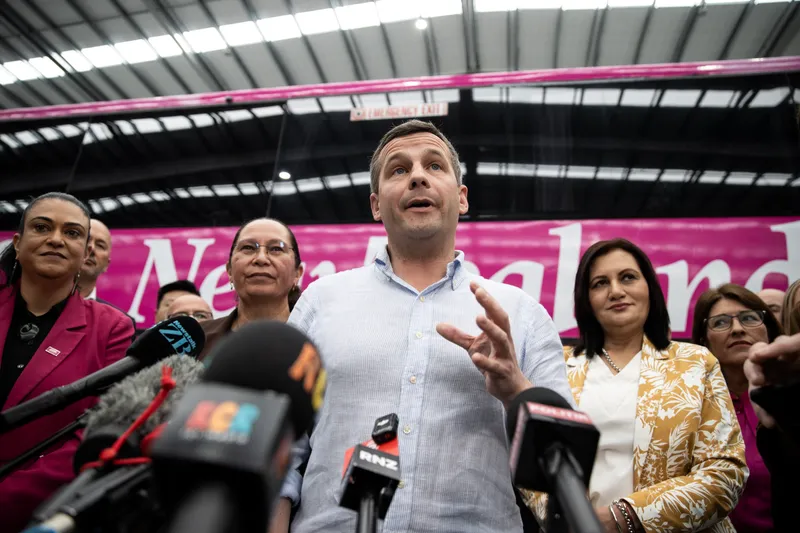
He’s still dark about how his fundraising attempt to drive a Land Rover up the steps of parliament was covered in February 2025. “I broke no rules. I suffered no penalty. What I did do was raise about $30,000 that day for children with holes in their hearts.” The story that ran on 1News that night, he says, focused on two negative comments rather than “the enormous uptick in donations that day”. There were “dozens and dozens of comments saying, ‘Good on you, Dave. This is a great cause. Thank you for that,’” he says, but these didn’t make it into the news clip. It seems a little trivial to bring it up now, against the backdrop of everything else that’s happened in the past term, but hints at an aspect of Seymour’s personality that’s a double-edged sword for any politician: an unwillingness to admit to ever misjudging a situation or making even the slightest misstep.
Then just like that, almost as an afterthought, he switches modes. “You know, just for what it's worth, I frequently defend the media to people who say that you're all a bunch of corrupt crooks.” One such incident occurred the day prior in conversation with “the chief executive of quite a large company”, he says. “I said, ‘Look, there's a number of things going on. They've lost all their revenue. The budgets have been slated. A whole lot of them got fired. That creates a fear mentality in the newsroom that makes it hard for people to step out and, you know, express their own view because you don't want to be next to get let go… you can understand why it's a challenging environment for them now. Most of them aren't evil.”
Even in alleging a leftwing bias in journalism, he’s nuanced. “I think it's also fair to say that because journalism doesn't pay as well as say PR and comms, a lot of the people that are doing it are people that do it because they have a sense of mission, and typically that mission is more collective mission than free-market mission.”

In 2021, riding high from Act’s phoenix-from-the-ashes act at the 2020 election, Seymour appeared on the cover of the NZ Woman’s Weekly declaring he’d give it all up for love. “If there was a magic wand that replaced politics with family, I’d wave it,” he said. Years earlier, he’d put a limit of three terms on his parliamentary career. Now, four terms in – and having found his life partner in fiancee Alexandra Martelli, for whom he tries to keep Saturdays clear – he’s going back for more. But some are questioning whether he’ll stick around for much longer, especially if the coalition doesn’t make it back in. Du Plessis-Allan has predicted he’ll be gone from parliament by the end of 2027, and will hand the reins to Act’s new star candidate James Christmas.
Seymour denies he’s quitting any time soon, but says his plan has always been to get the party to the point where it can run without him. “It’s like the old story of being an entrepreneur,” he says. “You want to build a business that's going to succeed without you.”
Andrew Ketels, Act’s chief of staff from 2020 to 2025, who’s been described as “joined at the ideological hip with Seymour”, says his former boss “wants to be able to go off and do other things with his life”. “I tend to think that his plan is still likely to, you know, foster that next generation of leadership within the caucus and then be able to pass the leadership on at the appropriate time,” he says. “He's always been keen to ensure that there are good talents coming through, and so I think at some point we'll see him pass the torch on.”
The man himself denies he’s planning to throw in the towel any time soon. The thing about politics, he says, is “most people don’t get to choose their own timing, so you just do your best to see what happens”. He sighs, switching into his signature deadpan tone. “And the problem is that all these press gallery journalists keep asking me if I'm going to leave, and I think, 'I'm going to stay on for many years, just because of you.'”

Alice Neville
Alice Neville is The Spinoff's deputy editor. Her interests include politics, food and data-driven deep dives of all kinds.


