The true story of the time a whole continent quit the Olympics – because NZ was there

Trevor Richards is a key voice on Walkout '76.
1981 is etched into our national consciousness. 1976 not so much. Why?
When Trevor Richards turned on the television to watch the opening ceremony of the 1976 Olympic Games, he was most interested in what wasn’t there. Or, rather, who wasn’t there.
“We were looking to see if Africa was going to stand up and say enough is enough,” said Richards, speaking to the Spinoff on At Large with Toby Manhire.
A founder of Hart (Halt All Racist Tours), Richards had been an integral part of the campaign to sever rugby ties with apartheid South Africa. That racist policy had seen most countries refuse to engage on the sports field. They’d been expelled from the International Olympic Committee six years earlier.
In the leadup to the Montreal games, the All Blacks set out to tour Springboks, with the approval of prime minister Robert Muldoon. In the days before the opening ceremony, African countries debated whether to respond by recalling their athletes in protest at the presence of New Zealand.
“The All Blacks had been sent to South Africa with the blessing and goodwill of the New Zealand government. The All Blacks had been sent to South Africa at a time when South African police are massacring school kids in the streets of the country,” said Richards. “We were looking to see what Africa's response would be, and what we didn't know when we woke up that morning … was that we were about to witness the first major boycott of the Olympic movement.”
He continued: “New Zealand was responsible for around 30 countries walking out of the Olympics. That boycott came before the boycott at Moscow in 1980. And Los Angeles in 1984, it was certainly something that we thought was possible, but we had no idea if it was really going to happen.” As the nations poured out, in alphabetic order, on to the track at Montreal Olympic Park, it quickly became “quite clear” that they would not be taking part.
That story, the leadup to it, and the role of Hart, is told in a new podcast, Walkout '76: Rugby, Racism and Revolt. Produced and hosted by Mary Ellen O’Connor, the series features Richards and other Hart activists, alongside Filbert Bayi, the formidable Tanzanian athlete whose anticipated rematch with John Walker in the 1,500m was not to eventuate, and former All Black Bob Burgess.
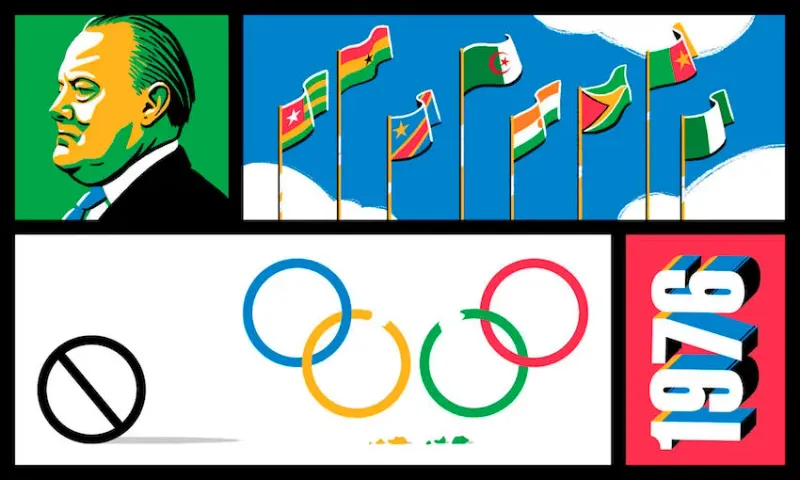
The project is in part designed to shine a light on a moment in history that, in New Zealand eyes at least, remains largely in the shadows – especially when compared with the events of 1981. Why had it been largely left in the background?
Partly because a sense of distance, said Richards. “1981 happened in New Zealand. It didn't happen on the other side of the world. It happened in New Zealand in such a way as to bring the country the closest it had come to civil war in the 20th century ... 1981 is taught in schools, so I think given all of these factors, it's not surprising that 1981 is well remembered, and it should be, because I think in terms of all of the protests made by New Zealand against apartheid, 1981 was the pinnacle of that protest.”
He continued: “But if we look at what the most effective protests involving New Zealand and South Africa had been, it was definitely, I think, 1976, and the consequences of that.”
Then there was the telling of the story. Out of 1981 there emerged, over the years, a sense of ultimately arriving on the right side of history. That was harder to find in the 1976 experience for New Zealand. “It's not possible to have fond memories of being a villain. So, if you can't have fond memories of it, just let's push it away and push it at the back of our minds,” said Richards.
“I think it's important to establish what happened in 1976. It's important to establish that New Zealand's time in the sporting arena has not always been one of which we can be proud. There were a number of New Zealanders in Montreal who pretended to be Australians because they didn't want to admit to being the cause of so much difficulty and problems for the Canadians, and in 1976 in Canada we were not popular,” he said.
“So I think that it's important to establish that countries can do good and bad things, and this was a time when we were doing something that was really quite shocking, and it needs to be remembered … We need to face it and admit what happened.”

Toby Manhire
Toby Manhire is editor-at-large at The Spinoff. He loves to cast a pod, whether it's Gone By Lunchtime, At Large or Juggernaut. He is a former editor of The Spinoff and has worked as a journalist in NZ and the UK since the last millennium.


