Is Paul Henry’s cancer centre a whim or a solid idea? Health experts give their verdicts

Act is now campaigning on Paul Henry’s cancer centre idea. (Photo: supplied. Design: The Spinoff)
As the public health system groans under pressure, four healthcare experts give their verdicts on whether a national centre for cancer excellence should be prioritised.
Paul Henry took his new boss David Seymour by surprise during his Act Party candidacy announcement in July, held on a swanky hotel rooftop. After paying tribute to Auckland’s “bloody beautiful” scenic background, Henry was asked if he had any particular ideas he’d like to implement if he became an MP. Henry paused. There was one thing, he admitted, but it wasn’t something he’d discussed with his leader before floating it to the nation. “David, you’ve not heard this before,” Henry warned Seymour. “Oh, good,” Seymour replied, laughing nervously.
Henry’s big, out-of-the-blue notion was to build a world-class cancer hospital in New Zealand. It would cost multiple billions of dollars, he supposed, but he reckoned we could “easily” find enough wealthy New Zealanders who could “stump up” with about $10bn. The rest of the cost? “We would borrow,” he mused, still flying by the seat of his pants and stretching out his hand as if to say “ta-dah!”
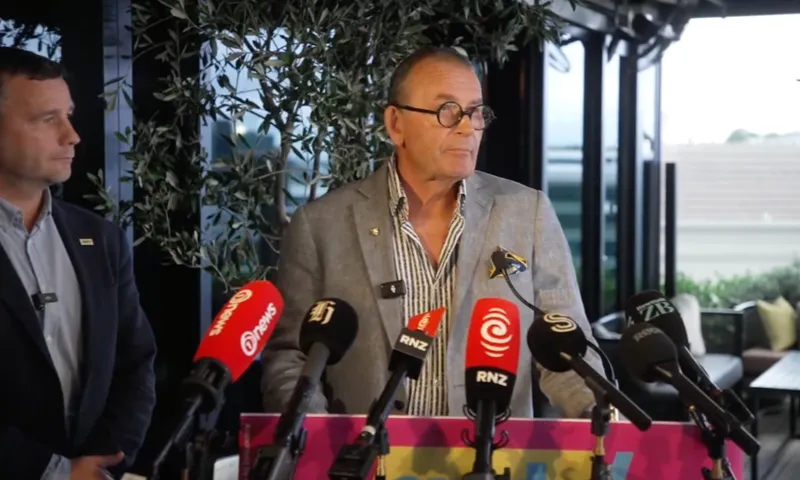
Henry appeared to be completely winging it, but since then, his cancer-centre dream has taken one step closer to becoming reality. At the recent launch of Act’s mainland campaign in Christchurch, Henry announced the party’s proposal for a purpose-built “global centre of excellence for cancer” with campuses in Auckland and Christchurch. The $2bn cost would be funded by a mix of existing government health investment, public-private partnership financing, philanthropy and private capital. “I now understand that announcing policies on the fly is probably discouraged among candidates,” Henry said in his speech. “But honestly, what did they think they were getting with me?”
Act’s announcement comes at a time when the public health service is under significant strain. Hato Hone St John ambulance services received a record-breaking number of 111 calls for two consecutive weeks last month, with one ambulance officer describing the demand as “worse than Covid”. Amid a Health NZ crackdown on hiring staff, nursing shortages have seen patients left waiting in soiled beds and ED nurses declaring “states of emergency” due to overcrowding. More than 1,200 support workers face losing their jobs, specialist doctors are leaving the country, while the worst flu outbreak in a decade has placed further pressure on health services and led to the cancellation of elective surgeries.
Should a national centre for cancer excellence be a focus for a new government? And would the idea actually work, or should it have remained an idea swirling around Henry’s head? We asked several New Zealand experts involved in cancer and healthcare for their thoughts.
Nicola Coom, Cancer Society New Zealand: ‘Let’s get the basics right first’
The chief executive of Cancer Society NZ, Nicola Coom, believes every government should be ambitious about cancer care, but they should be just as ambitious about getting the fundamentals right first. “We don’t have a lung cancer screening programme, we don’t have bowel cancer screening starting at the age of 50,” Coom says. “We don’t have access to good, best-practice cancer medicines, so there’s a lot of gaps in our system right now that we need the government to invest in.”
For Coom, the success of a national cancer centre depends on the details, including Act’s proposal to fund the facility with existing government health funding. “Any existing Crown health investment is already earmarked for replacing or expanding current cancer infrastructure and services,” she says. “So if that’s going to be redirected, where’s it going to be redirected from?”
Coom also believes New Zealand has some of the world’s best cancer clinicians and researchers, and that they should be at the centre of any important decision-making – as should the patients. “Where’s the patient voice in this? What do patients want? What work has been done, or is this just someone’s good idea?”
“Ambition is great and we really encourage it, but the devil is in the detail, particularly around funding,” she says. “Let’s get the basics right first.”
Malcolm Mulholland, Patient Voice Aotearoa: ‘I commend them for being aspirational’
Patient advocate Malcolm Mulholland believes a cancer centre of excellence would be a good development. “More often than not, we hear of New Zealand patients travelling to Australia and accessing the Peter MacCallum Cancer Centre in Melbourne,” he says. Mulholland believes that centre has been responsible for a number of developments in cancer care for Australians and is likely to be Act’s blueprint for a “one-stop shop” for cancer patients here.
However, Mulholland believes significant work needs to be done first, particularly in regard to access to cancer medications. “If you wanted to do clinical trials here, you also need to have guidelines in terms of testing and treatment options, many of which we either don’t have or have not been updated by the Ministry of Health for a very, very long time,” he says.
“I actually commend them for at least being aspirational and sparking the debate. I think it has merit, and it’s certainly worthy of having a discussion about it.”
Sarah Dalton, Association of Salaried Medical Specialists: ‘A shiny toy for an election’
The executive director of the Association of Salaried Medical Specialists, Sarah Dalton, says the government shouldn’t be focused on a purpose-built national cancer centre. “There are some really fundamental issues around our public health that need to be addressed first,” she notes, saying the government is currently failing to staff the health system safely and provide equitable access to services for cancer patients outside of the main cities.
Dalton says it’s unclear if Act has spoken directly to cancer patients and families, who often want to stay as close to home as possible while they’re unwell. “What does this mean for people in Invercargill? What does it mean for people in Gisborne and Northland?” she asks.
Cancer care doesn’t just involve oncologists, Dalton argues – it involves a range of healthcare providers like public health nurses, GPs and hospice, and depending on where the patient lives, these providers aren’t always in the same place. Patients will still need a range of care and support services when they return home, she points out, most of which is already in short supply.
Dalton would rather see a government commitment to staffing existing services, and then have a considered discussion about what cancer services might be centralised. She says the lack of detail in Act’s proposal is telling. “I just think it’s a shiny toy for an election. Obviously, if there’s a whole lot of detail that sits behind it, we’d be open to looking at it.”
Professor Frank Frizelle, Christchurch Cancer Foundation: ‘It’s coordination of care’
In his role as chair of Christchurch Cancer Foundation (CCF), cancer specialist Frank Frizelle has been advocating for a national centre of cancer excellence for seven years. In 2024, CCF commissioned and funded a report that proposed a new model of care for cancer in New Zealand to reduce avoidable deaths, which outlined the costs and benefits of a comprehensive national cancer service with campuses in Auckland and Christchurch. CCF sent the report to every political party for their urgent consideration.
Two years on from that report, Frizelle still believes a national centre of cancer excellence is something the government should consider, and that what Act is proposing would work. (RNZ reported that CCF and the department of Cancer Sciences at the University of Auckland will work on business cases for the proposed campuses.)
“Fifteen hundred people a year would be saved by reorganising cancer services, so that’s quite a lot,’ Frizelle says. He argues that centralising cancer services would remove the regional variation in access to care that currently exists, leading to a consistency of care, and would provide more opportunities for clinical trials, higher participation in new treatments and increased research integration. Frizelle also thinks a centralised structure would help to attract and retain clinicians and researchers, who he believes would be more likely to choose to work in a well-organised system that offers high-level delivery of cancer care.
“This is not just a flash building. This is about coordination of our care in a better way.”

Tara Ward
Tara Ward has written about television and culture for The Spinoff for several years. She lives in Ōtepoti Dunedin, where she tries to avoid walking up hills.


