Why the City Rail Link opening date gaffe matters

Chris Bishop and Wayne Brown laughing about the mistimed CRL announcement. (Photo: Isaiah Tour/The Spinoff)
A mistimed billboard and a flub from the transport minister made for a funny morning, but both spoke to the pressure people feel to get this right.
For months now, Aucklanders have peered inside the windows of the three new City Rail Link stations in the centre city and asked themselves: what the hell are we waiting for?
From all outward appearances, the new underground subway extension connecting Auckland’s existing train lines looks good to go. We’ve seen news stories about safety tests, hard-hatted politicians riding the trains and social media influencers giving sneak previews.
Journalists have been driven to madness trying to guess the opening date. BusinessDesk jumped the gun by reporting a leak that the CRL would open by the end of August. The Spinoff’s own Toby Manhire used the process of elimination and some tea leaves to divine his prediction of September 6.
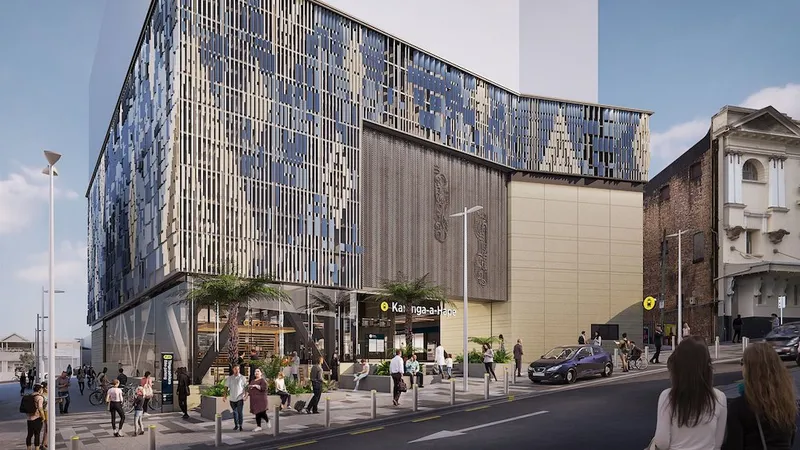
Finally, on Thursday at Karanga-a-Hape station, transport minister Chris Bishop and Auckland mayor Wayne Brown were meant to put everyone out of their misery. They descended down a silver escalator while a few dozen journalists and high-ranking transport officials gathered around a podium. But directly behind the podium, within camera shot, a large digital billboard spoiled the announcement. It declared that the opening date will be Sunday, September 13.
It wasn’t just inside the station either. Across the city, billboards bearing the opening date flashed to life at 6am, three hours before Bishop and Brown’s scheduled 9am announcement. Auckland Transport CEO Stacey van der Putten called the error “a bummer”. She said it was a content loading issue caused by human error – seemingly, someone set the incorrect launch time.
The mistake was particularly awkward for Chris Bishop, who was booked for an appearance on TVNZ’s Breakfast at 7:45am, an interview that was meant to occur before the announcement. Host Chris Chang, who, like anyone who had seen a billboard or read the news that morning, already knew the opening date.
Chang tried to get Bishop to confirm it on air. “Well you’ll have to wait 80 minutes for me to announce that,” Bishop said. Chang prompted him again: “So the date is…” Bishop stuck to his non-answer. This led to the bizarre situation where the job of announcing the premiere of New Zealand’s largest ever infrastructure project on national TV fell to Tova O’Brien, who waved her hands in the air and declared “13 September!”
“That’s a bit annoying isn’t it?” Chang asked. “It is annoying, no doubt about it,” Bishop admitted. “There are many different ways to announce the CRL opening. One is by the minister and the mayor. The other is on a billboard, randomly.”
When it came time for the official announcement of the date everyone already knew, it didn’t go much better for Bishop. “The mayor and I are thrilled to announce this morning that CRL will open on Friday, September 13 – oh, sorry, Sunday,” he said, laughing at his own gaffe.
A reporter at the standup asked: “Are you confident that all these tests and dress rehearsals have paid off and you’re not going to open with delays to the trains?” Bishop tilted his head, his face slightly scrunched, and replied “…yes?”. His tone conveyed shockingly little confidence but generated another laugh from the crowd. “We can never rule out a severe weather event or an act of God or anything like that, but yes,” he said.
Brown had his own issue: he and Bishop had entered via parallel escalators and “his escalator goes bloody faster!” He suggested that Auckland Transport could put a sign up saying: “if you’re really in a rush to catch the train, take this one”. He assured the audience that “these little things will be tuned up”.
In the big scheme of things, a slight flub in announcing the opening date on a project that has spent a decade under construction is inconsequential. Everyone at the press conference knew this and the mistakes were treated in good spirits. But it spoke to a real sense of nervousness from those in charge.
There’s a lot riding on the success of the CRL. The expectations upon it have somehow morphed from a faster way of getting around to a panacea that will solve all of Auckland’s economic and social problems. Spending $5.5bn on a single project is a huge risk – especially for a project focused on a transport mode that New Zealanders have ranked behind the motor vehicle for more than half a century. “We want people to use the City Rail Link, that’s our next step, our next challenge,” Brown said.
Any bad headline about delays on opening day might, in theory, dissuade some people from using the improved train network. More seriously, it could affect the political appeal of future public transport projects.
Both Brown and Bishop are clued in enough to the conservative movement to know that there are some who see the mere existence of public transport as a personal attack on anyone who drives a car. Hearing the two of them espouse the values of train travel and Auckland’s rapid bus network was to note a striking contrast to the previous transport minister, Simeon Brown, who couldn’t even turn sod on a busway without turning it into a car-based culture war.
The two men know that the CRL is a lot more than a train. It’s an opportunity to reshape the city of Auckland itself – its identity, its culture, and, significantly, its housing. “We are encouraging developers to build multi-storey units near train stations so people are close to the public transport, so they can and will use it,” Brown said. Bishop backed him up: “Find me an Aucklander who doesn’t think we should be building more densely around train stations.”
It was a rhetorical challenge, but if Bishop wants an example of one such Aucklander, he only need look as far as his cabinet colleague David Seymour, a libertarian who has strongly opposed the rights of property owners to build high-density housing in his Epsom electorate, which contains three train stations connected to the CRL.
Thousands of Aucklanders, many of whom have voted for Seymour and Brown, have great affinity for their city of motorways and sprawling villas. The CRL opening is a direct challenge to their worldview – and a chance to change their minds.
The announcement of the opening date is just one of the many tiny but important decisions that have been made over a decade of construction. In a few years’ time, no one will remember any of these individual moments. But they will all play a role in defining public perception of this project and all future rail projects to come.
The City Rail Link is a generational opportunity to reset Auckland’s transport, housing, cultural identity and political persona. The people responsible feel the pressure. Getting this right could decide the future of the city.

Joel MacManus
Joel MacManus is a senior writer for The Spinoff. He previously worked at RNZ and Stuff, and began his career at Critic Te Ārohi. His writing explores the political, economic and cultural systems that underpin modern New Zealand. He won the 2025 Voyager Media Award for Best Columnist, Opinion or Critique.


