New Zealand city centres have an empty shop problem. Do the Greens have the answer?

Image: Emily Wong/The Spinoff
The commercial property vacancy rate in city centres keeps rising. The Green Party thinks it has a solution.
In the 10 years prior to Covid-19, on average, just 2.8% of retail shop spaces in the Auckland city centre were empty at any given time. By the end of 2021 the vacancy rate had hit 14.4%, the most shop space up for lease since the mid 1990s. It currently sits at 8.5%, according to Colliers.
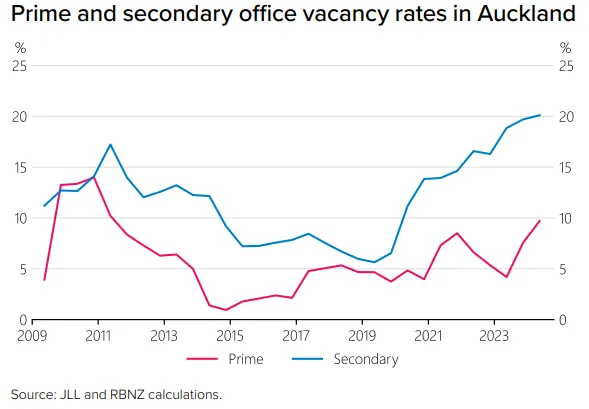
The statistics for office vacancies are even uglier. In 2019, 4.7% of office space in Auckland’s CBD was empty, a 20-year low. By 2025, that had more than tripled to 16.2%.
Empty shops can make a city feel abandoned, unloved, perhaps even dangerous. That hurts the people and businesses around them.
The Green Party on Sunday announced a centre city vibrancy policy aimed at addressing the empty shop problem. “There is no shortage of people with amazing small business ideas…but there also happens to be a lot of vacant commercial spaces. Something is not quite adding up here,” co-leader Chlöe Swarbrick said.
The party’s proposal would ban “ratchet” clauses, which require that rent can only be reviewed upwards. And if a building has sat empty for 12 months, councils would be enabled to auction off the lease. These “high street rental auctions” were introduced in some parts of the UK in 2023.
The empty shop problem is a phenomenon seen in many urban centres around the world. The rise of working from home reduced demand for office space and online shopping continues to chip away at brick-and-mortar retail. Add in the general economic malaise, construction disruption in the Auckland CBD and layoffs in Wellington, and it’s no surprise that demand for leases on city centre shops fell and vacancy increased.

What’s strange is how long the vacancy rate has stayed so high. In a normal market, you would expect landlords facing weaker demand to lower their prices until the spaces filled up. That doesn’t appear to be happening. Even as shops and offices get emptier, the price of rent isn’t falling enough to meet demand.
The result is a strange game of chicken where landlords are choosing to leave their building empty rather than rent it out at a price anyone is willing to pay. On the face of it, that appears to be an irrational position. Why would you choose to generate zero cash flow rather than generate some cash flow? Even if you’re holding out for a great long-term tenant, why not sign a short-term lease?
It all boils down to the fact that commercial property is valued by the rent it earns. A shop that is leased at $100,000 per year might be worth $1.5 million. But if that tenant leaves and the owner has to lower the rent to $70,000 per year, the building is now worth $1.05m. That could push them into negative equity. It could force them to sell other assets. If they have loans out against the building that get liquidated, it could cause further damage.
So instead the owner leaves it empty and eats the cost of rates and insurance themselves in order to maintain a fictional valuation. Or, as property management company Aspire Property reported earlier this year, some commercial landlords have been offering as much as six months free on a three-year lease – effectively lowering the rent without admitting it.
You could call that greed. Or you could call it capital following the incentives laid out before it.
As the Reserve Bank said in a 2024 review, “commercial property is a relatively risky investment class”. It follows a boom and bust cycle. “Default and loss rates for loans to commercial property are among the highest across sectors in economic downturns.”
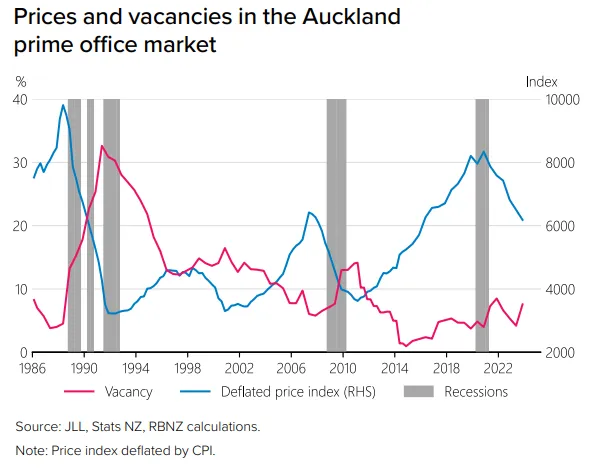
Property speculators losing money is no great tragedy. But their risky bets can affect more than just themselves and their family. When the 1987 stock market crash lowered demand for office and retail spaces, many commercial property loans defaulted, deepening the recession and ultimately leading to the bailout of the BNZ.
The current empty shop problem shows that even without defaulting on their loans, risky bets by commercial property investors can negatively affect the community around them. It raises the question of whether we need stricter banking regulations on commercial property. For example, in 2024, the European Union introduced changes requiring banks to use more conservative valuations so as to prevent loans being given out based on inflated, peak-of-boom prices.
Considering they hold the electorates of Auckland Central and Wellington Central, there was an onus on the Green Party to bring ideas to the table on this issue. Hopefully other parties will follow. The empty shop problem deserves to be treated like more than just a local issue. New Zealand’s urban economies have struggled since 2020, with growth lagging far behind rural areas, and a system that encourages building owners to leave their property empty rather than put it to productive use certainly isn’t helping.

Joel MacManus
Joel MacManus is a senior writer for The Spinoff. He previously worked at RNZ and Stuff, and began his career at Critic Te Ārohi. His writing explores the political, economic and cultural systems that underpin modern New Zealand. He won the 2025 Voyager Media Award for Best Columnist, Opinion or Critique.


