NZ has been failing mothers who struggle with their mental health for generations

The author’s great grandmother at 75 and the gravestone of her great-great-great grandmother. (Photos: supplied. Design: The Spinoff)
Generations of Rebecca Jayde’s family have suffered from severe post-partum depression and received little help. She asks why New Zealand still doesn’t give mothers the support they need.
Warning: This article discusses suicide
In Pukekohe in 1897, my great-great-great grandmother Sarah died while her horrified children watched on. Her adult daughter had tried to stop her but it was too late. She suffered an agonising death.
Her family had battled to get her help for years and her older children had monitored her 24/7. From the age of 17, she had given birth to 12 children, two of whom died in infancy. The coroner ruled temporary insanity, going to great lengths to explain that she did not have the capacity to comprehend what she was doing.
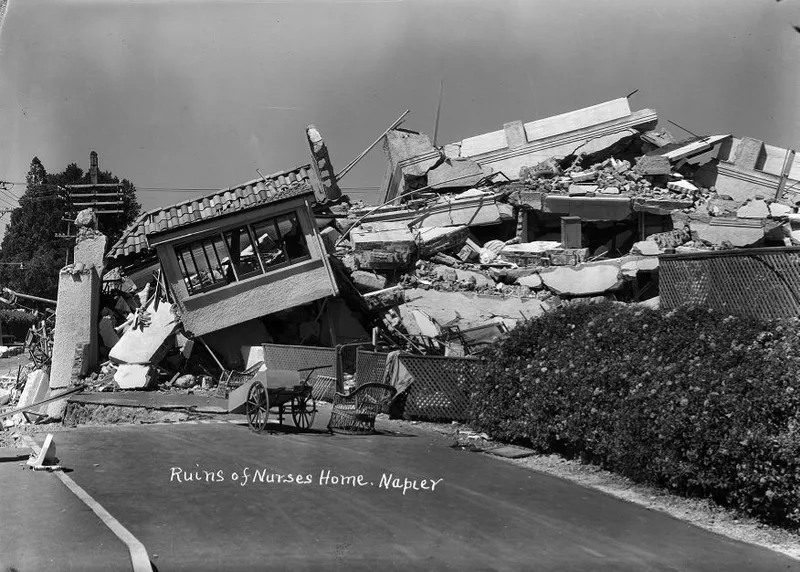
Many years later, Sarah’s granddaughter (my great grandmother), who was born eight years after she died, had her own experience of severe post-partum depression after giving birth to five children. She was on her way from Auckland to Napier to receive respite care and avoid the social stigma of being a mother struggling with her mental health, when the 1931 earthquake hit. She was quickly evacuated and the facility that was to help her was completely destroyed. Her 97-year-old daughter, my grandmother, told me this for the first time the other day as we sat talking. Her mother went straight back to parenting duties and her illness was never mentioned again.
Maternal mental illness is not some new concept that has suddenly arrived in the 21st century like some kind of TikTok trend. New Zealand has been watching mothers struggle through pregnancy, childbearing, birth and motherhood for generations. We have been failing them for just as long.
A recent Te Whatu Ora report, released after pressure from NZ Herald political editor Thomas Coughlan, revealed that a third of women don’t get the perinatal mental health care they likely need. Another recent report, commissioned by The Tindall Foundation, has concluded that clinical perinatal mental distress costs Aotearoa New Zealand more than $2 billion annually, with that figure climbing to $4.3bn when subclinical distress is included.
So, the question is not whether we know mothers are suffering – we absolutely do – the question is what we are going to do differently now?
We have built an entire industry around caring for babies. We check their heartbeat and monitor them on scans during pregnancy and provide midwife and Plunket services to ensure the baby is thriving once born. Even if these services are diligent enough to pick up on a mother who may need extra support, they often refer them on to other stretched and understaffed medical services which often have unacceptable wait times. So many are left to continue on without help, carrying the load day to day.
A woman can be lonely, sleep deprived, dealing with the physical aftermath of birth, traumatised, financially desperate, completely overwhelmed, and yet still tell everyone around her that she is “fine”. Because the baby will not wait. Because there is no one else to step in. Because the baby’s other parent might be working very long hours just to keep the household afloat in a cost-of-living crisis. Because she is terrified of how a professional might react if they admit she is not coping – could they come under scrutiny from social services or have their baby uplifted? Because. Because. Because. We need to stop expecting mothers to reach out and instead find ways to meet them where they are at.
We also need to stop assuming that all mothers have the same starting point. The horrifying truth is that wāhine Māori are disproportionally affected by perinatal mental health inequities, accounting for 60% of maternal suicide deaths in Aotearoa between 2006 and 2017. Data from the Growing Up in New Zealand study confirmed that Māori, Pacific, and Asian women who had experienced unfair treatment by a health professional in their lifetime were 66% more likely to suffer from postpartum depression.
Colonisation plays a role too. Māori understandings of childbirth and parenting were not organised around the isolated individual mother. In traditional Māori societies, parenting was a role that all members of the community contributed to. Childbirth and motherhood were connected to whakapapa, whenua and collective responsibility. For wāhine Māori, childbirth did not mean being confined to the role of caregiver. They continued to contribute to their whānau and wider community in many different ways, and European observers frequently noted the important and varied roles women held within both. Policies and responses that address these inequities and support Kaupapa Māori services and whanau centred approaches should be urgently strengthened.
We urgently need more access, facilities and professionals for medical interventions for maternal mental health – not least because our maternal suicide rate is roughly six times higher that the United Kingdom’s. But we also need prevention – and that involves different systems of care entirely.
Research suggests this could look remarkably ordinary, like a room and a regular time each week. Somewhere you can bring your baby no matter what state you are both in, containing the only other people in the world who know what you are going through right now – other mothers. A place where you have permission to say what is actually happening.
This is one reason why programmes like Space are so interesting. Space is an Aotearoa program incorporated by The Parenting Place and supported by the Ministry of Education for parents with new babies, designed around parents bonding and learning alongside their babies, and crucially, alongside each other. It is available throughout the country, often at Playcentres, and runs for around 30 weeks for each group of parents and is led by skilled facilitators who guide parents through the program. Research has found that participation in Space could help overcome the isolation that can overwhelm new mothers, while creating shared understanding between parents, babies and facilitators.
Social connection is a big part of mental health care. A mother sitting in a room full of other mothers discovers something powerful: I am not the only one. Not the only one crying in the shower, or scared she doesn’t love her baby enough, or begging her partner to come home early from work.
Perhaps most importantly, that mother has somewhere to go where she can be heard and seen, before she reaches crisis point, not after.
But this isn’t what prevention always looks like. It can look like yelling “self care” at a drowning new mother and thrusting her a brochure about “sleeping when the baby sleeps” when her blessed baby doesn’t care to sleep at all.
What if we stopped telling mothers to build their own support networks, and built them for them? I’m not talking about a class where they are lectured about what to do or not do, or a casual coffee group where different people drift in each week. I’m definitely not advocating for another service where they have to justify that they are sick or needy enough to enter. I’m talking about a place where skilled facilitators get to know mothers week after week and cater the programme to their unique needs. A place where culturally appropriate models of care are designed with communities of women rather than imposed upon them.
The problem is that maternal mental health has been easy for successive governments to ignore. Conveniently, the cost is invisible if it happens behind closed doors, and the consequences are often invisible too, making themselves known only years later when it is way too late. It’s the child who is disruptive in school, or the teenager leaving school early to get a job to support his ill mother, or the young adult now in the justice system. Then the next generation, lugging their problems, struggle to cope with motherhood.
This doesn’t mean every new overwhelmed mother needs to be pathologised, instead we need to create a society in which a new mother does not need to become severely mentally unwell, for our country to see another tragedy, before she is taken seriously.
I think of my great-great-great grandmother, Sarah, and her children, left without a mother, and the impact on the generations all the way down to me. As her descendent, I am appalled at how little has changed. We must act.
Helplines
Lifeline – 0800 543 354/0800 LIFELINE (7am-midnight), or free text 4357 (HELP). Here to listen and help.
Depression Helpline – 0800 111 757 (24/7), or free text 4202. To talk to a trained counsellor about how you are feeling or to ask any questions.
Suicide Crisis Helpline – 0508 828 865 (0508 TAUTOKO). If you, or someone you know, may be thinking about suicide, call for support from a trained counsellor.
Samaritans – Free call 0800 726 666 for support for anyone who is lonely or in distress (24/7).
Aoake Te Ra – Supporting people bereaved by suicide. For immediate support – text/phone 1737 Championing perinatal wellbeing in our communities
Perinatal Anxiety and Depression New Zealand Championing perinatal wellbeing in our communities.

Rebecca Jayde
Rebecca is a coach and facilitator as well as a writer with postgraduate training in communication, education and trauma theory. She explores stories of grief, resilience and the human condition in both historical and contemporary contexts.


