
Qiulae Wong thinks she can change the system from the inside. (Photo: The Spinoff/Isaiah Tour)
Sceptics to the left see her as an empty vessel. To the right, she’s a leftie in a flash suit. In the fourth of The Spinoff's leader profiles, Hayden Donnell writes that Qiulae Wong might be something stranger.
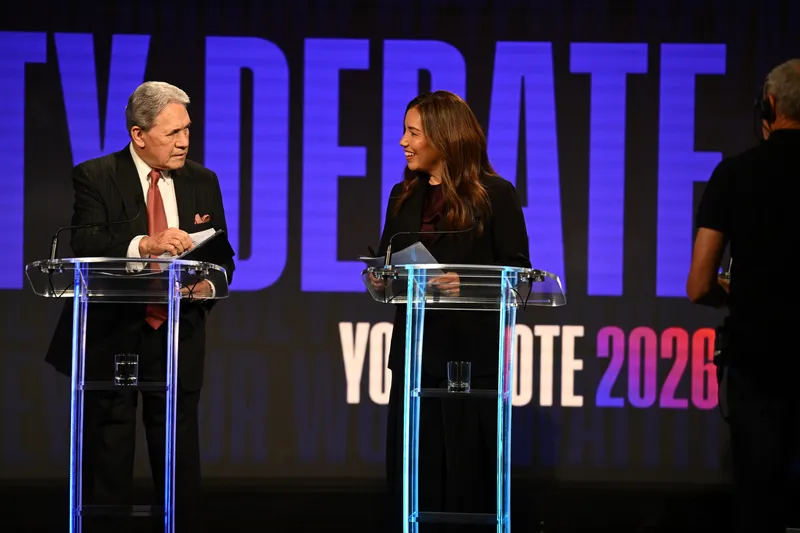
Qiulae Wong was serene as chaos erupted all around her. It was the TVNZ multi-party debate and the Opportunity Party leader was under fire from her literal and philosophical left and right. To the left, Green leader Chlöe Swarbrick contrasted her party to Wong’s, saying unlike them, she wasn’t willing to reinstall Chris Luxon as prime minister or back a government that has attacked Te Tiriti ō Waitangi. To the right, NZ First’s founding father Winston Peters alternated between calling her a newbie and a numpty. “You’ve never been here for five minutes,” he said, after she told him it was racist to tell Green MP Lawrence Xu-Nan to “go home”. “Now how would you know?” he sneered after she accused him of “dangerous rhetoric” on immigration.
Wong weathered the verbal shellacking with her hands clasped loosely at the lectern. Her expression alternated between impassive and vaguely bemused. She stood straight as a board, still as a tuatara in the sun, putting her case politely but forcefully. Afterward, commentators united in anointing her the debate's winner. “It’s hard to believe this is her first campaign not just as leader, but as a frontline candidate,” wrote the Herald’s political editor Thomas Coughlan.
Maybe Wong’s nerves had been soothed by a 1News-Verian poll revealed just minutes before the debate, which had Opportunity on 8% and holding the balance of power. Those heights would have been scarcely believable only months ago. The party had gone through four leaders and was routinely polling under 1% before she took over as leader in November. Now it's above the 5% threshold in a host of polls, including 1News-Verian, RNZ-Reid Research and the statistical wild child Roy Morgan. Only Curia’s latest poll has it narrowly missing out on parliament.
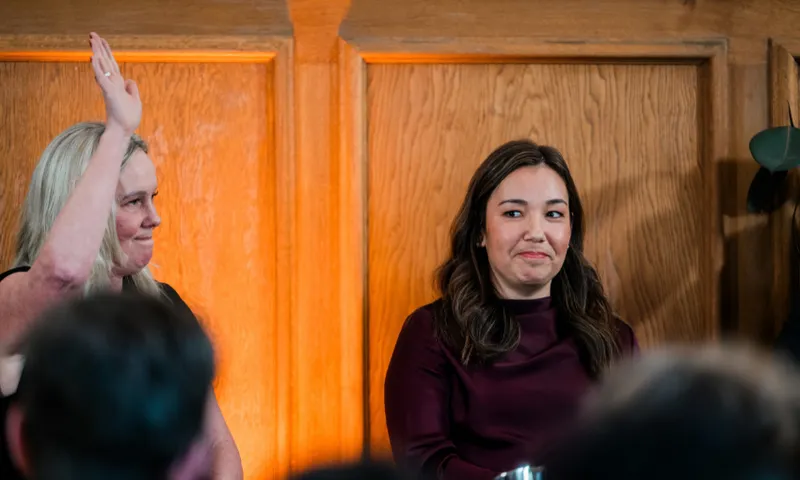
It’s got there in large part thanks to Wong’s ability to look like she’s done all this before. From the start she's projected confidence. She was poised in an introductory interview with Jack Tame on Q+A and more recently at The Spinoff's debate in Mt Albert, where she shrugged and raised her hand in response to the question: “Who sees themself as a future prime minister?”.
But there's also another side to Wong. Even as she hopes to rise to the highest office in the land from Opportunity's current platform of around 6% of the vote, she's beset by insecurity. “I have latent anxiety every day, telling me not to fuck this up,” she tells The Spinoff over a coffee in Morningside, close to her home in the Mt Albert electorate she’s trying to win. She still has to remind herself regularly that people actually want to hear what she has to say. "The anxiety comes from now we've now got something to lose, and there's a lot of expectation around us.”
This mix of humility and ambition is Wong’s election campaign, writ small. On the one hand, Opportunity is positioning itself as an almost uniquely inoffensive party. It wants to rise above the pugilistic back and forth of politics, approaching its rivals from a posture of respect and collaboration. Its bottom lines aren’t all that specific or transformational; beefing up climate action, empowering the Commerce Commission and improving long-term planning on health.
On the other hand, its ultimate ambitions are almost staggering in their scope. Look at the party’s platform and it wants no less than a complete overhaul of our tax system and the introduction of the most all-encompassing state benefit in New Zealand history. A land tax and universal basic income would fundamentally reshape the country’s economy before even looking at Opportunity’s other ideas around stuff like climate change and renewable energy.
In short, the 38-year-old is campaigning for a sensible, moderate political revolution. No wonder she’s always a bit worried about fucking it up. It’s an awkward ideological dance, pitching as both the palatable ally to our terminally unambitious major parties and a circuit breaker for those sick of the status quo. If you want to reconcile those two strands of Opportunity, and Wong herself, it’s worth going back a few decades to a biology class at Diocesan School for Girls.
Madeleine Wright remembers the moment well. The environmental and resource management lawyer has been friends with Wong since they met as eight-year-olds at Diocesan’s junior school in the mid 90s. The pair, now in their teens, had just been sent out of class over some minor prank. “It wouldn't have been a whoopee cushion, but it was that style of thing,” she says.
Most kids would have spent their time on the school benches moping, mucking around or muttering recriminations. Instead they decided to dedicate their time to brainstorming ways educators could become more supportive of different learning styles. “She was always thinking about what those little changes in the future might be,” says Wright. “I think that’s just her long-term thinking, along with her mind for making practical steps in how you actually get there.”
The detention-based blue sky session is a window into Wong’s dorky side. Sure, she’s always been sporty and tries to find time to go running or head along to gym yoga classes on the campaign trail. Yes, she picked up a love of pints and chips during a nine-year stint in London and can regularly be found consuming both at the Pt Chevalier Bowling Club when she’s not binging reality TV shows like Survivor and Love Island. But she can still come across as something of a swot. It's served her well, first in countering corporate boys' clubs, and lately on the campaign trail, where she’s bested more experienced politicians with her command of detail.
The brainstorm is also a window into her theory of change. Wright says her friend has always been more inclined towards reshaping the system from within than trying to overthrow it. Wong herself acknowledges that’s her preferred mode, identifying as more of a reformer than a protester. “I think it takes activists to get out there and march on the streets and it takes people to get inside the belly of the beast,” she says. “What’s the alternative? We sit on the sidelines. Complain about the status quo. That fills me with more dread than trying to change the system.”
Wong frames her openness to insiderdom as an asset. Her philosophy was perhaps most cleanly summed up in her response to Swarbrick’s barbs during that TVNZ debate last week. After the Green leader criticised her for being open to working with National despite disagreeing with many of its actions, Wong argued taking a righteous stand can do more harm than good. “Imagine how many of those most egregious things that have happened in the last three years the Greens could have stopped if they were willing to work with National,” she shot back.
In short, Wong will talk to anyone after the election because that’s how she sees herself getting inside our political beast’s poisonous belly. Opportunity’s general manager, former Labour MP Iain Lees-Galloway, puts it like this: “We have some very bold policy and that helps us articulate the vision that the party has for the country. But to make progress on that, you have to be pragmatic. You have to work with others, and as much as possible, seek a level of consensus.”
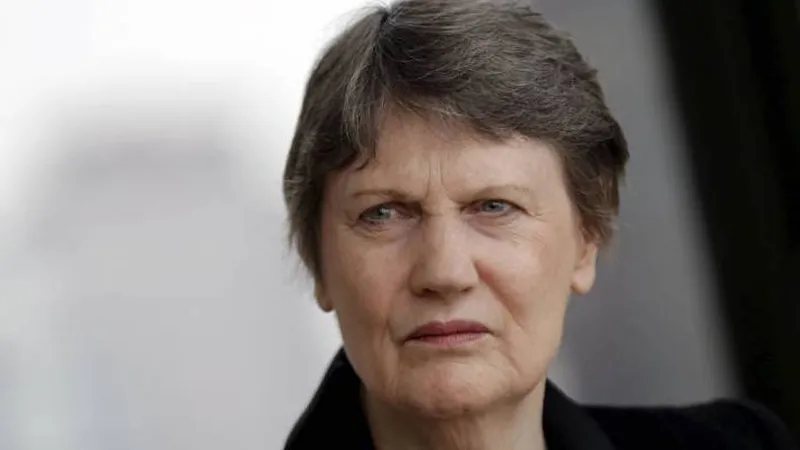
Supporters look at this and see a party of sensible pragmatists. Others see a pack of sellouts. Former Labour prime minister Helen Clark is one of Opportunity’s highest-profile critics. She calls it the “opportunistic party” and sees its openness to National and Labour as evidence of a lack of moral conviction. “From what one observes, the party itself is a somewhat empty vessel which could go in any direction,” she tells The Spinoff. “Its raison d’être seems to amount to not much more than sitting somewhere in the middle of the road and being able to veer right or left.”
For Clark, the party’s boasts about its lack of “ideological baggage” are more irritating than appealing. “Party politics in a democracy is about a contest between different sets of values and the policies which flow from those. It would be churlish to dismiss that as ‘partisan politics’.”
Former Green Party-aligned Dunedin mayor Aaron Hawkins is similarly sceptical about what he sees as Opportunity’s lack of fixed values. He says parties need to draw lines in the sand so voters know how they will act when unexpected situations crop up during a tumultuous term of parliament. “If Opportunity ends up in government, or even in opposition, we’re given no steer as to how they might respond to the messy business of politics. It just seems really naïve. The naivety that, entirely understandably, comes with never having had to navigate this before.”
Hawkins sees a level of privilege in the party’s inside-the-tent approach. It’s the kind of stance people might be more inclined to take when they haven’t been burned by politics before, he says. “Our personal experiences certainly colour our sense of urgency. For those of us who grew up in communities on the wrong side of Ruth Richardson, watching that roll out again is a motivating factor in the desire for a change of leadership.”
Others have focused their critique on Opportunity’s policy. Michael Fletcher is a research fellow at Victoria University and a long-time UBI sceptic. He’s dug deep on the party’s proposed citizen’s income and while he finds more value in it than its previous UBI proposals, he’s critical of how little it offers the lowest earners in society. Beneficiaries would be on roughly the same extremely paltry incomes as they are now under the new system, he says. “I think it would be hard to justify such a huge change without dealing with income adequacy. That's not just being a liberal lefty wanting to deal with poverty. That's a serious problem with our welfare system.”
It all adds to the suspicion on the left that Opportunity may be a right-wing party with kinder branding. That feeling has only intensified since its deputy leader Daniel Eb told Kea Kids News he’d probably vote National if he couldn’t vote for his own party, adding that he was only picking that option because that’s what he used to do, “which is not a good reason to do anything”.
Wong doesn’t really do angry or abrasive, preferring to live most of her public life in a state of monastic zen. But the closest she gets to an emotional explosion is when she tilts her head and sighs before rejecting the critics who see her as an empty, values-free vessel. She points out that she’s spent her career trying to achieve environmental and social goals – first in the Ethical Fashion Group, then as a sustainable business consultant at KPMG. “Just because I've worked in corporate environments and sometimes I dress professionally doesn't mean I don't give a shit about the environment and about people,” she says. “Actually, if we want to make progress on those things, you have to be able to sit in the room with those people and speak their language.”
She’s similarly dismissive of the opposite critique from the right. Newstalk ZB host Heather du Plessis-Allan has branded Opportunity “a radical left-wing party… fronted by a nice lady from Auckland”. Prime minister Chris Luxon has accused it of “wanting to make every New Zealander a beneficiary” through its UBI. He's also ruled out working with the party, albeit seemingly by accident. The allegation is that Opportunity’s candidates are anti-business taxoholics in suits, and it’s one that Wong rejects as being rooted in a false binary. “I’ve seen very clearly that when we care for the environment and make sure that people are well, we have strong businesses and a strong economy,” she says. “To write those things off as woke, or to say that we should be driving GDP growth and profit at the expense of all else – it's short-sighted and narrow-minded.”
Even if she thinks it’s meritless, the criticism takes a toll. Wong has jumped almost overnight from being an anonymous Mt Albert consultant to one of the more well-known political figures in the country, and that leap has come with its usual side helping of deification and demonisation. Sometimes things have gone beyond just ordinary disagreement, with people using AI to create offensive memes using her likeness. “You really hope that your kids never see that,” she says.
Beyond dealing with a smattering of abusive weirdos, there’s also just the relentless nature of politics. Wong has a husband, Palmerston North native Grant Anthony, who she met in London after breaking up with the boyfriend who’d convinced her to move to the UK in the first place. They have two children: Malia, six, and Clio, two. She has to balance her election campaign with the usual rigours of family life and she knows the grind is unlikely to let up if she makes it into parliament. “I'm sure many parents experience this when your kids are the ones going, ‘Mum, put your phone away’ and you think, ‘oh my God, I'm such a bad person’,” she says. “It's just all-consuming in terms of your headspace, and I feel bad for my family and my husband in particular that when I wake up and go to sleep, it's like the first and the last thing on my mind.”
She’s getting help handling the transition from someone who’s been there before. When Opportunity’s polling started trending up, Labour’s consumer affairs spokesperson Arena Williams got in touch to suggest a coffee. She also has young kids and knows the stresses a career in politics inflicts. If she had one message, it was that it takes a village, Williams says now. “There's no secrets to that. I live with my dad and my husband, and have an extended family who are super supportive in South Auckland, and I was trying to share some of the realities of what the travel takes, what the demands of the job are, the early mornings, the late nights,” she says.
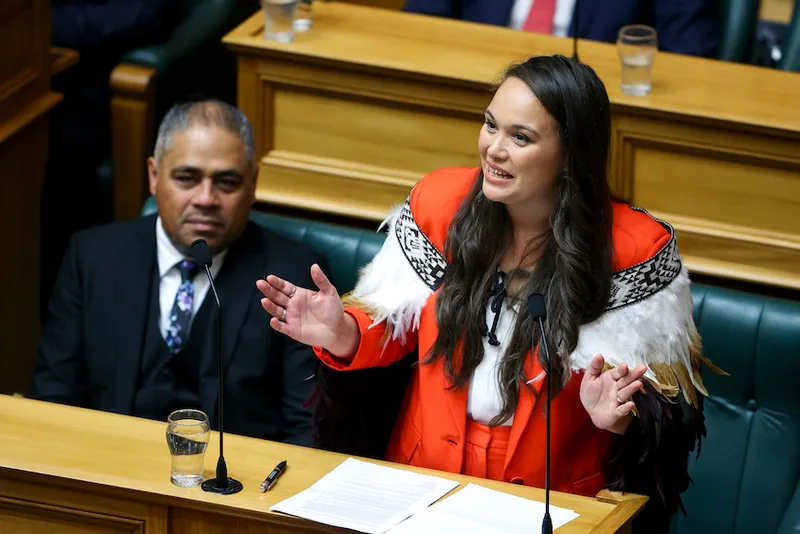
Williams wanted to reach out to someone who’s technically a political rival, partly because she wants parliament to be more welcoming for mums. “We’ve got to make it normal for another generation of young women politicians. They shouldn’t think that they need to be superhuman to do these jobs,” she says. She also knows Wong from their days together at Diocesan and thinks she’d be a good addition to the house. “She was always thoughtful about the world. That's why I had no hesitation,” she says. “We were both nerds, definitely. Go the mums. Go the nerds.”
Wong is willing to put up with what's euphemistically deemed the parenting juggle, and more accurately its unceasing barrage of impossible expectations, because it's the only way she can ward off what seems to be the gnawing sense of unhappiness and self-reproach that starts playing on her mind when she doesn’t feel like she’s doing enough to change the world. “I’m also a strong believer that happy parents are good parents. And if you’re doing something you believe in, you set a good example for your children. I hope that’s what I’m doing,” she says.
For someone who’s accused of being a principle-light moderate, Wong often presents as an almost starry-eyed idealist. One of her first jobs was at Borderless Productions, the agency her sister Qiujing Wong founded to achieve social change. She went into business, not politics, in part because she was left disillusioned by a politician who she refuses to name who visited her university and made the job seem like it was more about people-pleasing than effecting change.
When she finally changed her mind, it was again because she didn’t feel like she was making enough of a difference. After the government changed in 2023, businesses started backing out of their climate commitments and returning to their old carbon-intensive modes of operation. If she was in parliament, Wong thought, maybe she'd be able to change the settings driving those decisions. Being inside the belly of business wasn't enough. She needed to find a bigger beast.
So she applied to lead Opportunity. The party had posted a job ad on Seek, but she got in touch after being sent an email about the position. It wasn’t an easy process, with Lees-Galloway putting her through a mock media interview and a simulated town hall Q&A before offering her the role. Wong says she was surprised to succeed. Lees-Galloway says the outcome wasn’t really in doubt. “She is very good at talking about policies and politics in a way that's real for voters and relatable,” he says. “She’s just a relatable person. We enjoyed the conversations with her and we could imagine voters really enjoying having conversations with her as well.”
Just a year or so later, the move has paid off more than the party would have dared think possible. Most polls have Wong replacing NZ First leader Winston Peters as the person holding the balance of power after the election. The new kingmaker couldn’t be more different to the old one. Where Peters is focused on restoring what he remembers as a sunnier past, Wong is always looking forward to what she envisages as a better future and plotting ways to get there.
Wright insists that’s always been the case. When they weren’t brainstorming outside detention, she and Wong were part of Dio’s future problem-solving team. They were given an assignment on nanotechnology one year. Wong remembers coming up with an idea for some self-cleaning pyjamas. But what Wright remembers is her friend meticulously plotting out the ways they could bring the product to market. “I think her career reflects that she's taken steps in a different direction. None of them have been huge on their own. But when you look at them in totality, they end up where she's at now. And I think the campaign sort of reflects that too. You don't make astronomical change overnight. You have to take small steps to get there and make small wins.”
There’s that theory of change again. It’s got Wong this far. But she knows if things go Opportunity’s way on election day, its toughest test is yet to come. It’s one thing to get businesses to focus more on climate action and social justice, it’s another to sit on an office chair opposite politicians like Peters or Act leader David Seymour and convince them to do the same. Sceptics think Wong is in for a rude awakening. “Naive,” says Clark, of Wong’s mission to stare down the veteran politicians. “Who are they sending into coalition negotiations that’s going to outmanoeuvre Peters and Seymour? Luxon, sure, but not the other two,” says Hawkins.
Wong would be lying if she said she doesn’t have doubts. That voice in her head is always there, urging her not to fuck this up. But there’s also always a part of her that has faith. Ask her what she loves most about politics, and she’s quick off the mark. “The hope that it gives me,” she says. “Because I feel a sense of agency that we can do something to make change.”
The teenager who brainstormed on the benches outside class and plotted ways to get nanotechnology-infused pyjamas to market is now 38 and laying out her most audacious plan to change the system yet. Her path doesn’t run through a few teachers any more, but instead some of the savviest and most experienced political operators in the country. Her hope’s first brush with death is scheduled for the day ballots are cast, November 7. But if it makes it through, the question is whether it will perish in the same place it has for so many other MMP politicians with dreams; on a negotiating table in Auckland or Wellington with Winston Peters sitting opposite, his dark eyes twinkling like a shark’s before a particularly satisfying meal.

Hayden Donnell
Hayden Donnell is a senior writer for The Spinoff. He previously worked at RNZ, TVNZ and the New Zealand Herald, alongside other media companies that have since closed down or been renamed. His primary passions are local politics and the Big Fresh animatronic fruit and veggies.


